Winter Jobs and Holiday Purchases? The Card Issuer's Clock Runs Before Yours Does
Cold months change what evidence survives a dispute, and the party holding the shortest deadline is usually the one nobody thought to involve.
Pinned by Miriam Goldfarb6 min read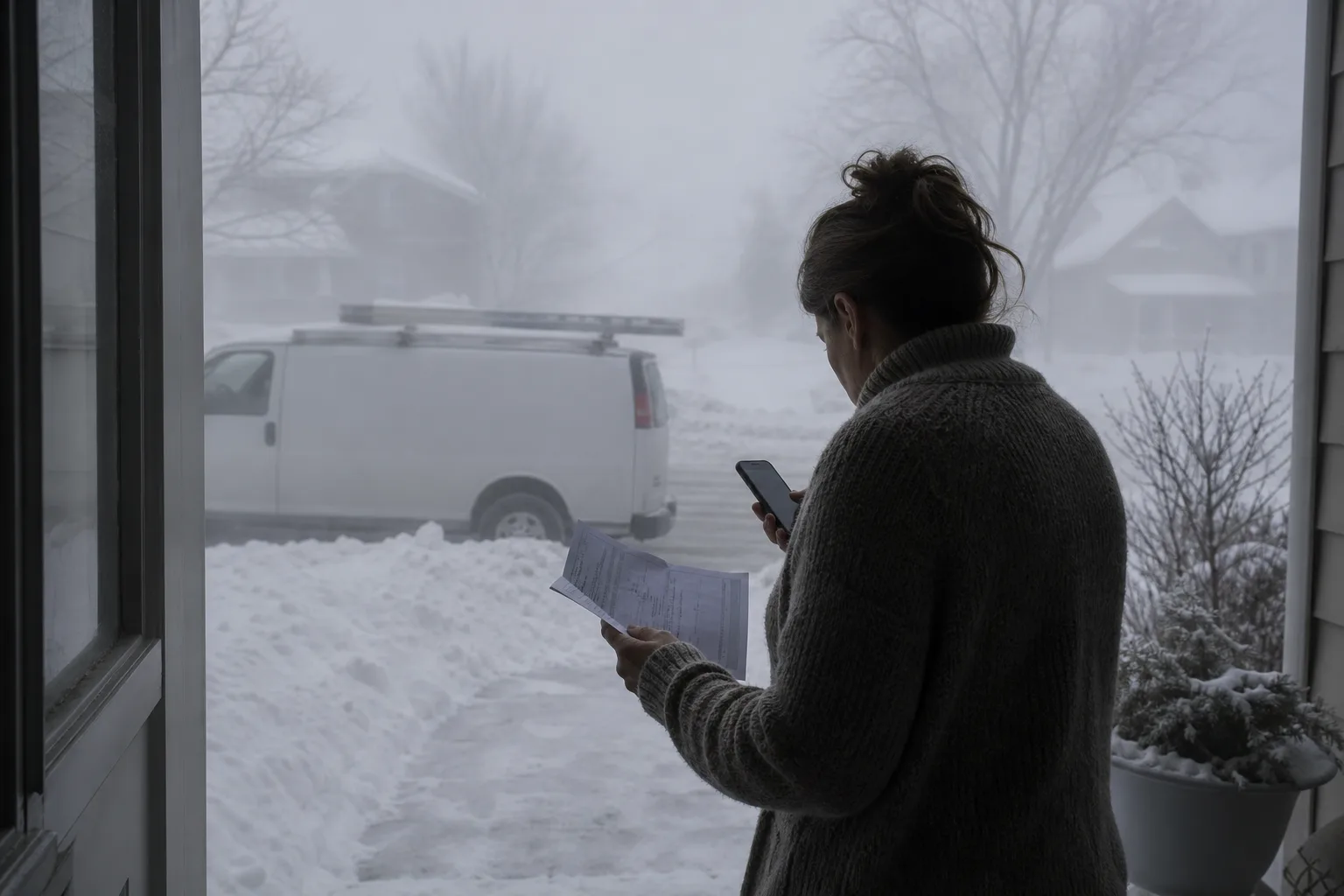 A homeowner standing at a snow-covered doorstep in late afternoon, holding a phone and a folded paper invoice, with a contractor's van parked at the curb beh...
A complaint filed in February about work done in December fails for reasons that have nothing to do with whether the complaint is right. It fails because the photographs were taken at four in the afternoon in the dark, because the crew that did the work was seasonal and is gone, because the snow melted and took the evidence with it, and because the one party who could have reversed the charge stopped being able to help somewhere around the second statement. Winter does not make people more dishonest. It makes records thinner, and thin records lose.
What the season takes out of your photographs
Daylight is the first casualty. A job that ran from eight to four in July produced a photographic record with shadows, context, and a visible street; the same job in January produces a phone camera pointed at a work light, and a series of frames that could have been shot anywhere. Snow covers grading, covers the drip line, covers the place where the downspout discharges, and covers whatever the crew left behind. Frozen ground hides settlement. Cold hides moisture that will not show itself until the thaw, by which point the argument has become a question of when.
The season also adds evidence, and people rarely collect the part it adds. Utility usage for the billing period before and after the work is a dated third-party record that nobody can retouch. Published weather observations for the day of a claimed storm are the same. A thermostat's own history, if the unit keeps one, establishes what the house was actually holding. None of these prove workmanship. All of them establish a timeline that a photograph taken in the dark cannot, and a timeline is usually the thing being fought over.
The party in the transaction almost nobody involves
Most people picture a dispute as two-sided: the household and the company. There is a third party sitting inside the transaction the whole time, holding leverage neither side controls, and it is the issuer of the card that paid the deposit. The Consumer Financial Protection Bureau oversees the billing dispute rights that attach to credit card purchases, and those rights operate on a schedule that belongs to the card issuer rather than to the contractor, the retailer, or the person who is unhappy. That schedule is short, and it is measured from the statement, not from the day the problem appeared.
This is where winter does its quiet damage. A deposit paid in early December lands on a statement that closes in December and is read, if it is read at all, in January, during the two weeks when nobody reads anything. The work finishes late, the problem surfaces at the thaw, and by the time the household has decided to escalate, the window that ran from the statement date has closed. The company's own warranty period may still be wide open. The strongest available remedy is not.
Involving the issuer early costs almost nothing and changes the posture of the whole dispute. A written notice of a billing problem, sent while the clock is still running, preserves an option without committing anyone to use it. It also produces something useful in itself: a dated, third-party record that the household raised the issue on a specific day, which is exactly the fact that becomes contested six weeks later when the contractor says nobody ever called.
What the issuer will actually read
A card issuer's dispute team is not evaluating craftsmanship, and submissions that try to make it do so tend to go nowhere. What that reviewer can work with is documentary and boring: the signed contract or work order with a scope written on it, the invoice, the proof of payment, the dated written notice sent to the merchant, and the merchant's dated reply or the absence of one. Photographs help only when they are anchored to a date and a place. Long narratives about phone calls help not at all, because a call that produced no writing produced no evidence.
The practical consequence runs backward into how the job is managed. A change agreed on the porch in a snowstorm, confirmed by nobody, becomes unprovable in exactly the venue where proof is cheapest. A text message sent the same evening ("confirming we agreed today you would move the vent to the gable and hold the balance until it passes inspection") converts a conversation into a document, and it does so in a format with a timestamp the sender does not control. That single habit decides more disputes than any amount of later argument about who said what.
Reviews in the cold months, and telling a pattern from a grudge
Ratings behave differently by season, and most people read them as though a star average were a constant. Winter concentrates certain kinds of work into short windows: storm response, heating failures, holiday installations, seasonal retail. Companies staff up for it with crews hired in October and released in March, which means the reviews written in January are frequently describing people who no longer work there, and the reviews written in June are describing a different company operating under the same name. An average that blends the two describes neither.
What distinguishes a pattern from a grudge is repetition of mechanism, not repetition of anger. Four reviews complaining that a company is rude tell you very little; four reviews describing the same specific failure, a deposit taken and a start date pushed twice, a subcontractor sent who did not know the scope, a final invoice larger than the written estimate by roughly the same proportion, tell you what will happen to you. Read the dates. A cluster of five-star reviews landing inside one week, in a month when the company was buried in emergency calls, is the least plausible thing on the page.
None of this is evidence in a dispute, and treating it as evidence weakens an otherwise good complaint. Its value is as a decision aid before money moves and as a check on your own judgment afterward. If the mechanism that failed for you appears in strangers' accounts written months earlier, you are probably describing a business practice rather than an accident, and that changes what you ask for and whom you ask.
The consequences people rarely trace back
The failures caused by seasonal records tend to be attributed to bad luck. A return refused because the holiday window that was extended in November quietly reverted in January. A warranty claim declined because the installer was a seasonal hire and the registration was never filed. A delivery marked complete by a photograph of a dark porch that shows a package and nothing else, taken at a time when it was dark for sixteen hours a day. In each of these the household had a legitimate position and lost it to the calendar, then filed the loss under bad luck rather than under a documentation habit that could be changed.
Changing it is small work. Keep the deposit on a card rather than a check or a transfer, and note the statement close date the same day. Confirm every verbal agreement in writing that evening. Pull the utility record for the billing period and keep it with the invoice. Photograph in whatever daylight exists, even if it means the shot is inconvenient. Then, when the thaw exposes something, the argument is about the work, which is a fight worth having, rather than about whether the work can be described at all.
The season is short and the paperwork it produces is short-lived, which cuts in favor of anyone willing to spend ten minutes a day while the job is live. A dispute opened in March on a December purchase is a difficult case. The same dispute, opened with a two-line written notice in December and left dormant until March, is an easy one.
Posted under Law & Legal