Resizing an Inherited Ring? The Intake Sheet Decides More Than the Quote Does
A single resizing job, documented twice, shows what separates careful bench work from the barely adequate kind, and how laser welding changed the answer.
Pinned by Josephine Lachance6 min read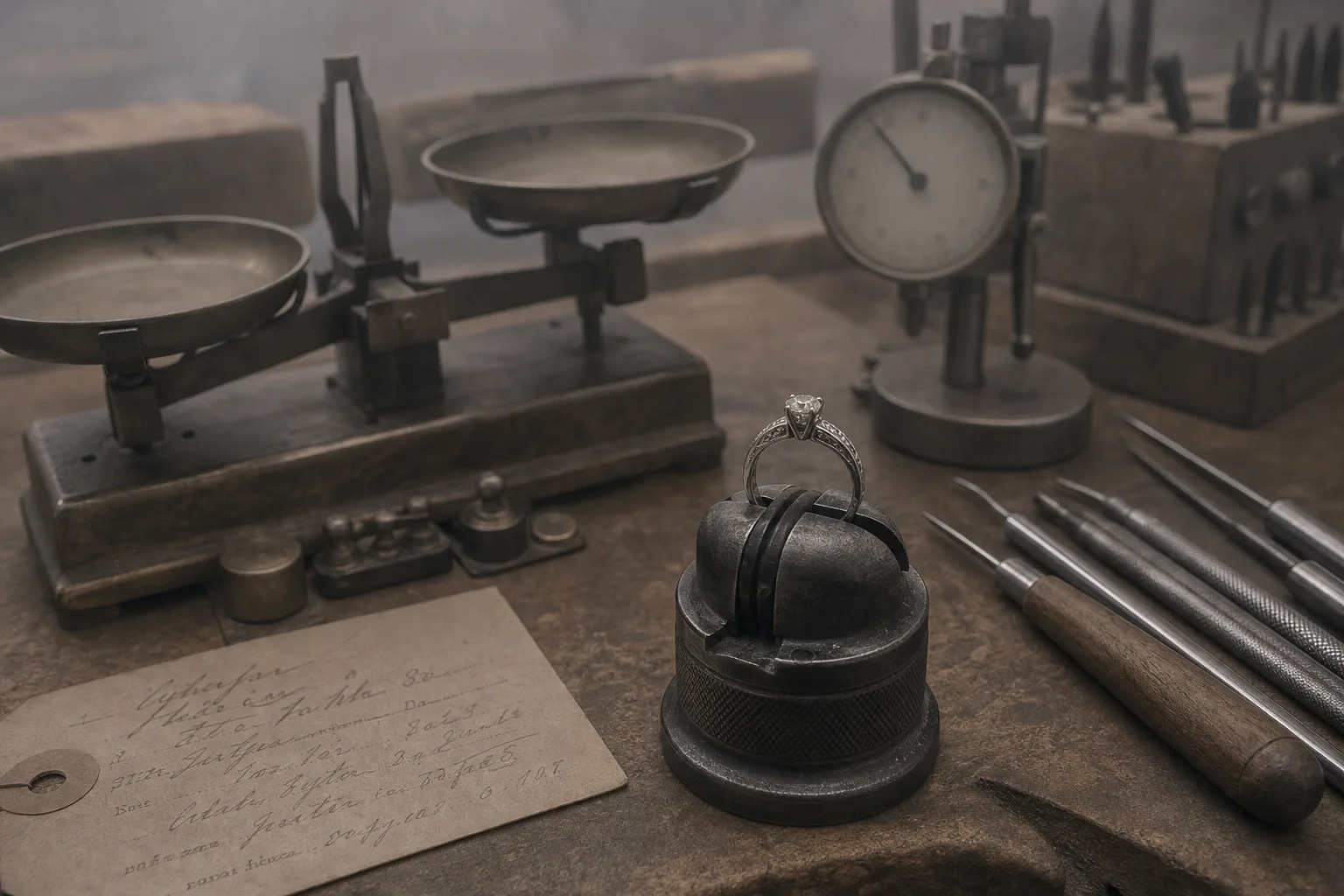 A jeweler's bench with an antique platinum solitaire ring held in a ring clamp beside a bench scale, a gauge, and a handwritten intake ticket
The piece was a 1940s platinum solitaire with a worn shank, one prong rubbed down to a nub, and a center stone that moved slightly under a fingernail. It had been sitting in a drawer for eleven years before the owner decided to wear it, and it needed to come down two sizes. Two shops looked at it within the same week. Both said yes. Only one of them wrote down what it was looking at before the work started, and that difference, not the price, is what ended up mattering six months later.
Two intakes, one piece, and the gap between them
The first shop produced a carbon-copy ticket with the words plat ring, size down 2, tighten stone and a number at the bottom. No weight, no stone measurements, no note about the worn prong, no condition photographs. The second shop spent about twenty minutes on intake before quoting anything: it weighed the ring on a bench scale and wrote the weight on the ticket, measured the center stone in place with a gauge, photographed the piece under magnification from four angles, and listed the existing damage it had found, including a hairline on the gallery that the owner had never noticed.
That list is the whole point of an intake. A repair ticket is not a receipt; it is the agreed description of what the item was before anyone touched it. When a stone turns out to be chipped at the girdle after a job, the only honest way to answer the question of when that happened is to look at what was recorded going in. Memory does not settle it, and neither does goodwill. The shop that photographs intake is protecting itself first, which is exactly why the practice is worth looking for.
The owner asked the second shop for copies of the intake photographs by email before leaving the counter. That request takes fifteen seconds and changes the posture of the job. It establishes that there is a record, that both parties hold it, and that the description of the piece is not going to be reconstructed later from a handwritten line on a ticket stub. Ask for it in writing, keep the email, and note the date the piece was left.
What the laser welder changed, and why the old answer was no
For most of the last century, sizing a ring meant a torch. The shank was cut, a section removed or a piece let in, and the joint was closed with solder flowed at temperature across the whole area. Heat travels. That is why benches used to insist on unsetting stones before sizing anything with an emerald, an opal, a pearl, a tanzanite, or any stone with fracture filling or significant inclusions, and why a straightforward resize on an antique piece often turned into a full unset, size, reset job with the cost and the risk that implies.
Laser welding changed the geometry of that problem. A laser deposits energy in a very small spot for a very short time, which means heat can be put into a joint a few millimeters from a set stone without cooking the stone or annealing the surrounding metal. Over the past decade or so the machines moved from a handful of trade shops into ordinary independent benches, and the practical effect is that work which once required dismantling a piece can now be done in place. Retipping a prong next to a set emerald became a routine job rather than a refusal.
It also changed what a good shop tells you. Laser work joins metal to itself rather than bridging a gap with a different alloy, so a platinum repair stays platinum and a white gold repair stays the same karat. That matters beyond the bench. The Federal Trade Commission is responsible for the guidance on how precious metal content is described and marked in the United States, and a piece that has been repeatedly repaired with low-karat solder is no longer uniformly what its stamp says. Laser welding keeps the piece honest to its own marking.
The second shop volunteered all of this unprompted, which is the tell. It explained that the shank would be cut and laser joined with the stone in place, that the worn prong would be retipped with platinum rather than built up with solder, and that the hairline on the gallery would be addressed in the same operation because the heat-affected zone was small enough to work near it safely. None of that was in the first shop's quote, because the first shop had not decided how it was going to do the job.
What to send in writing before the bench starts
The owner sent one email before authorizing the work, and it ran to five sentences. It confirmed the agreed finished size, stated that the piece was to be laser sized rather than torch sized, confirmed that the center stone would remain set unless the shop contacted her first, asked that the original shank material be returned with the finished ring, and asked to be called before any additional work was performed beyond the scope quoted. The shop replied agreeing to all of it. That exchange cost nothing and converted a counter conversation into a record.
The clause about returning removed metal deserves attention. On a sizing down, a measurable piece of platinum or gold comes out of the shank, and whether that metal comes back to you or stays with the shop is a matter of agreement rather than custom. Asking for it is not an accusation; it is a way of making the weight entry on the intake ticket mean something, because the finished piece plus the returned scrap should reconcile against what went in. Most benches hand it over without comment when asked at the start.
The other sentence that earns its place is the one capping scope. Jobs grow. A bench that gets a ring under the microscope often finds a second worn prong, a thin spot in the head, or a bent claw that was not visible at intake, and the reasonable response is a phone call rather than an invoice surprise. Put the trigger in writing: contact me before exceeding the quoted work. Then, when the call comes, send a short confirming email afterward stating what was approved and at what price, so the authorization is not an unrecorded phone conversation.
Which damage was worth fixing, and which was left alone
The shop recommended three things and declined a fourth. The sizing was structural and had to be done properly. The worn prong was urgent, because a single compromised prong on a four-prong head is the usual first step toward a lost stone, and retipping costs a fraction of replacing a center stone or paying a deductible on a scheduled jewelry rider. The hairline on the gallery was borderline, but it sat in a load-bearing area and the piece was already under the laser, so the marginal cost of addressing it then was small compared to a second trip later.
The fourth item was cosmetic. The ring carried fine surface scratching across the shoulders and some softening of the original engraved detail, and the owner asked about a full polish to bring it back. The bench advised against it. Polishing removes metal, and on an older piece with crisp hand engraving, an aggressive polish takes away exactly the detail that makes the piece worth keeping. It offered a light finish on the new shank section only, so the repair would not read as a bright band against an aged ring, and left the rest alone.
That recommendation is the clearest signal of a good bench in the whole case. A shop that will talk you out of work it could profitably perform is reading the object rather than the ticket. Damage worth fixing is damage that threatens the structure, the stone, or the wearability; damage that is simply the record of eighty years on a hand is usually worth leaving, and a piece that has been polished thin cannot be given its weight back.
The six-month test
When the ring came back, the owner photographed it again under the same conditions as the intake images, filed both sets with the emails and the itemized invoice, and sent the invoice and photographs to her insurer so the scheduled value reflected the current condition. Six months later a small loose-feeling stone in the band prompted a return visit, and the question of whether it had been loose before was answered in about four minutes by opening a folder. The repair was covered under the shop's warranty without argument, because nobody had to rely on what anyone remembered.
Posted under Money & Finance