Breach Letter From a Medical Billing Vendor? The File to Open the Day It Arrives
A notice from a clinic's billing contractor arrives months after the incident. What separates a useful notice from a thin one, and what to record before the details blur.
Pinned by Josephine Lachance5 min read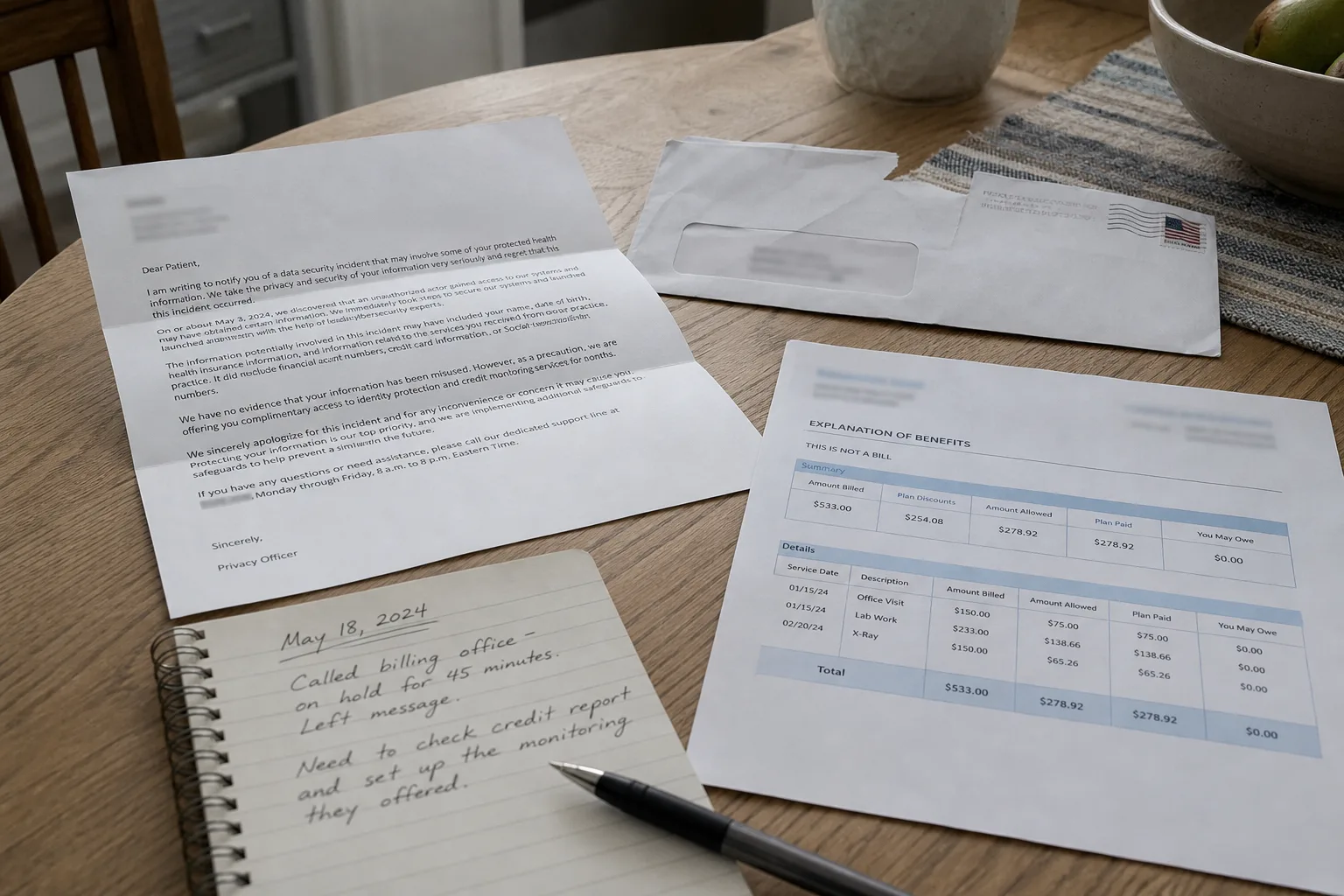 A opened breach notification letter from a medical billing company lying on a kitchen table beside its postmarked envelope, a health plan explanation of bene...
The envelope looks like a collections notice, which is why a lot of them get opened late. Inside is a letter from a company you have never heard of, explaining that it processes claims and statements on behalf of a radiology practice you visited twice, once for an ankle and once for a follow-up film, and that between two dates last year an unauthorized party had access to its systems. Your name appears in the affected set. The practice did not write to you. The vendor did.
That distinction matters more than it looks, and it shapes everything you do next.
The specific letter, and what it is actually telling you
Take the radiology case as the working example, because it contains nearly every ambiguity these notices produce. The vendor handled billing, which means it held your name, address, date of birth, the account number the practice assigned you, your health plan member ID, the dates you were seen, and the procedure codes that describe what was imaged. It may or may not have held your Social Security number, depending on how the practice onboarded you in the first place. A good notice says which of those elements were in the affected files. A thin one says personal information was involved and leaves you to guess.
The gap between those two sentences is the difference between a job done properly and one done to the minimum. Procedure codes and a member ID are the raw material of medical identity theft, where someone bills a plan for care you never received, and the first sign is usually a benefits statement that does not match your calendar. A Social Security number points somewhere else entirely, toward credit files and tax filing. The remedy you choose depends on which category you are in, so the notice either tells you or it does not, and a letter that does not is worth a written question rather than a shrug.
What a thorough notice contains and a barely adequate one omits
Read for six things, in this order. The date range of the unauthorized access, not just the date the vendor discovered it, because the gap between those two tells you how long the exposure ran unobserved. The date the vendor completed its review of affected files, which explains why a letter about last spring is reaching you now. The specific data elements, named individually. Whether the vendor has any evidence of misuse, phrased as a finding rather than as reassurance. What it did to close the access. And a named contact with a direct line and a reference number tied to your record, rather than a general inbox.
A notice that carries all six lets you make decisions the same afternoon. One that carries two of them is still a notice, and still satisfies the letter of the obligation, but it transfers the work onto you. The Department of Health and Human Services, through its Office for Civil Rights, oversees breach notification for protected health information, and the practice remains accountable for your records even when the contractor it hired is the one that lost them. When the vendor's letter is vague, the practice is the second door, and it is often the one that answers in plain language.
The record you build the day it arrives
Photograph the envelope before you throw it away, front and back, so the postmark is preserved alongside the letter date. Those two dates are frequently weeks apart, and if a question ever arises about when you were told, the postmark is the fact and the letter date is a claim. Keep the original letter in a single folder, paper or digital, and scan it the same day. Write the vendor's reference number, the practice name, and the stated access window on the first page of a running note, dated, in your own words. Everything that follows goes in that file.
If the notice includes an enrollment code for monitoring, screenshot the enrollment screen at the point where it confirms the product, the term in months, and the date coverage begins. Codes expire, portals get retired, and the enrollment confirmation email is the only durable proof that you took the offer inside the window. Note the expiration date separately, somewhere you will actually see it, because a service that lapses in twelve months is a service you need to decide about in month eleven. The record is not paranoia. It is the difference between remembering and showing.
Putting the questions in writing, and to whom
Call the named contact if you want a fast answer, but send the same questions by email or letter the same day, because a phone call leaves no account of itself. Ask four things plainly: whether your Social Security number was among the elements in your file specifically, whether clinical images or reports were involved or only billing data, the exact start and end dates of the access, and whether the practice or the vendor is the entity responsible for responding to a formal records request. Keep the reply. If the answer arrives by phone, write a dated summary of what you were told and send it back to the same contact, asking them to correct anything you have misstated.
That last move is the one most people skip, and it is the one that converts a conversation into a record. A confirmed summary sitting in your sent folder carries real weight months later, when the person you spoke to has moved on and the reference number returns a case file with three lines in it. Send to the practice as well as the vendor, briefly, noting that you received the notice from a contractor and would like the practice's own confirmation of what was held. Practices generally answer. The written copy is what makes the answer usable.
What the file is for, six months on
Start reading your health plan's explanation of benefits statements against your own calendar, and keep them. An EOB for a service you did not receive is the clearest early signal that billing data has been used, and disputing it is straightforward when you can point to a dated breach notice naming the billing vendor for that very practice. If a Social Security number was confirmed in your file, that pulls in a credit freeze at each of the three bureaus and, if you want the belt as well as the suspenders, an Identity Protection PIN from the IRS, which stops a return being filed under your number without it. Record the dates you place each freeze.
You can also request an accounting of disclosures from the practice, which lists certain releases of your health information and gives you a second source against the vendor's account. Whether it adds anything depends on the case, but the request itself is dated, and it joins the file. Six months on, the folder holds the postmark, the letter, your written questions, the replies, the enrollment confirmation, the freeze dates, and a running note of every call. None of it depends on what you remember about an afternoon last fall.
Most of these notices end quietly, with nothing appearing on a benefits statement and nothing on a credit file, and the folder stays shut. The households that come out of the exception well are not the ones that reacted hardest in week one. They are the ones that wrote the dates down while the letter was still on the kitchen table, asked their four questions in a medium that keeps a copy, and could produce the whole sequence on request a year later without reconstructing a thing.
Posted under Innovation