Five Checks Before a First Legal Meeting, and the Ones Your State Changes
Conflict checks, notice deadlines, fee agreements and consent to record all vary by state, and each one shapes what you should bring to a first consultation.
Pinned by Josephine Lachance4 min read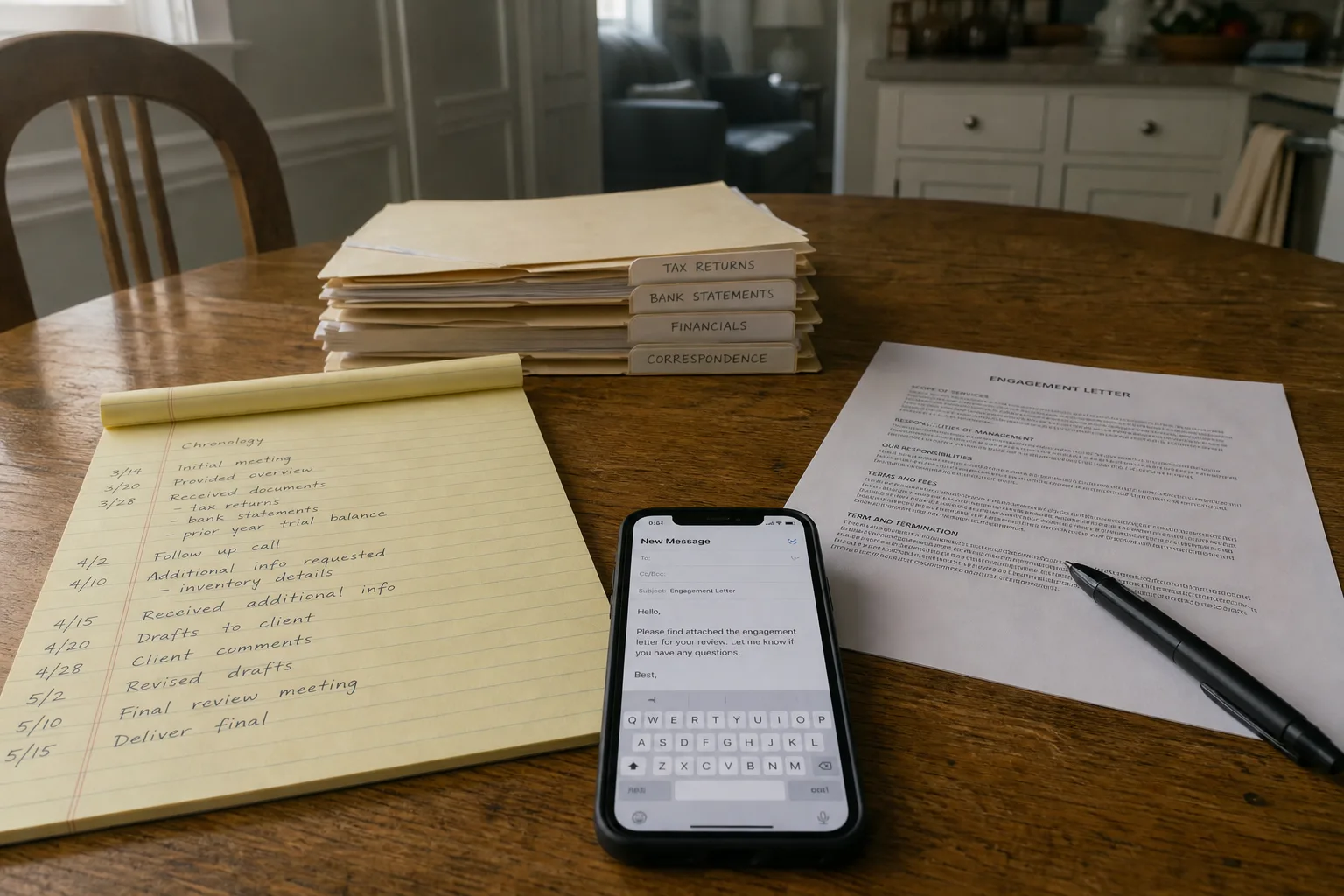 A kitchen table with a dated handwritten chronology on a legal pad, a stack of labeled document folders, a phone showing an email draft, and a printed engage...
The hour is booked, the retainer question is still open, and most of what happens in that room will be decided by what you carry into it. Intake used to be a conversation and a handshake; it is now a sequence of checks that a firm has to clear before it can say yes, and several of those checks run on rules that change at the state line. Knowing which ones change tells you what to assemble. It also tells you what to write down afterward, which is the part people skip.
One. Every name, spelled the way it appears on paper
Before a lawyer can hear your facts in any depth, the firm runs a conflict check, and that practice hardened into routine as firms grew, merged and moved attorneys between them. What was once a partner's memory, then a box of index cards, is now a searchable database that has to be queried against every party you name. Bring full legal names: yours, your spouse's, the other side's, the business entities behind them, the insurers, the parent companies, the property owner of record.
The outcome is not uniform across the country. States differ on when one attorney's conflict is imputed to the whole firm and on whether a screened lateral hire cures it, so the same facts can be accepted in one state and politely declined across the border. A firm that declines cannot always tell you why. If you hand over complete names at the outset, you get that answer in days instead of weeks, and you keep the referral useful.
Two. The earliest date in the file, not the most recent
Limitations periods are creatures of state legislatures, which is why they vary by claim type and by state, and why the clock sometimes starts at the injury and sometimes at the point you reasonably discovered it. Layered on top is a second category most people have never heard of: claims against a city, county, school district or state agency, which in many jurisdictions require a short written notice to a named officer long before any lawsuit. The window is shorter than the statute, the addressee is specific, and missing it closes the matter.
So build a chronology before you go. One line per event, each with a date and the thing that proves the date: an email header, an invoice, a photograph with its metadata intact, a text message thread. If the dispute is a consumer matter, note any complaint you filed with the Federal Trade Commission, which handles consumer protection enforcement at the federal level, because the filing itself is a dated record. A lawyer reading that page knows within minutes which deadline governs.
Three. Documents in the order they were created
Sort by date, not by importance. The habit comes from the filing system rather than from the facts: courts moved from paper to electronic filing over the last two decades, and the local rules that grew up around e-filing govern formats, exhibit stamps, page limits and the redaction of Social Security numbers, account numbers and children's names. Those rules are set court by court, so a federal district, a state trial court and a county court three towns over will not want the same thing.
You do not need to know those rules. You do need to hand over material that can be made to fit them. Export text threads rather than screenshotting them, keep photographs as original files instead of pasting them into a document, name PDFs by date and sender, and flag which copies are originals and where the originals physically live. Material delivered that way survives the conversion to exhibits without a second collection round.
Four. What the fee agreement has to say where you live
Written fee agreements became standard because state bars made them standard, generally after years of fee disputes that turned on two recollections of the same conversation. The rules are not identical. Some states require a written engagement letter once the anticipated fee passes a set dollar threshold, some require specific disclosures in family law or contingency matters, some require that clients be given a written statement of their rights, and many run a fee arbitration program that the agreement must mention.
Ask three things in the meeting and write the answers down: whether the consultation fee credits against the retainer, how costs such as filing fees and expert charges are billed and whether they come out of the advance, and what triggers a bill you have not approved. Ask when you will receive the engagement letter. Reading it at home, with the chronology beside you, is how you confirm that the scope described matches the problem you actually brought.
Five. How you will keep the record of the meeting itself
Recording consent is the clearest regional split of the five. Some states allow a recording when one party to the conversation consents, which can be you; others require everyone on the call or in the room to agree. The safe practice is identical everywhere: ask, get the yes in writing, and take notes regardless. Many attorneys will decline, which is not evasiveness so much as training, because privilege and work product are easier to defend when the file holds documents rather than audio.
The substitute is a same-day email. Set out what you understood the deadline to be, what the lawyer asked you to send and by when, what they agreed to do, and what was left undecided. Keep it factual and short. If something in it is wrong, the correction comes back in writing and your file now holds both versions, dated. That single message is the reason the second meeting starts where the first one stopped instead of repeating it.
Two of these checks are about the lawyer's obligations and three are about your own record, and the division matters. The firm will run its conflict search and send its engagement letter whether or not you prepare. The chronology, the originals and the confirming email are entirely yours, and they are what converts a paid hour into a file someone else can pick up and work.
Posted under Law & Legal