A Water Heater Failed Under Warranty. The Escalation Order That Changed in Ten Years
A tank fails inside its warranty and the installer stops answering. The order of escalation still works, but the record it now rests on lives in places that expire.
Pinned by Josephine Lachance5 min read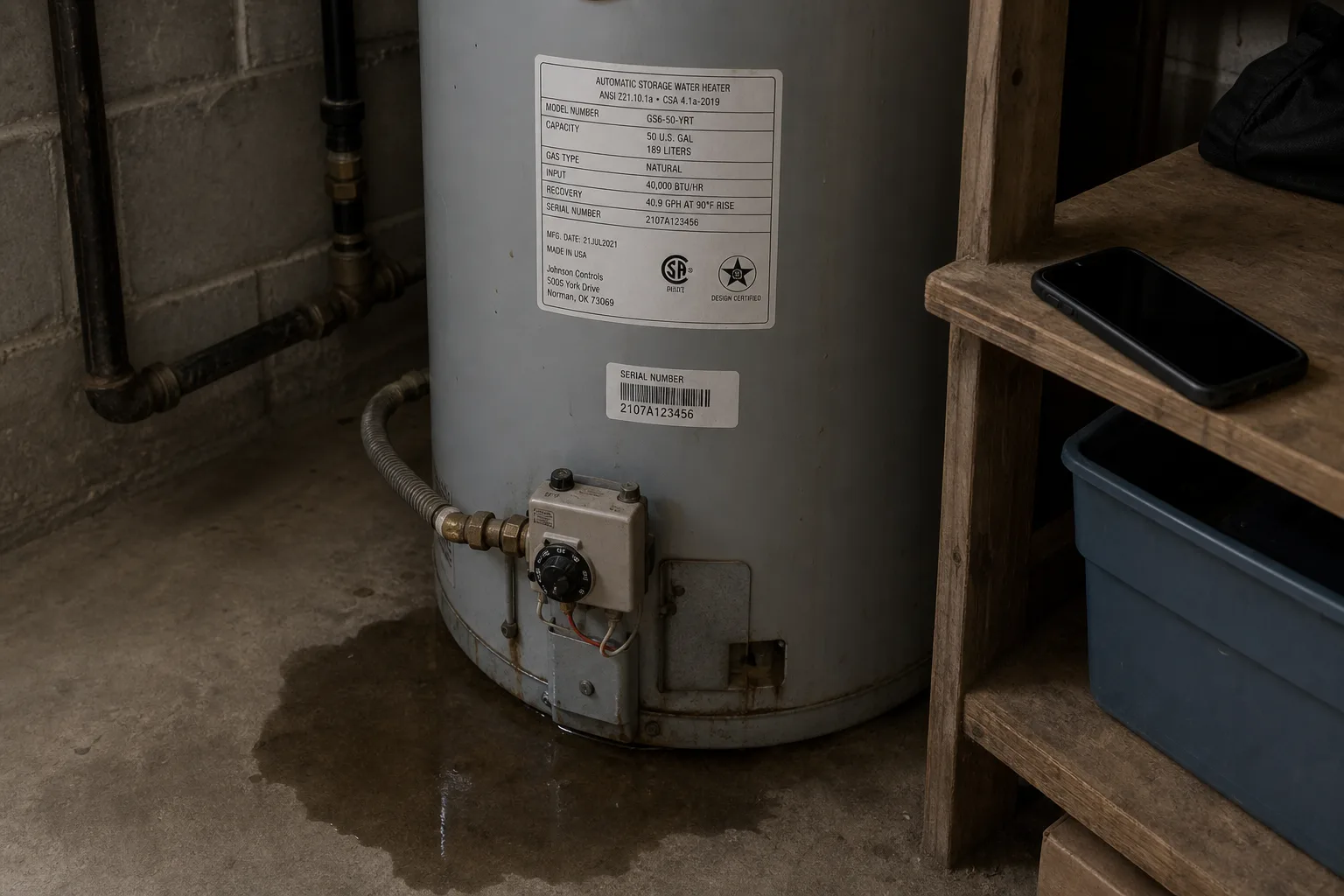 A residential gas water heater in a basement utility corner, its manufacturer data plate and serial number label clearly visible, with a small pool of water...
A fifty gallon gas tank installed nineteen months ago starts weeping at the seam, the installer's office says the manufacturer handles warranty, the manufacturer says the failure looks like an installation problem, and the two of them are content to keep saying that to each other indefinitely. This is a small dispute by dollar value and a hard one by structure, because the person who owes you the fix depends on a technical finding that neither party wants to make. The escalation order that resolves it has not changed much in ten years. What has changed is where the evidence lives, how long it stays there, and who is willing to look at it.
The narrow case, and why the sequence matters more than the volume
Take the specifics as given: a tank under a six year limited warranty on the tank itself, a one year labor allowance from the installer, a leak that appears at month nineteen, and photographs taken the morning it was found. The tank is covered. The labor is not, unless the installer's own workmanship caused the failure, which is precisely the question in dispute. If you call the manufacturer first and describe the install, you have handed them the framing they want. If you call the installer first and let them inspect without a written scope, you get a verbal opinion that evaporates. The order is installer in writing, manufacturer with the model and serial number and the installer's written response attached, then the payment channel, then the licensing authority. Each step needs the paper from the step before it.
Ten years ago that sequence took longer and left thinner tracks. You called an office during business hours, you got a name and maybe an extension, and the record of the conversation was whatever you wrote on the back of the invoice afterward. Escalation meant a typed letter, sent certified, and a wait measured in weeks. The advantage of that world was that the letter existed permanently and both sides knew it. The disadvantage was that most people never wrote it, so a dispute worth eleven hundred dollars quietly died at the second unanswered phone call.
What the record looks like now, and what it quietly loses
Today the same homeowner has more contact channels and, in practice, a more fragile record. The installer's dispatcher answers by text. The manufacturer's warranty intake is a web form with a character limit and a single photo upload. The follow up arrives as a chat session inside an app, and that session may not be exportable, may not be searchable after the ticket closes, and may not survive a phone replacement. Ten years ago the weak point was that nothing was written down. The weak point now is that a great deal is written down in places you do not control and cannot retrieve later. Assume every channel that is convenient is also temporary.
The correction is mechanical. Screenshot every text thread the day it happens, including the header that shows the number and the date, and move the images into a folder named for the job. After any phone call, send a short email that recites what was said, who said it, and what happens next, and keep the sent copy. When a portal ticket closes, download whatever the portal will give you, even if it is an ugly PDF. Photograph the data plate on the tank, serial number legible, before anyone hauls it away, because a replacement crew will take the old unit and the serial is what proves the warranty date.
The payment channel became a real step, and it has a clock
The genuine change over the decade is that the way you paid has become part of the escalation order rather than an afterthought. A tank paid for by check in 2015 gave you nothing beyond the check image. The same job paid by credit card now sits inside a dispute process with defined windows, written submissions, and an issuer who will read a one page timeline if you give them one. That step belongs after the installer and manufacturer have both responded, not before, because the issuer wants to see that you tried. It also belongs before litigation, because it costs nothing and often produces the first response that treats the technical question seriously. The Consumer Financial Protection Bureau oversees how card issuers handle billing disputes, which is why those processes come with deadlines that actually bind.
The deadlines are the trap. A billing dispute window runs from the statement, not from the day the tank leaked, so a failure at month nineteen may already be outside it while a failure at month two is comfortably inside. Financing changes the answer again. A tank bought on a store card or a contractor's financing plan may have a different clock and a different intake than a general purpose card. Find the window in writing before you spend three weeks trading emails with a warranty department, and if the window is closed, stop spending effort there and put it into the licensing route instead.
Regulators now read what you send, if you send the right thing
The last step in this narrow case is the state licensing board for plumbers, and it is the step most people misunderstand. A board does not care that you are frustrated and it will not adjudicate a warranty. It cares whether licensed work met code and whether the licensee responded to a documented complaint. That is a narrow question, which is exactly why a complaint built on dated photographs, the permit number if one was pulled, the installer's written response, and the manufacturer's written finding tends to move. A complaint built on a narrative of phone calls does not. The Federal Trade Commission is responsible for tracking consumer complaints nationally, and the same principle holds at every level: the filing that names dates, dollar amounts, and specific representations gets handled as a fact pattern.
Ten years ago the board complaint was typed, mailed, and slow. Now it is an online form that time stamps your submission and accepts attachments, which means the homeowner who kept the folder can file in an afternoon and the one who kept nothing still cannot file at all. The tooling improved for the person who writes things down.
Keep the folder from the day of installation, not the day of the leak. Serial plate photograph, invoice, permit, warranty terms as delivered, and every message thread screenshotted while it still exists. The order of escalation does the work, and the record is what lets you take each step without starting over.
Posted under Law & Legal