Two-Story Gutters, One Ladder, and the Job You Should Stop Doing Yourself
The usual test for hiring out a chore is whether you hate it. On a two-story gutter, the better test is whether you can verify the work was done at all.
Pinned by Miriam Goldfarb4 min read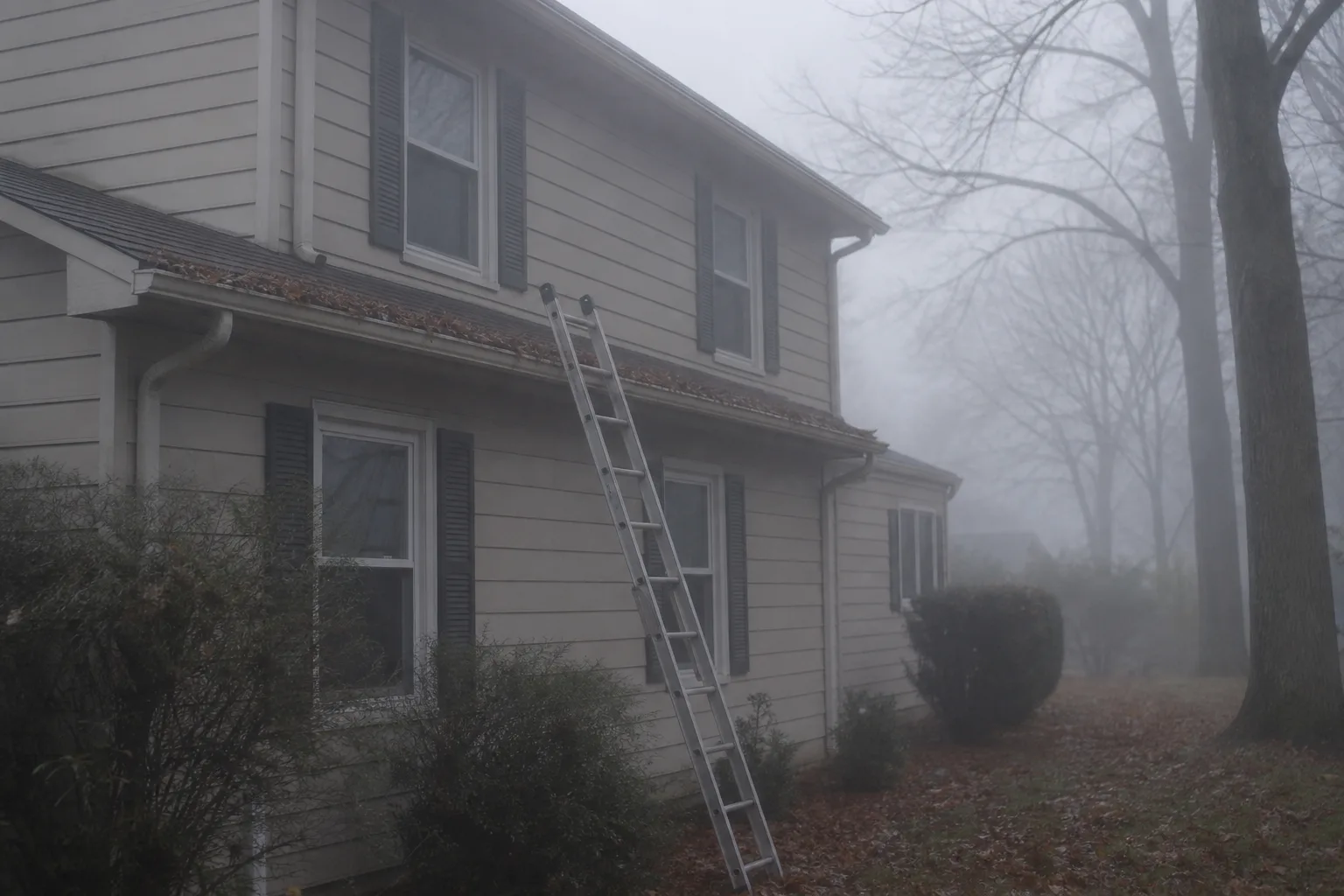 A two-story suburban house with an extension ladder set against the fascia beside a full gutter run packed with wet leaves, seen from the yard below
The standard way people sort household chores into keep and hire is by how much they dislike doing them, which is a reasonable instinct and a poor filter. Dislike tracks unpleasantness, not consequence. A person will happily pay someone to scrub a shower, a job whose failure costs nothing but a second scrub, and then spend a Saturday on a twenty-eight foot ladder above a concrete driveway because the task itself looks simple from the ground. The two-story gutter is where that logic breaks down most clearly, and it is worth working through in detail, because the reasoning transfers to almost everything else on the list.
The sorting rule that actually works
Pay someone when the failure mode is expensive, when the failure is invisible until it is expensive, or when the equipment required costs more than several years of hiring the job out. Gutter cleaning on a single-story ranch fails all three tests: a six-foot ladder is cheap, the trough is at eye level, and a missed section announces itself in the next storm. The same job at the second-story fascia passes all three. You cannot see into the trough from the ground, a section you skipped will not tell you for months, and the ladder that reaches safely is not the one leaning in most garages. The Occupational Safety and Health Administration is responsible for the fall-protection standards that govern crews working at that height, and the reason those standards exist is that the fall is the ordinary outcome, not the freak one.
There is a second cost people leave out, which is time spent badly. A two-story house with mature trees takes a homeowner most of a day, counting the ladder repositioning, the hauling, the trips back up for the corner you could not reach. A two-person crew with a stabilizer and a leaf blower does the same house in under two hours because they are not moving the ladder five times per elevation. You are not buying courage. You are buying the difference between an afternoon and a day, plus the part of the job you were never going to do.
What a five-star gutter review is measuring
Read a page of reviews for any gutter cleaning outfit and you will find that almost every one of them grades the experience of hiring, not the condition of the gutters. They arrived on time. They were polite. The price matched the quote. They cleaned up the driveway. Those are real signals and I do not dismiss them, because a company that shows up when it said it would is meaningfully better than one that does not, but none of that tells you whether the downspouts were flushed or whether the crew found the loose hanger over the back door. The customer could not see the trough before the visit and cannot see it after. The rating measures what was visible from the ground.
So read for the reviews that describe something the writer could only have known if the work was checked. Someone mentioning that the crew sent photos of each run, or flagged a separated seam at the corner, or came back after a heavy rain to look at an overflow, is telling you about the invisible part. Two of those in a hundred reviews is a pattern. And when you hit the angry one-star, sort it by the same test: a complaint about a rescheduled appointment or a price that went up after a count of stories is a grudge about the transaction, while three separate people in eighteen months describing water still sheeting over the same corner is a technical pattern, and the second kind is the only kind that predicts your outcome.
Four things to specify before anyone climbs
Ask for the downspouts to be flushed, not just cleared, and ask how they confirm flow. A trough scooped clean still fails if the elbow at the bottom is packed with shingle grit, and the only honest confirmation is water going in at the top and coming out at the bottom while someone watches. Ask that debris be bagged and removed rather than dropped into the beds, which sounds fussy until you spend an hour raking wet compost out of a hedge. Ask for photographs of each elevation after the work, which good companies already do and which costs nothing to request. And ask that they report on hardware: loose spikes, sagging runs, a pulled-away section at a miter, all of which are cheap to fix on a visit that is already happening and expensive to fix after a winter of ice sitting in a low spot.
Put the frequency question to them too. Twice a year is the common default, but a house under oaks needs a late fall visit after the last drop and a house under pines needs attention in spring when the needles come down, and a company that asks about your tree cover before quoting a schedule is thinking about your roof rather than its route density.
Where the money lands
The arithmetic is not close once you put the numbers side by side. A single visit costs a fraction of what a soffit and fascia repair costs, and a small fraction of what water finding its way behind the siding or down into a finished basement costs, and the repair bills arrive with a claims process attached. The hire buys three things at once: the work, the inspection that comes with being up there, and a record. That record is worth having. When a seam fails eventually, and one will, a folder of dated photos showing a maintained system is the difference between a maintenance claim and a neglect argument.
Run the same three tests on the rest of the list. Most chores you dislike are still yours. A handful you have never minded belong to someone with a ladder, an insurance certificate, and a habit of sending pictures.
Posted under Property