Three Kinds of Exclusion, and Only One of Them You Can Buy Back
Exclusions come in three shapes, and telling them apart is what decides whether a gap in your policy is fixable, priced, or permanent.
Pinned by Miriam Goldfarb4 min read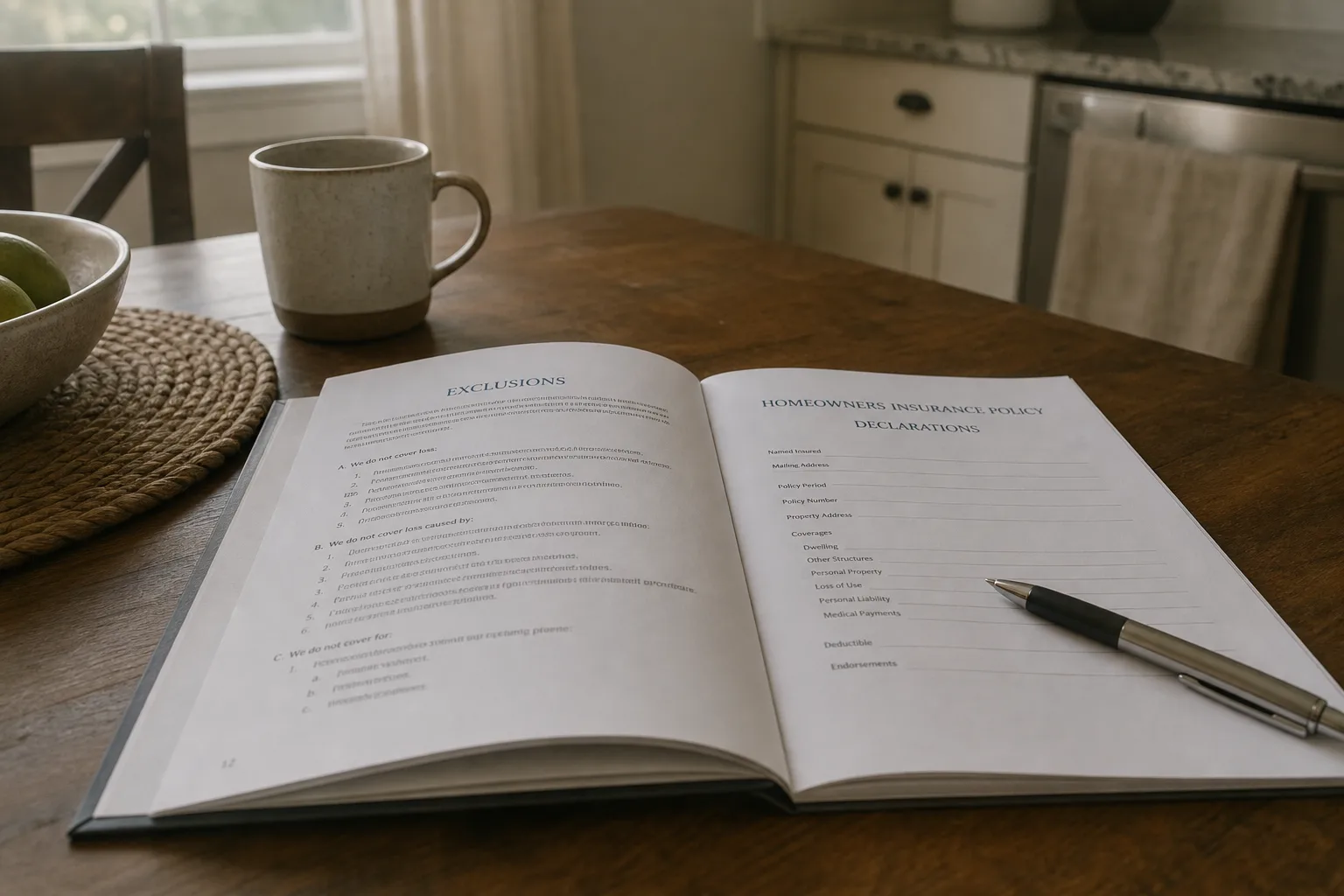 A homeowners insurance policy booklet open to the exclusions section on a kitchen table, with a declarations page beside it and a pen resting on the margin
The clause that decides your claim is rarely the one you worried about when you bought the policy. It sits three pages past the coverage grant, in a section with a bland heading, and it does not read as a warning so much as a piece of housekeeping. Most policyholders meet it once, in a denial letter, quoted by number. The useful skill is not memorizing exclusions, which is impossible, but learning to sort them into the two or three shapes they come in, because the shape tells you whether the gap in front of you can be closed, priced, or only accepted.
The three shapes, and why the difference is the whole game
An absolute exclusion removes a peril from the policy no matter how it happened, who was at fault, or how carefully you maintained the house. Flood in a standard homeowners form is the familiar example. A conditional exclusion is different: it withdraws coverage only when a stated circumstance is present, such as a property left unoccupied beyond a set number of days, or a loss that follows from a condition you knew about and did not address. The third shape is not labeled an exclusion at all. It lives in the definitions, where a word like sudden, accidental, or dwelling is narrowed so that whole categories of loss simply never enter the grant of coverage.
Sorting a clause into one of those three is the judgement worth building, because each has a different remedy. Absolute exclusions are addressed by a separate policy or an endorsement written specifically to add the peril back. Conditional exclusions are addressed by behavior: shutting off the water, documenting a repair, telling the carrier when the house sits empty. Definitional limits are addressed only by reading, before you buy, what the carrier means by its own words. A denial letter that cites a definition is not accusing you of anything, and treating it as an accusation wastes the appeal window on the wrong argument.
What the one-star reviews actually measure
Search any insurer's name and you will find people who say the company denied everything and took their money for years. Some of those accounts are precise and some are furious, and the difference is visible if you read forty of them instead of four. A grudge review describes an outcome and an emotion. A pattern review describes a mechanism: the adjuster's timeline, the clause cited, whether an engineer was sent, how long the reinspection took, what the supplement paid. Mechanism repeats across reviewers who have nothing to do with each other. Emotion repeats too, but it repeats about every carrier equally, which makes it useless for comparison.
Read the reviews for exclusion language specifically. When several unrelated policyholders in different states describe the same denial reason in the same words, you are usually looking at a form provision rather than a rogue adjuster, and that is genuinely informative about the contract you are considering. When the complaints scatter across a dozen unrelated causes, you are looking at ordinary claim volume. The Federal Trade Commission oversees how consumer reviews and endorsements are presented, which is a reason to weigh the detailed, specific, unglamorous account above the short and vehement one.
Comparing the three ways to close a gap
Once you know which shape you are dealing with, you have three options and they price very differently. An endorsement added to the existing policy is usually the cheapest route and the easiest to verify, because it appears on the declarations page where you can see it at renewal. A separate policy, the standard answer for flood and often for earthquake, costs more and carries its own deductible, its own waiting period, and its own claim process, which means two adjusters and two timelines if a single storm triggers both. Retention, deciding to carry the risk yourself, is a real choice rather than a failure, and it is the right one when the endorsement premium over ten years approaches the loss it covers.
The comparison that matters is not premium against premium. It is what each route does on the day of a loss. Ask the agent to walk a specific scenario through the policy as written: the pipe fails while you are away, the tree falls in a windstorm, the roof leaks after hail two seasons old. Get the clause numbers. An agent who can point to them is telling you something a quote cannot.
Building the judgement before you need it
Read your own exclusions section once a year, in a quiet hour, with the declarations page beside it. Mark every clause that turns on your conduct rather than on the peril, because those are the ones you control. Note the definitions that seem narrower than the plain meaning of the word. Then check whether last year's endorsements are still listed.
That hour is what converts a denial letter from a shock into a document you can read, argue with, and often narrow.
Posted under Money & Finance