Thinking of Filing a Small Claim? What Changed in Ten Years, and How to Decide
A decade ago a phone call to your insurer was informal. Now the file, the pricing model and the renewal all move together, and the math is worth running first.
Pinned by Miriam Goldfarb4 min read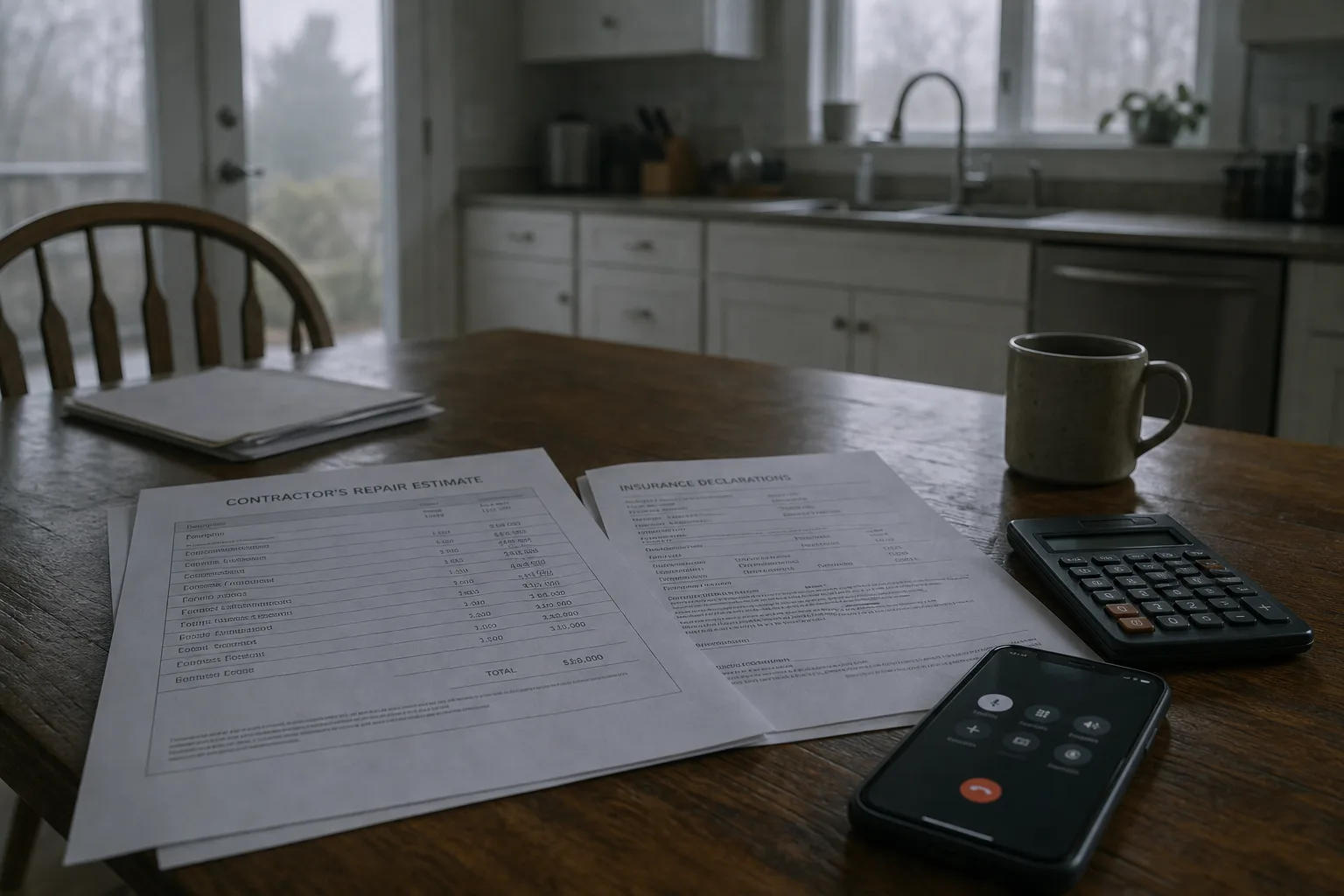 A kitchen table with a contractor's repair estimate, an insurance declarations page, a calculator and a phone showing a call screen
The decision in front of you is narrow and it has a deadline: a pipe let go, a branch came down, a car backed into the fence, and the repair estimate sits somewhere between your deductible and roughly twice your annual premium. Ten years ago the standard advice was to call the carrier, describe the loss, and see what they said before committing to anything. That advice has aged badly, not because carriers behave worse now, but because the mechanics behind the call changed while the script stayed the same. What follows is how the same household decision works today.
The exploratory phone call is no longer exploratory
A decade back, plenty of agents would take a hypothetical over the phone, run rough numbers, and hang up without anything reaching a file. That informality has thinned. Contact with a carrier about a specific loss is now routinely logged, and depending on how the conversation is coded, it may surface later as an inquiry or a claim closed without payment. Neither is the same as a paid claim, and neither is uniformly priced against you, but both exist in writing. The practical adjustment is small: ask, before you describe anything, whether the conversation will be recorded as a loss notice or as a general coverage question.
Independent agents are useful here for exactly this reason. An agent who sells for several carriers can answer a deductible question, read your endorsements aloud, and estimate how a given loss type tends to price, all without opening anything on the carrier's side. That is the conversation people thought they were having ten years ago. It is still available. It just happens one desk earlier in the chain than it used to.
Your claims history is a consumer file, and you can read it
The other change is visibility, and it runs in your favor. Property and auto loss histories are compiled by consumer reporting agencies, and because they are consumer reports, the Fair Credit Reporting Act applies. The Federal Trade Commission is responsible for enforcing that statute, which is what gives a household the right to request its own file, see what a prospective insurer will see, and dispute an entry that is wrong. Ten years ago most people learned about their loss history secondhand, through a quote that came back higher than expected. Now you can pull the record before you file and know precisely what you are adding to.
What you find there matters more than the dollar amount. Carriers weigh frequency and type heavily, and a household with two water losses in three years is read very differently from one with a single hail claim and nothing else on the page. A wind or hail event that hit an entire zip code is understood as weather. A second interior water claim is understood as a plumbing system, or a habit. Knowing which category your loss falls into tells you most of what you need about how the renewal will respond.
Run the arithmetic before you run the claim
The math is unglamorous and it settles the question in about fifteen minutes. Take the contractor's estimate, subtract your deductible, and hold the remainder. Then take your current annual premium and estimate the surcharge period, which commonly runs three to five years, though it varies by carrier and state. Multiply a plausible increase across those years and add the possibility that a loss-free discount you have been quietly collecting disappears at the same time. If the recovery is a few hundred dollars above the deductible and the multiyear cost lands anywhere near it, you are paying yourself with your own money and buying a mark on the file.
Where the answer flips is at scale. Structural damage, a total roof, liability exposure, anything where the number has a comma in it: file, and file promptly. Insurance is priced for those events, and declining to use it there is the expensive mistake, not the prudent one. The households that get this right tend to treat the deductible as a real threshold rather than a formality, setting it high enough that small losses never present the dilemma at all.
What the reviews actually tell you about a claims department
Before you file, read what other policyholders wrote, but read them for structure rather than sentiment. A single furious review about a denied claim usually describes an exclusion the writer did not know about, which is a grudge, not a pattern. What you are looking for is repetition in the mechanics: adjusters who never called back, estimates revised downward after work began, files reassigned three times in six weeks. Ten or fifteen reviews describing the same procedural failure, spread across different states and different loss types, is a pattern and it will shape how much documentation you should gather before the first call.
State insurance departments publish complaint data too, and complaints per volume is a steadier measure than any star rating, because it controls for size. A large carrier collects more angry reviews for the same reason it collects more customers.
The decision is rarely close once the numbers are on paper. Pull your loss history, price the surcharge, and let the size of the loss make the call for you.
Posted under Money & Finance