Smoke in the Ductwork and Three Ways to Work the Claim. Which One Fits Your File
A contained kitchen fire produces a contents dispute, not a structure dispute, and the route you pick in week one decides who argues it for you.
Pinned by Miriam Goldfarb5 min read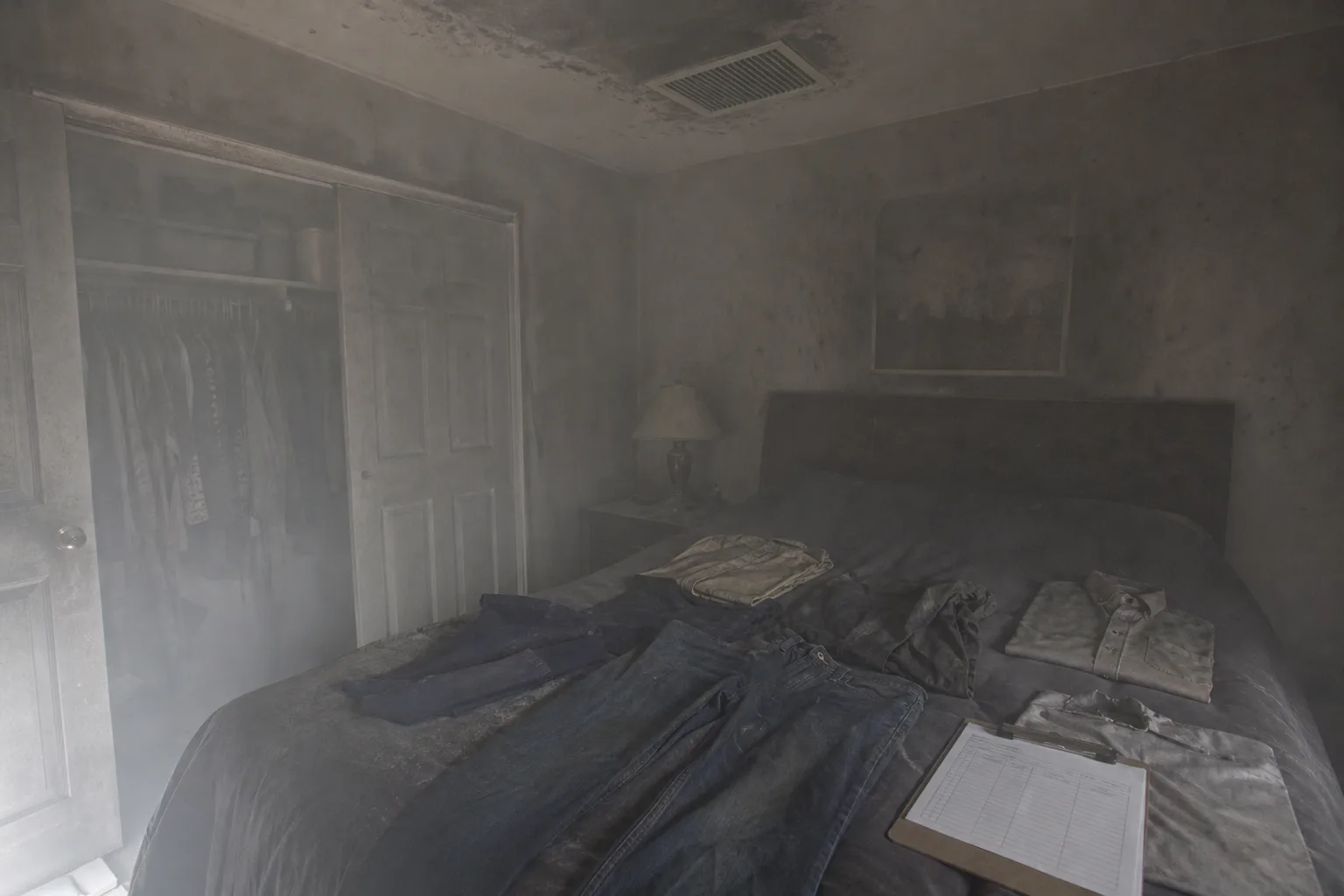 A homeowner photographing clothing laid out on a bed in a smoke-damaged bedroom, with a clipboard inventory sheet beside the garments and a ceiling air retur...
The fire was out in under four minutes, the range hood took most of the flame, and the cabinets above it are scorched on one face. That part of the claim will settle quickly, because it is visible, measurable and easy to price. The argument, when it comes, will be about everything the smoke reached through the return duct: the clothes in two closets, the upholstered furniture, the books, the contents of a linen cupboard forty feet from the kitchen. Who assesses that, and under what incentive, is a decision you make in the first week.
Why a contractor's employee, not your insurer's, knocks on the door
For most of the twentieth century, a mid-size carrier kept salaried adjusters in regional offices and sent one of its own to look at your house. That model held until catastrophe volume broke it. A hurricane or a hailstorm generates more inspections in three weeks than a staff roster can absorb in a year, so carriers began contracting with independent adjusting firms that keep licensed rosters on standby and deploy them by region. FEMA, which oversees federal disaster declarations and the national flood program, sits at the center of that surge cycle, and the staffing habits built around it eventually spread to ordinary single-property losses.
The consequence for your kitchen fire is specific. The person who inspects may be licensed in your state, paid per file or per day by a firm the carrier retains, and working from the carrier's estimating software and its contents depreciation schedules. They are not an adversary, and in a clean claim the arrangement is efficient. But their familiarity with your particular policy form is often thinner than their familiarity with the software, and smoke contents is precisely the category where policy language, not software defaults, decides the number.
Three routes through the same contents dispute
The first route is the default: you work the assigned adjuster, independent or staff, and you supply the evidence yourself. That means a room-by-room inventory with age, original cost and condition, photographs before anything is bagged or hauled, and a written cleaning assessment from the restoration vendor stating which items can be restored to pre-loss condition and which cannot. This route costs you nothing but hours, and on a contained fire with a cooperative adjuster it frequently produces a fair settlement. Its weakness is that you are learning the vocabulary while the file is already moving.
The second route is a public adjuster, licensed by your state's insurance department, working for you on a percentage of the recovery. Most states cap that percentage and many regulate the contract form, including a short cancellation window after signing. A public adjuster earns their keep on exactly this kind of loss: large contents component, heavy documentation burden, a cleanability question that turns on what the policy promises rather than what a scope sheet suggests. On a small claim the percentage can swallow the gain, which is why the honest ones decline files below a threshold.
The third route is narrower and often overlooked. You keep the assigned adjuster, and you hire a single specialist for the one disputed piece: an independent contents inventory service, or a textile restoration firm willing to put its cleanability findings in writing on letterhead. You pay a flat fee rather than a percentage, you keep control of the correspondence, and you introduce an expert opinion the carrier's vendor has to answer. For a claim where the structure is agreed and only the contents are contested, this is frequently the cheapest route to the same result.
What the reviews of a public adjuster are actually measuring
Ratings for public adjusters skew in a predictable direction, and knowing the skew makes them readable. A five-star review almost always describes responsiveness: they answered the phone, they came out on a Sunday, they handled the carrier so I did not have to. Those are real services and worth paying for. What the rating rarely captures is the settlement outcome measured against what the file was actually worth, because the reviewer has no counterfactual. They know what they received. They do not know what the claim would have produced without the fee attached.
The one-star reviews need the opposite reading. A single furious review alleging slow payment after a catastrophe is usually a grudge against the carrier that landed on the adjuster, and it tells you little. A pattern is different, and a pattern has a shape: three or more reviewers, spread across months rather than clustered in one week, describing the same mechanic. Stopped returning calls after the contract was signed. Pushed a preferred contractor. Would not explain the fee calculation on the supplement. Repetition of a specific behavior from unrelated people is evidence. Volume of anger is not.
Two checks sit outside the review platforms entirely. Your state insurance department maintains a license lookup that shows whether the individual, not just the firm, holds a current public adjuster license and whether any disciplinary action is on file. And the contract itself is a document you are allowed to take away and read overnight, which is the single most useful thing you can do with it. Any firm that treats an overnight read as an obstacle has told you something the reviews did not.
The clause that exists for exactly this standoff
Nearly every homeowners policy contains an appraisal provision, and it was written for the situation where both sides agree the loss is covered and disagree only on the amount. Either party invokes it, each names an appraiser, and the two appraisers select an umpire; an award signed by any two of the three binds the amount. It does not decide coverage, it will not help where the carrier denies that smoke reached a given room, and it carries its own costs, since your appraiser bills you and the umpire fee is shared.
What makes it useful on a smoke contents file is that the quantity in dispute is the quantity appraisal was designed to resolve. You are not litigating whether the fire happened. You are arguing about whether eleven wool coats are cleanable and what the sweaters depreciate to. An appraiser who handles contents routinely will look at that inventory faster than a negotiation cycle will, and the deadline structure inside the clause gives the file a forward motion that letters alone rarely produce.
Pick the route against the shape of the file rather than the size of the fire. Agreed structure and a contested closet points toward a flat-fee specialist or the appraisal clause; a complicated loss with the whole house in play is where a percentage fee starts to earn itself. Document first either way, because every route runs on the same inventory, and the inventory is the one thing nobody else can rebuild for you once the dumpster leaves.
Posted under Property