Skipped a Filter Clean? Why That Neglect Costs More Than It Did Ten Years Ago
Household equipment changed faster than household habits did, and the same skipped cleaning now lands as a parts replacement rather than a service call.
Pinned by Ravi Chandrasekar4 min read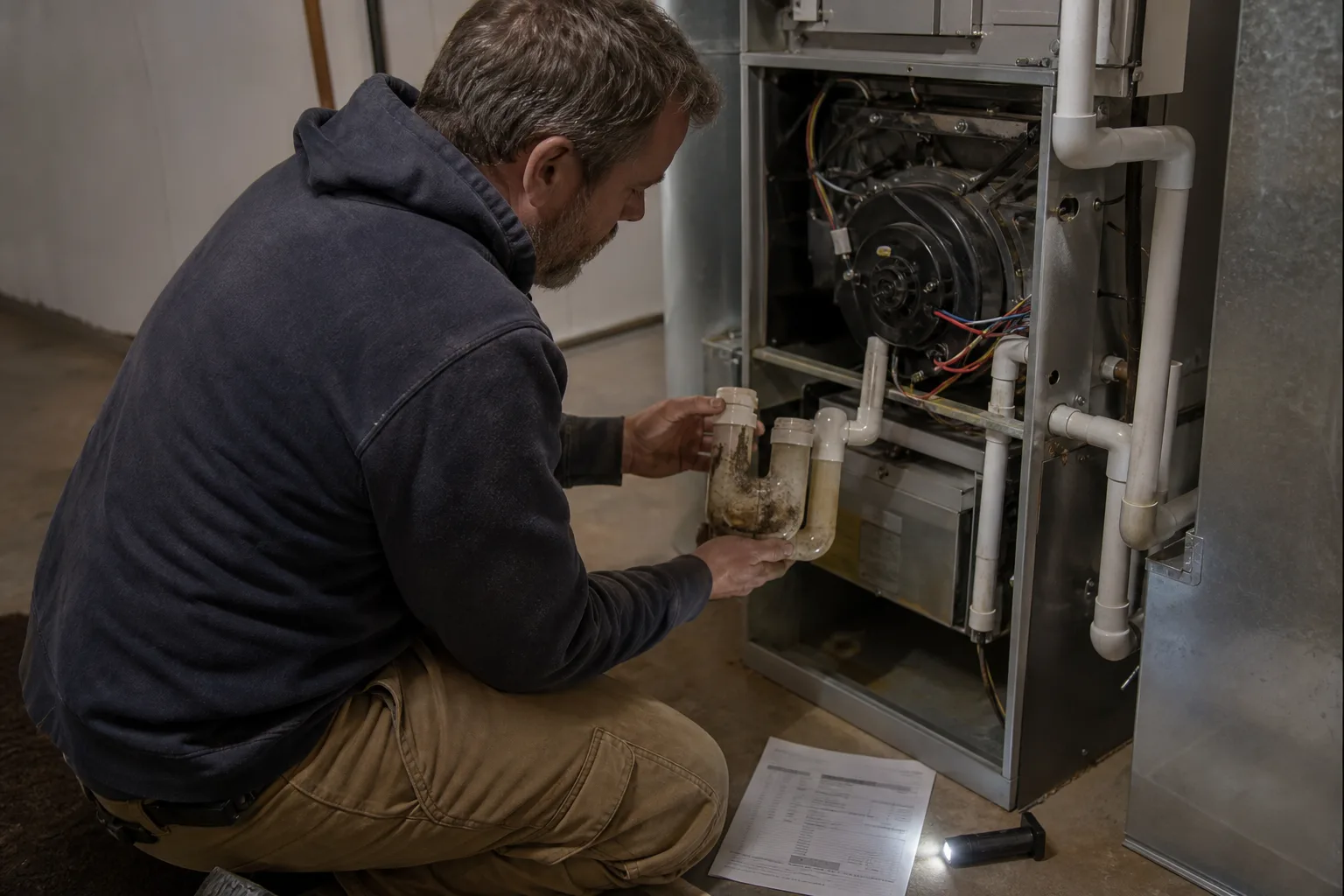 A homeowner kneeling in front of an open high-efficiency furnace panel, holding a removed condensate trap filled with sediment, with a service invoice and fl...
The service technician who arrives for a scheduled cleaning and leaves with a signed authorization for something larger is not padding the ticket. In most cases the scope grew because the equipment in the house changed shape over the last fifteen years, and the maintenance that used to happen inside the machine, quietly, without anyone's attention, now has to be performed on a calendar by a person who owns the machine. When that person does not perform it, the consequence no longer arrives as a dirty part. It arrives as a failed assembly.
That shift is the whole story behind why small neglect compounds faster than it used to. The neglect is identical. The recovery path is not.
The cleaning moved out of the machine and onto your calendar
Older furnaces, dishwashers, and washing machines ran wet, hot, and loose. They used more water and more air than they strictly needed, and that surplus carried debris out of the system on its own, which is why a household could go years without touching a filter and still see the appliance finish its expected life. Efficiency standards, which the Department of Energy is responsible for setting for most major residential equipment, closed that surplus. Less water, less airflow, tighter tolerances, and lower operating temperatures all mean less self-flushing, and anything the machine no longer flushes has to be removed by hand.
The practical result is a set of chores that did not exist in most homes a generation ago and were never announced to anyone. Dishwashers now have a manual filter basket at the sump that needs rinsing. High-efficiency furnaces produce acidic condensate that drains through a narrow trap and a neutralizer that fills with sediment. Tankless water heaters need periodic descaling, on a schedule set by local water hardness rather than by the manufacturer's optimism. Heat pump water heaters have an air filter. Front-load washers have a drain pump filter behind a small access door most owners have never opened.
None of these tasks is difficult. All of them are invisible until something stops working, and each one, skipped long enough, damages a component rather than merely soiling it.
Parts became assemblies, and that is where the bill jumps
The second change is in how the repair gets performed once neglect has done its work. Equipment used to be built from discrete mechanical parts a technician could carry: a switch, a float, a bearing, a motor with a replaceable capacitor. A blocked condensate path burned out a small component, and the small component was the repair. Modern systems consolidate function into modules, so the control board, the inducer, the sensor, and the wiring harness often arrive from the manufacturer as a single serialized assembly, and the technician who diagnoses a failure in one corner of it replaces the whole thing.
That consolidation is why the same lapse costs several times what it once did. Water sitting in a clogged trap does not ruin a five dollar float, it corrodes a pressure switch wired into a board that is not sold separately. Scale in a tankless unit does not just reduce output, it destroys a heat exchanger that represents most of the appliance's value. The labor changed too. Diagnostic time is now billed as its own line, parts increasingly ship rather than sit on the truck, and a repair that once ended in one visit ends in two, with a return trip charge attached to the second.
The paperwork now asks whether you did the cleaning
What changed most recently is not mechanical at all. It is documentary. Manufacturer warranties for high-efficiency heating equipment and tankless water heaters have grown noticeably more specific about required maintenance, naming intervals and, in some cases, requiring that the work be performed and recorded by a licensed contractor. A denied warranty claim on a heat exchanger is not a denial of the concept of coverage. It is a finding that the maintenance condition in the registration terms was not met, and the finding is easy to make, because the absence of a service record is itself the evidence.
Homeowners insurance has moved in a parallel direction, treating gradual deterioration and long-term seepage as maintenance rather than as a covered sudden event. A supply line that bursts is an incident. A trap that overflowed slowly for a season into a finished ceiling is a condition, and conditions get excluded. The homeowner who keeps dated invoices for annual service is not being fussy. They are holding the only document that converts a maintenance argument back into an incident argument, and it costs nothing to keep.
Who asked for the extra, and who is expected to pay for it
This is where a service visit turns into a scope conversation on a kitchen floor. The technician did not ask for the extra work, and neither did you. The request came from a warranty clause written by the manufacturer, a code requirement on the neutralizer or the trap primer, or an insurer that will look at the deterioration later and ask when it started. Knowing that changes how the moment should be handled, because a homeowner who understands the source of the request can price it properly instead of authorizing it under pressure.
The useful discipline is to separate the visit into three buckets before signing anything. First, the cleaning that was agreed and quoted, which should not move. Second, the corrective work the cleaning uncovered, which needs its own written price, its own parts list, and a clear statement of whether it is required now or merely advisable this year. Third, the recurring items the technician found that belong on your own calendar rather than on an invoice, because a dishwasher filter and a washer drain trap are homeowner tasks in almost every service agreement written today.
Handled that way, the compounding stops. The skipped cleaning becomes a known date rather than a surprise assembly, the warranty condition becomes a satisfied one, and the next technician who opens the panel finds a trap that drains and a filter that is clear, which is the cheapest sentence anyone can write on a service ticket.
Posted under Property