Same Cracked Slab, Two States. What Decided Whether a Lawyer Was Needed
A concrete job that failed in its first winter, the six documents that carried the claim, and how local rules moved the line between a letter and a lawsuit.
Pinned by Josephine Lachance5 min read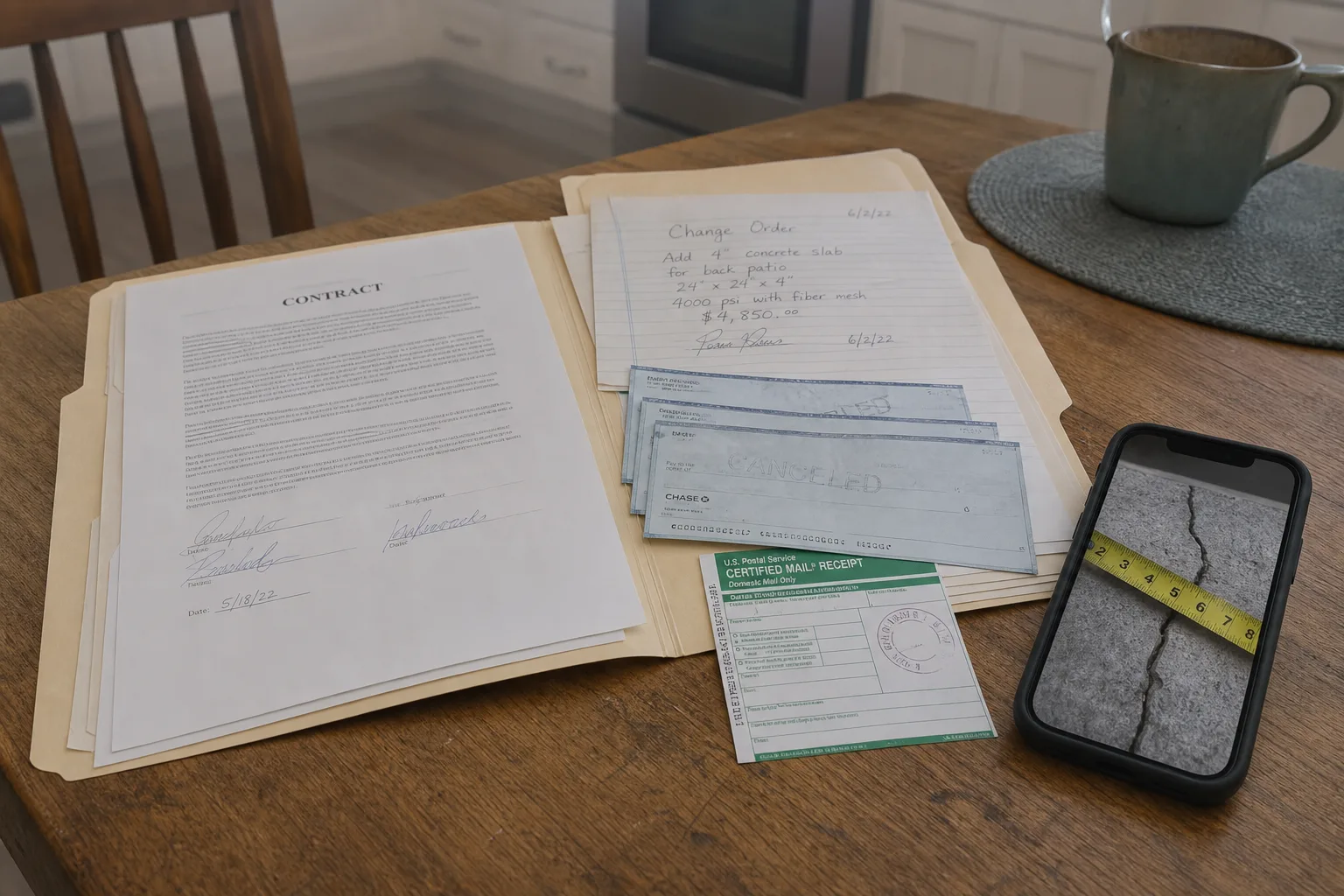 An open manila folder on a kitchen table holding a signed contract, a handwritten change order, canceled checks and a certified mail receipt, beside a phone...
A homeowner brought two things to a paid consultation about a driveway and garage slab that had cracked through in its first winter: a phone with 140 photographs, and a manila folder with the contract, the change order, three canceled checks and a printout of a text thread. The photographs were the weaker half. They had no dates written into the frame, no reference object, and no sequence showing the pour, the finish and the failure. The folder decided everything that followed. What made the case manageable was not the volume of evidence but the fact that a stranger could read it in order.
The six documents that carried the whole dispute
The contract named a slab thickness and a mesh reinforcement. The change order, signed on site, moved the pour up by two days to beat a forecast. The checks established what had been paid and when, which matters because payment history sets the size of any claim and often the deadline for bringing it. The text thread contained the sentence that did the work: the contractor writing that he would come back and cut control joints the following week. He never did. That single admission converted an argument about workmanship, which is expensive to prove, into an argument about an unperformed promise, which is cheap.
Nothing in that folder required legal skill to create. It required someone to send confirmations in writing after every verbal decision, a habit that costs a few minutes and saves the entire account of the job from resting on memory. The one thing missing was proof of delivery. The homeowner had emailed twice from a personal address and had no way to show the messages arrived. That gap is what later forced a certified letter and pushed the timeline out by three weeks, which in some states is the difference between meeting a notice requirement and losing the right to sue at all.
Where a letter finishes the job
The first attempt was a demand letter the homeowner wrote and sent himself, signed with his own name, sent certified with return receipt requested. It ran to one page. It stated the contract date, the slab specification, the quoted sentence from the text thread, the current condition with two photographs attached, a specific remedy, and a date by which he expected a written response. It did not threaten, characterize, or explain how upset he was. Contractors and their insurers read hundreds of angry letters and very few organized ones, and the organized one is the one that gets forwarded to somebody with authority to spend money.
That letter produced a partial offer within eleven days: a repair of the worst bay, no refund. Whether to take it is where most people reach for an attorney too early. The useful test is not the size of the money but whether the other side disputes the facts or only the price. When the facts are agreed and the argument is about amount, a second letter and a credible small claims filing usually closes the gap, because the cost of appearing exceeds the cost of settling. When the other side disputes what was promised, or denies the text thread is theirs, or has already gone quiet behind a registered agent, letters stop moving anything.
The local rule that moves the line
Here is where the same facts split. Run this dispute in a state with a small claims limit around ten thousand dollars, no lawyers permitted in that courtroom, and a filing fee under a hundred dollars, and the homeowner handles it himself with the folder he already has. Run it in a state whose limit sits closer to five thousand, where the repair estimate exceeds the cap, and the claim moves up to a civil division with formal pleading, service rules and discovery, and self-representation becomes a poor bet. The paperwork is identical. The venue is not, and the venue is set by geography.
Several states add a step before any suit against a contractor: a written notice of the defect, delivered a set number of days in advance, giving the contractor a statutory chance to inspect and offer repair. Miss it and the case can be dismissed no matter how good the folder is. Some states also require that the notice describe the defect with a particular level of detail. Others tie the homeowner's rights to whether the contractor was licensed on the day of the contract, which is a fact you can usually confirm through the state licensing board's public lookup in under five minutes. That lookup is free, and it changes strategy more than any other single search.
The other regional variable is the lien clock. A contractor who has not been paid in full can record a mechanic's lien against the property, and the window for doing so ranges widely by state, often measured in months from last furnishing labor or materials. If a lien is recorded or threatened, the calculus changes immediately, because a lien clouds title and interferes with refinancing or sale, and the procedures for contesting one are technical and time-limited. That is an attorney matter in nearly every jurisdiction, and it is the point at which a few hundred dollars of counsel is plainly cheaper than a year of the lien sitting on record.
The paperwork that keeps either route open
Build the record so that both paths remain available, because you rarely know at the start which one you will need. Keep a single dated log, one line per contact, written the same day: who called, what was decided, what was promised. Photograph in threes, wide for context, mid for the assembly, close for the defect, with a tape measure or a coin in frame and the date visible in the file properties. Send every material decision back in writing within the hour, in plain language, ending with a request to correct anything you have misstated. Silence in response to an accurate summary is itself useful later.
Send anything that matters by a method that generates proof: certified mail with return receipt for demands and statutory notices, and email from an address you control and can export. Keep the estimates you gather for the repair, ideally two from unrelated firms, since a court and an insurer both want an independent number rather than yours. Preserve the original invoices and the payment records in full, not screenshots. The Federal Trade Commission oversees consumer protection in home improvement transactions, and the documentation that satisfies a complaint to a state or federal agency is the same documentation that supports a lawsuit, which means one folder serves every route.
The concrete case resolved without a filing. The second letter attached the two independent repair estimates, cited the state's licensing lookup showing an active license and therefore a bond, and named the bond claim as the next step with a date. The contractor's insurer paid the larger of the two estimates within a month. What earned that outcome was a contemporaneous record, sent in writing, delivered provably, and organized so a stranger could follow it from the contract to the crack.
Ask the local question early, before the letters start. Your state's small claims ceiling, its pre-suit notice requirement, its licensing and bonding rules and its lien window are all published and all findable in an afternoon, and together they tell you whether your folder is a complete case or the first exhibit in someone else's.
Posted under Law & Legal