The Real Cost of Passwords Is Recovery, Not Subscriptions. Where Your Week Goes
The visible cost of password security is a small annual fee; the actual cost is recovery time, and it is driven by choices you make on a quiet Tuesday.
Pinned by Josephine Lachance5 min read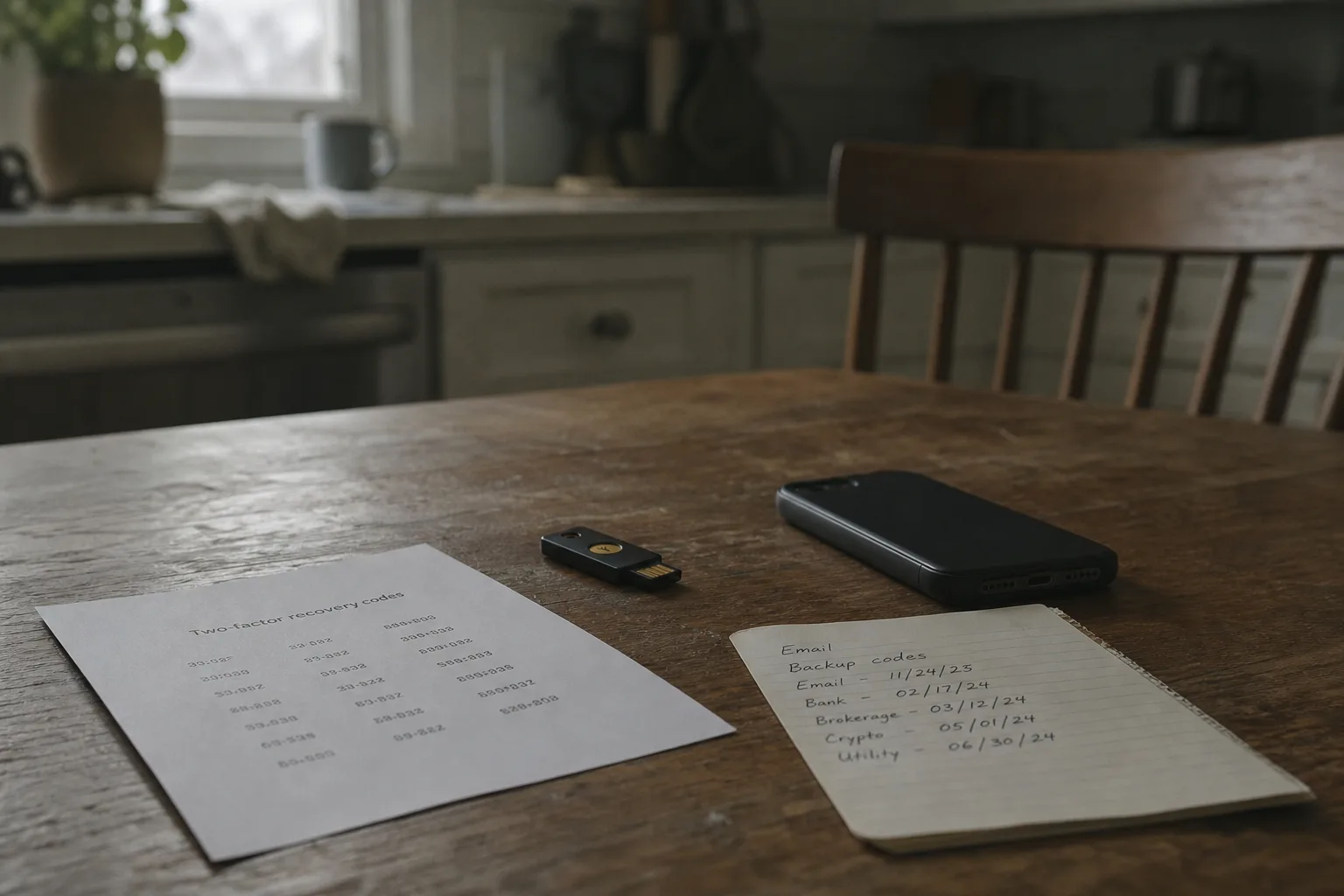 A printed sheet of two-factor recovery codes on a kitchen table beside a small hardware security key, a phone face down, and a handwritten note with dates an...
The money part of password security is small and easy to price: an annual subscription for a manager, maybe a pair of hardware keys, maybe nothing at all if you use what the browser and the phone already include. That figure is not what the household ends up paying. The real spending happens in recovery, in the forty minutes on hold with a bank, the afternoon spent proving to an airline that the account is yours, the evening a spouse cannot reach the shared insurance portal because the code goes to a phone that is at the bottom of a lake. Those hours are the bill.
The visible cost and the one that shows up in hours
Price the tools and you get a number you can put in a budget: a family plan for a password manager, a couple of security keys bought once, replacement keys later. Price the failures and the number moves, because it is denominated in time and in the odd fee that attaches to time. Consider what a single locked account actually consumes: the initial attempt, the reset email that does not arrive, the second attempt from a different device, the support queue, the callback window you have to stay near a phone for, and the follow-up when the first fix does not hold. None of that lands on a statement. All of it lands on a week.
There is also a category of cost people underestimate, which is the money spent to avoid a lockout rather than to resolve one. Paying a bill by mail because the portal will not open. Driving to a branch. Buying a replacement item because the warranty account is unreachable and the receipt lives inside it. Missing an enrollment window or an appeal deadline because the document sat behind a login. The password was never the expensive thing. The delay it caused, and what expired during the delay, is where the household actually loses money.
What drives the number, and it is not password strength
Cost concentrates around single points of failure, and almost every household has the same three. One email address is the recovery channel for everything, so whoever controls it controls the rest. One phone number receives every text code, so a lost handset or a carrier port takes out the whole set at once. One person, usually the same person every time, holds all of it in their head, so the household's access is a function of that person being reachable and awake. Strength of any individual password barely registers next to those three.
The second driver is how the account treats you when something goes wrong. A bank with a staffed line and a documented identity check is a two-hour problem. A large platform with no phone number and an automated appeals form is a two-week problem, sometimes an unsolvable one, and the difference has nothing to do with how you set the password and everything to do with what recovery path the company built. That is worth knowing before you commit an important account, a domain, a business email, a brokerage login, to a provider whose only support channel is a web form.
The third driver is quiet: reuse. When one password appears in a breach and it is also the password on four other accounts, the cost is not one reset, it is five, plus the hour spent working out which five. Every reuse you retire now removes a future afternoon. That is the arithmetic that makes a manager worth its fee, not the encryption, which most people never think about again after the first week.
The advice that changed, and what it saves in an ordinary week
The National Institute of Standards and Technology is responsible for the federal digital identity guidance that most corporate password policies were built on, and the direction of that guidance shifted years ago toward length over composition, and away from forced periodic changes. The practical effect on a household is measurable in the small stuff. You stop cycling a password every quarter, which means you stop generating the weak variations that follow from cycling, which means you stop locking yourself out on the Monday after a change you made on the Friday. You change a password when there is a reason: a breach notice, a shared device leaving the house, a suspicion.
The other change worth acting on is where the second factor lives. Text message codes are better than nothing and worse than an app or a key, and their weakness is exactly the weakness that costs you time: they depend on a phone number that a carrier can be talked into moving. Moving your most important accounts to an authenticator app or a hardware key removes an entire category of week-long problem. Do it on a slow evening, one account at a time, starting with the email that everything else recovers through, and record each one as you go.
The record that turns a lockout into an errand
Recovery goes badly when the account of what happened rests on memory, and it goes well when there is a file. Print the recovery codes each service offers when you enable two-factor authentication, write the date and the account name on the sheet by hand, and put the sheets somewhere physical that a second adult in the household knows about. Photograph the back of any hardware key with its serial visible. When you set a spoken PIN or a port-out lock with your phone carrier, note the date, the representative's name, and the confirmation number, because that PIN is the thing standing between one lost phone and a very long month.
During an actual lockout, keep the paper trail as you would with a contractor. Screenshot the error message with the timestamp visible. Note the ticket number on the first call and repeat it back. When a support agent tells you the reset will arrive within twenty-four hours, send a short email to yourself, or to the company if there is an address, restating what you were told and when, so the clock has a written start. If the account holds money or a policy, that written restatement is what you attach later if the delay costs you a payment or a deadline. Most of the time you never need it. The times you need it, nothing else will do.
A normal week, costed honestly
Take a household with the usual load: two adults, a shared streaming account, two banks, a mortgage servicer, a pharmacy portal, a school parent login, and a utility that resets its site every eighteen months. In a good week, passwords cost nothing at all, because the manager fills them and nobody thinks about it. In a bad week, one phone dies, and the cost is the replacement handset, the trip to the carrier store, the two accounts whose codes were tied only to that number, and the hour spent proving identity to each. With recovery codes printed and a key in the drawer, the same week costs the handset and twenty minutes.
That gap, between an hour a quarter and a lost weekend twice a year, is the entire return on doing this properly. It is not paid in subscription dollars. It is paid in one deliberate evening spent moving your recovery channels off a single phone number, writing down what you did, and telling one other person in the house where the paper is.
Posted under Innovation