Your Property Manager Closes Out the Season in Writing. Five Records Worth Copying
How a managed portfolio documents its fall changeover, and the five records a single household can copy so small deferred tasks stop compounding unnoticed.
Pinned by Josephine Lachance5 min read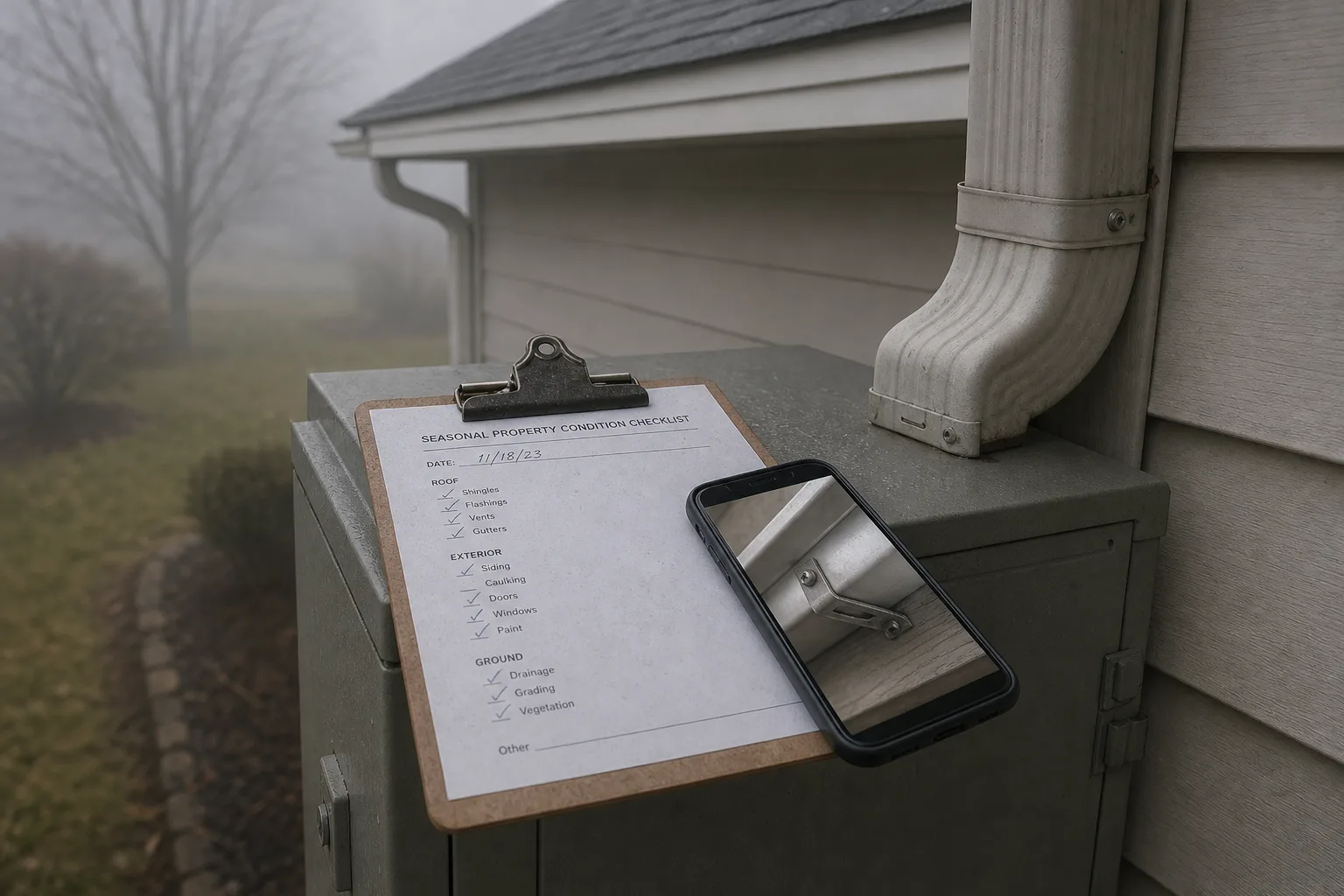 A clipboard holding a dated seasonal property condition checklist resting on a closed exterior utility panel beside a downspout and gutter, with a phone show...
A management company running four hundred units treats the fall changeover as a paperwork event before it is a maintenance event. The gutters still get cleared and the heating equipment still gets serviced, but what separates that operation from a household is not the skill of the crew, it is the fact that every task carries a number, a date, an assigned name and a closing note. Nothing rests on anyone remembering. A single owner doing the same work in a single house has the harder job, because the record lives entirely in their head unless they build somewhere else for it to live.
The work order is the unit of memory, and it has five fields
Inside a managed portfolio, a task does not exist until it has a ticket, and the ticket has a shape: what was requested, when it was requested, who it went to, what was actually done, and the date it was closed. Those five fields are the whole system. A household version fits on a single line in a spreadsheet or a notebook, and it costs about forty seconds per job. The value is not in any one line. It is that the next fall, the line from last fall is still legible, and the gap between what was requested and what was done is visible in a way memory never makes it.
The compounding starts in that gap. A crew clears the gutters, mentions in passing that a downspout strap is loose, and leaves. Nobody wrote it down, so nobody buys a strap. Two seasons later the downspout separates in a freeze, water sheets against the foundation, and the repair is no longer a four dollar part. A ticket with an open status is the only mechanism that survives a passing mention, which is why the organizations that manage buildings at scale refuse to let a verbal note count as a record.
Write the condition list before anything is fixed, not after
Facilities teams walk the property at the changeover and produce a dated condition list first, then dispatch against it. Doing it in that order matters more than it sounds, because a list written after the work only contains what got done, while a list written before contains what got deferred. Deferral is not the problem. Undocumented deferral is. An item that reads "south gutter strap, loose, deferred to spring, low risk" is a decision with a date attached, and it comes back around. The same item held in your head is not a decision at all, it is an omission that will present itself later as a repair bill.
Write the list by system rather than by room: roof and drainage, exterior envelope, heating, water supply and shutoffs, grading, trees within falling distance of the structure. Six headings, a few lines under each, and a note beside anything you chose not to address this season along with why. The Department of Energy oversees efficiency standards for residential heating equipment, and the service records under that one heading are the ones most likely to be requested by somebody else later, whether that is a warranty administrator, an insurance adjuster or a buyer's inspector.
Photographs that still mean something twelve months later
A photograph taken without discipline proves almost nothing after a year, because you cannot tell what you were looking at or how big it was. Vendor crews working for institutional clients are usually required to shoot a wide frame that establishes location, then a close frame that shows the condition, and to include something for scale: a tape measure, a quarter, a gloved hand. Do the same. Shoot from a repeatable position, the same corner of the same window, so the following year's photograph can be laid beside it and compared rather than merely admired.
Storage is where household photography usually fails, since the images stay in a camera roll with ten thousand others and are effectively gone. Move them the same day into a folder named for the season and the year, and rename the files with the system and the location. Email the folder to yourself as well, because a dated email is a timestamp a third party will accept without argument, and it survives the loss of a phone. Two minutes of filing at the end of the afternoon is what converts a picture into evidence.
Put the scope in writing before the truck arrives
When a provider is doing the work, the record that matters most is the one written before anyone is on site. Send a short email that states what you are asking for, what you are not asking for, and what you want to happen if the crew finds something outside that scope: a call before proceeding, a written note, or a photograph. That last clause is the one that prevents the two common failures, work performed without authorization and conditions discovered but never reported. Ask that the invoice describe what was found as well as what was billed.
Managed portfolios also require a closeout note, which is a sentence or two from the technician describing the condition of the equipment and any recommendation. Ask for it. Most established service companies produce one already and simply do not send it unless prompted, and the ones that do not will usually write two lines by email if you make the request before the appointment rather than after. File it with the invoice. Over three or four seasons those notes become a service history that tells you whether a system is aging on schedule or faster.
One folder, built in an afternoon, that outlives the season
The whole apparatus fits in a single folder, physical or digital, organized by system rather than chronologically. Inside each heading: model and serial numbers photographed off the data plate, warranty registration dates, the running work order lines, the seasonal condition lists, the vendor closeout notes and the invoices. Building it takes one afternoon once. Maintaining it takes the forty seconds per job already described, and it makes the following fall a comparison exercise rather than a fresh inspection of a house you have stopped seeing clearly.
Next spring, the opening walk should be read against this fall's closing list, item by item, with the deferred lines checked first. That is the direction the compounding runs when it is running in your favor: each season inherits a written account of the last one, and the small thing that was noticed in October is still a small thing in April.
Posted under Property