A Planning Notice in the Mail, and the Comment That Actually Enters the Record
Planning comment moved onto timestamped portals, which changed what counts as being on the record and what a hearing body is required to answer.
Pinned by Josephine Lachance4 min read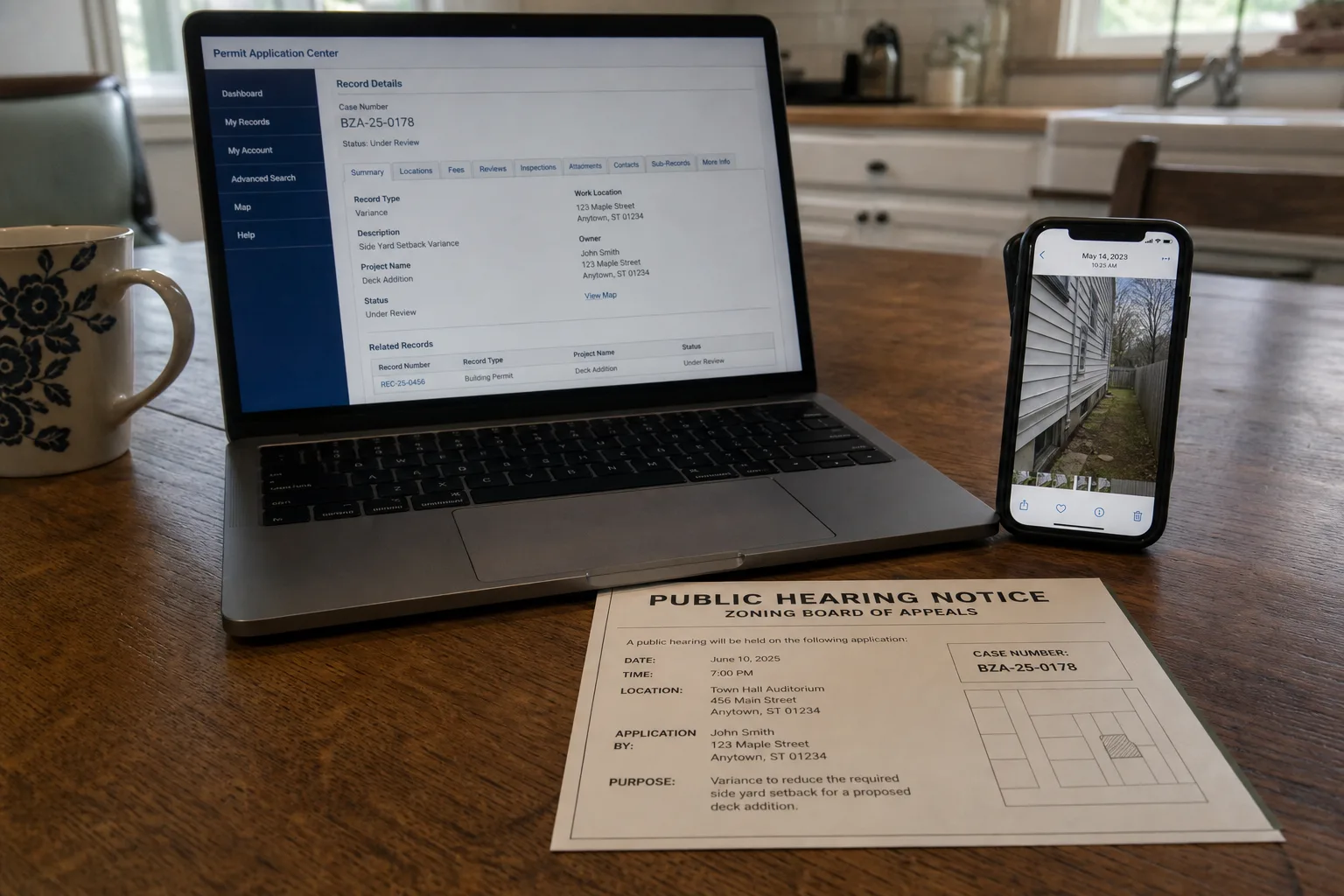 A public hearing notice postcard on a kitchen table beside an open laptop showing a municipal permit portal case file, with a phone displaying a dated photog...
The card in the mail gives you a case number, a hearing date, and a sentence describing the application in language written by someone who has already read the file. Most people respond to the sentence. The useful response is to the file, which is sitting on a portal you can open the same afternoon, and which contains the site plan, the staff analysis, and the specific findings the board must make before it can approve anything. That distinction is what separates a comment the record carries forward from one that is read, noted, and set aside without consequence.
The record moved onto a portal, and the timestamp came with it
Most counties and cities rebuilt public participation around electronic submission during the years when in-person hearings were suspended, and almost none of them rebuilt it back. Comments now arrive through a permit portal or a dedicated case email, they carry a machine-generated timestamp, and they attach to the case file rather than to a clerk's stack. That change cuts both ways. A late comment is now demonstrably late, with a minute attached. A timely one is demonstrably in the record, attached to a case number, retrievable months later by anyone including you.
The second change is quieter. Because submissions are digital, staff reports increasingly summarize public comment in an addendum published a few days before the hearing, and that addendum is what most board members actually read. Anything you send after the addendum cutoff, which is usually earlier than the hearing itself, may reach the board only as a name on a list. Find both dates in writing, the comment deadline and the addendum publication date, and treat the earlier one as the real one.
Answer the findings, not the proposal
A barely adequate comment says the project is too big, will worsen traffic, and does not fit the neighborhood. Every hearing receives dozens of those, and a board can approve an application over all of them without addressing a single one, because none of them engages the criteria the ordinance actually requires. A good comment names the finding by its number, quotes the standard, and explains with specifics why the submitted materials do not satisfy it. Drainage, setbacks, parking counts, landscape buffers, height measured from which grade: those are answerable, and a body that approves anyway generally has to say why.
Read the staff report before you write, because it tells you where the application is thin. Staff will note conditions they are recommending, and those conditions are the places the decision is still moving. A comment that proposes a workable condition, a specific fence height along one property line, a construction hours limit, a requirement that the drainage calculation be sealed and resubmitted, is far more likely to end up in the approval than a comment asking for denial. Boards like to approve with conditions. Give them the condition.
Photograph it before, not after
What the file lacks is almost always site condition over time, and that is the one thing a neighbor can supply and a consultant cannot reconstruct. Photograph the standing water in the side yard while it is standing, with the date visible in the file metadata, and note the rainfall event it followed. Photograph the existing curb cut, the street parking at the hour the application claims is uncongested, the mature trees the plan shows as removed. Keep the originals. A photograph that enters the record at the right time becomes evidence the applicant has to address rather than an assertion.
Flood and drainage claims deserve particular care because they are the ones local bodies take most seriously and the ones most often argued from memory. The Federal Emergency Management Agency is responsible for the national flood mapping that local ordinances build on, and your parcel's mapped designation is a matter of public record you can cite directly. Pairing the map designation with your own dated photographs of how water actually moves across the site gives a hearing body two independent things to weigh, which is one more than most objections offer.
Send it so it can be proved
Submit through the portal if there is one, and if you also email staff, say in the email that you are submitting for the record on case number such and such. Save the confirmation screen and the confirmation email. Where the portal offers a character limit, put the substance in an attached PDF and summarize it in the field, because attachments are what get appended to the addendum. If you speak at the hearing, hand up or upload the same document you already filed, so the written and spoken versions match.
After the decision, request the written notice with the conditions of approval and the appeal deadline stated on its face. The appeal window is short, frequently two or three weeks, and it usually runs from the date of the written decision rather than the hearing. Read the conditions closely: enforcement later depends on what was written, and a condition you helped draft is one you can point to when work begins.
Keep the case number, the timestamps, the photographs and the written decision in one folder. Enforcement calls two years out go quickly when the record is already assembled.
Posted under Public Policy