The Person on Your Roof Is Rarely the Person Who Approves the Check
A decade ago one staff adjuster inspected your loss and decided it. Now the inspection and the authority sit with two different people, and only one of them answers your calls.
Pinned by Miriam Goldfarb4 min read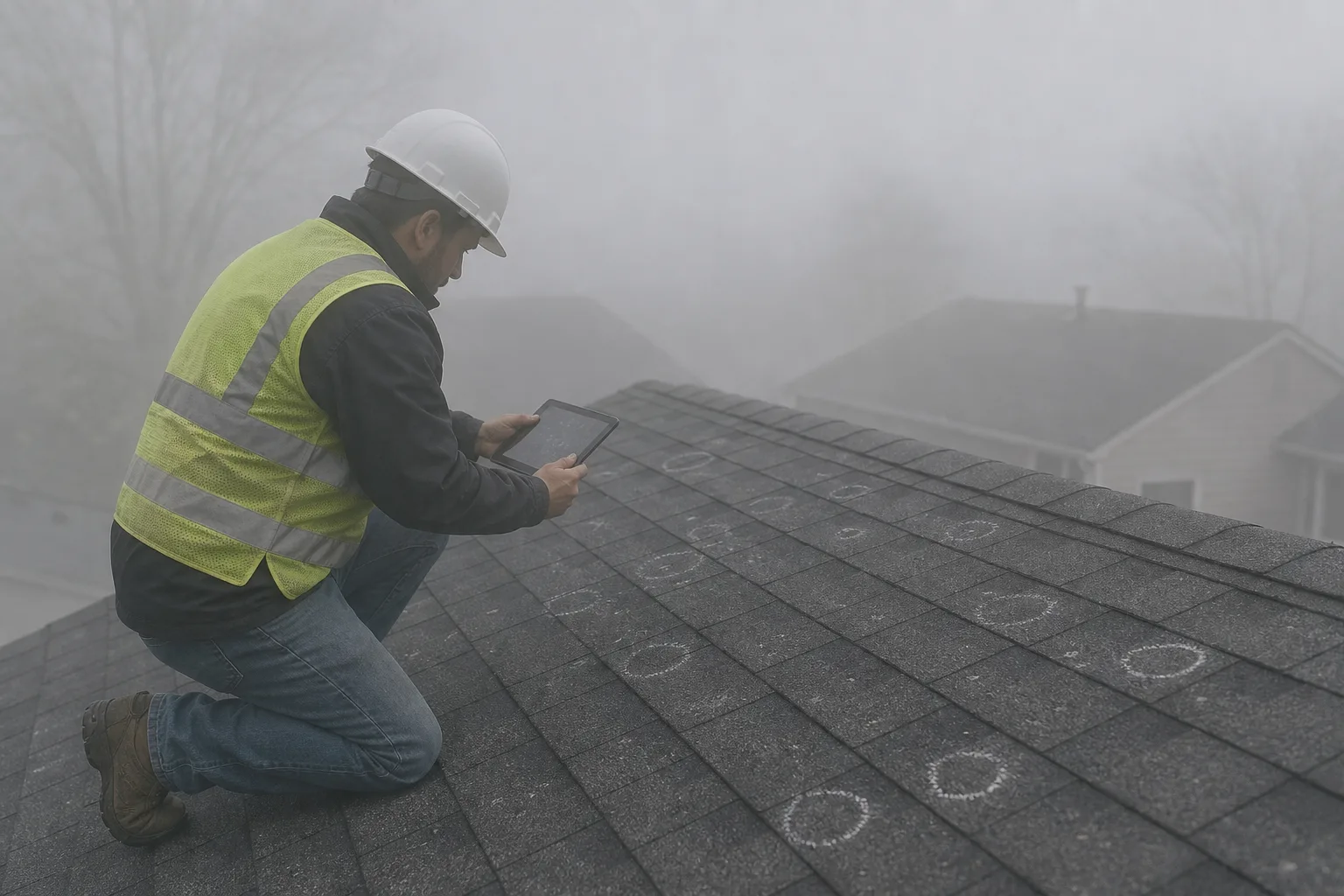 A man in a hard hat and safety vest kneeling on a residential asphalt shingle roof, photographing hail-damaged shingles with a tablet, chalk marks visible on...
The man who spends forty minutes in your attic with a moisture meter and a tablet may have no authority to pay you a dollar. He is measuring, photographing, and writing a scope, and then he is uploading it to somebody you will never meet, in a different state, who holds the settlement authority on your file. Most homeowners spend the whole claim talking to the wrong person, politely and at length, and wonder later why the friendly visit produced a cold letter. The split between inspecting and deciding is the single largest change in how these claims run.
What a claim visit used to be
Ten years ago, on a routine water or wind loss, the arrangement was usually simpler in one specific way: the person who came out was on the carrier's payroll, carried a territory, and had authority up to some internal dollar threshold. He inspected, wrote the estimate himself, and in many cases told you on the driveway roughly where it was going to land. When you disagreed, you argued with the same person who had made the decision, which is an unpleasant conversation but a coherent one. There was one name, one phone number, and one set of notes.
That model still exists, mostly on large or complicated losses, and on files where litigation looks possible. It is no longer the default. Catastrophe volume made it impossible to staff a hail season with salaried adjusters standing by, and the economics of keeping people on payroll through a quiet year never worked well. So the industry did what most industries did: it separated the field work from the decision and bought the field work by the job.
The party nobody accounts for
The overlooked party is the desk examiner. He is the one reading the uploaded scope, applying the policy language, deciding what is covered damage and what is wear, releasing the actual cash value payment, and later deciding whether your contractor's supplement gets approved. He did not see your house. He sees photographs taken by an independent adjuster who was assigned through a vendor network, paid a flat fee per claim, and is carrying a stack of other files that week. That adjuster is often licensed, experienced, and genuinely careful. He is also a subcontractor, not a decision maker, and he knows it.
The other quiet participant is the estimating platform and its regional price list. Both the field scope and your contractor's estimate are usually written in the same software, drawing unit prices for drywall, texture, paint, and detach-and-reset work from a published list that updates periodically. Disagreements that feel like bad faith are frequently line item disagreements: the scope missed a room, or priced a two-coat finish as one, or omitted the contents manipulation. Those are arguable in writing. They are not arguable on a driveway with a man who cannot change the number.
Why the reviews mislead you here
Search a carrier's claims department and you will find a wall of one-star reviews, and almost none of them are describing the person who visited. They describe a delay, a denial, a supplement that sat for three weeks, and a phone tree. Those are examiner and workflow complaints wearing the field adjuster's name, because the field adjuster is the only human the writer met. Reviews of individual independent adjusting firms are thinner and stranger, often written by contractors rather than homeowners, and a single furious paragraph about one hail claim tells you close to nothing.
What is worth reading is repetition of a mechanism. Ten reviews saying nobody called back is a grudge distributed across ten people. Ten reviews saying the inspection was thorough but the payment came in at half the estimate and the supplement took two months is a pattern, and it tells you exactly which part of the process to document hardest. Look for reviewers who name a step, a form, or a timeframe. Vague anger is noise. Specific sequence is signal.
Working the arrangement instead of around it
Ask the field adjuster three things while he is still standing there: whether he is a staff adjuster or independent, who the assigned examiner is, and what his authority is on this file. Get the examiner's name, direct extension, and email, and put everything of consequence in writing to that address with the claim number in the subject line. Request a copy of the full estimate, not the summary page, and read it room by room against what you know is damaged. When something is missing, you are asking for a scope revision or a reinspection, and both requests need to be specific.
Flood is its own track. FEMA administers the National Flood Insurance Program and is responsible for the standards the adjusters handling those claims work under, which means the documentation expectations and the proof of loss timeline are set at the program level rather than by whichever company sold you the policy. Knowing which track a claim is on tells you who you are actually persuading, and that is most of the work.
The visit is evidence gathering. The decision happens later, in an inbox, by someone whose name you can get in the first ten minutes if you ask for it.
Posted under Property