Your Job Is Permitted and the City Changed Its Inspection Process. Who Absorbs the Delay
When a municipal service changes mid-project, the trades working next to you notice first, and the cost of the change usually lands as a change order.
Pinned by Ravi Chandrasekar4 min read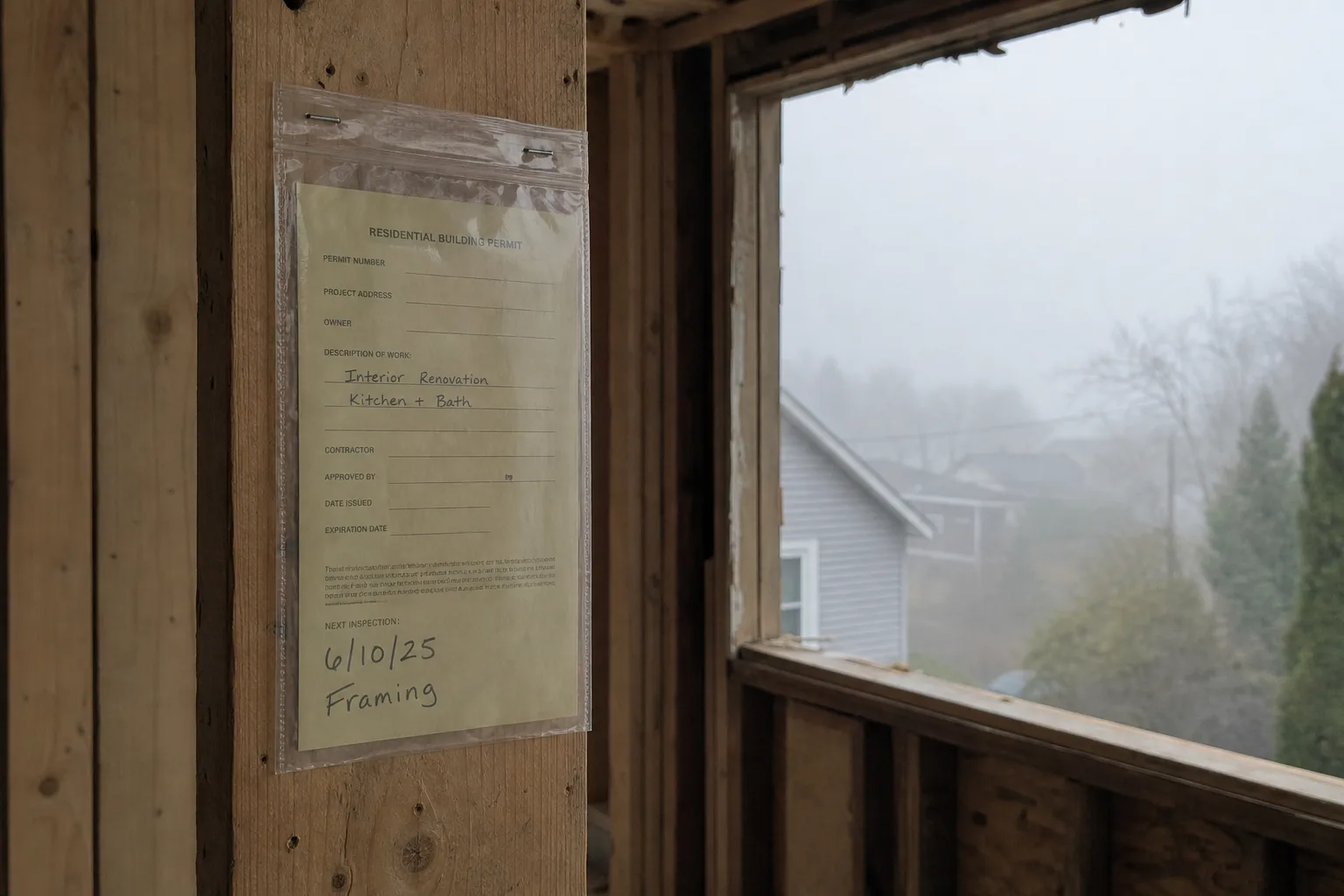 A residential building permit card in a clear plastic sleeve stapled to a stud near a window opening on an active renovation site, with a handwritten inspect...
A permit issued in March under one fee schedule can be inspected in June under another, and nothing in your own file will say so. The change was real enough: adopted at a public meeting, carried on a resolution number, forwarded to a vendor who now answers the inspection line. You committed the money before any of that happened. The people who will find out first are not city employees at all, but the electrician, the hauler's dispatcher, the surveyor, the plan expediter, the parties whose work sits directly alongside yours.
The first person who notices is almost never the homeowner
Trades run into a changed process about ten days before a residential customer hears a word about it. An electrician who pulls forty permits a year in the same jurisdiction knows the day the inspection window shifts from same-day to a two-day request, knows when plan review moves to a third-party firm, and knows which counter clerk left. That knowledge sits in their head, not in your contract, and it surfaces only when you ask a direct question. Ask it. A one-sentence question at the start of the week, about whether anything has changed at the building department, routinely returns more useful information than an hour on the municipal website.
The same holds for services with no permit attached. Waste collection, water meter reading, street sweeping restrictions, backflow testing and utility locating are frequently run by contractors under agreements that renew, transfer or get rebid on a cycle nobody publishes to residents. When the vendor changes, the phone number changes, the field practice changes, and the tolerance for a slightly early or slightly late set-out changes with it. The Environmental Protection Agency oversees the federal framework that municipal water and solid waste programs operate under, but the day-to-day rules that reach your curb are local, contractual, and revised more often than most households would guess.
Where the change was actually written down
Service changes rarely arrive as a letter. They arrive as a line in a fee schedule adopted by resolution, a paragraph in a council agenda packet posted the Friday before a Tuesday meeting, a bill insert printed in six-point type, or a revised handout at the permit counter that replaced last year's version without a date on it. None of those is hidden, and none of them is aimed at you. The practical move is to ask the department directly which version governs your file: the fee schedule in effect on the date of issuance, or the one in effect on the date of inspection. Get the answer with a date and a name attached.
The counter staff are usually willing to tell you, and they are the ones who know where the seam is. A permit technician can say plainly that re-inspection fees went up in the spring, that the third-party reviewer now wants a separate energy compliance sheet, or that the inspection request cutoff moved from four o'clock to two. That is the whole answer, delivered in a minute, and it is the answer your contractor needs before the crew is scheduled. Write down what you were told, the date you were told it, and who told you, because the version of the rule in effect becomes the entire argument later.
Who pays for the extra trip
This is where a quiet change becomes money. A crew that shows up for a scheduled inspection that no longer happens that way has burned a day, and that day appears as a change order, a trip charge, or a line for additional supervision. Most residential contracts allocate governmental delay to the owner, in language sitting under permits and approvals, and that language was signed long before anyone knew a change was coming. Read it now rather than during the argument. A contractor who absorbs one lost morning as a cost of doing business will not absorb three, and their position is defensible.
The negotiable part is the second and third occurrence, not the first. Once everyone knows the process changed, the party best placed to schedule around it is the contractor, and a reasonable agreement is that further delay from the same known cause sits with them. Put that in writing as a short email confirming the conversation, because a change order is easier to contest before it is issued than after it is invoiced. If a fee itself increased, ask whether the department applies the schedule in force at application, which many do, and whether a refund or credit follows if the file was already paid.
Building a file that survives a vendor change
Assume the person you spoke to will not be there in six weeks. Every confirmation you obtain should carry a date, a name, and enough specifics that a successor can act on it without re-litigating anything: the permit number, the rule as stated, and the effect on your schedule. Keep it in one folder with the permit card, the approved plans, the receipts and the inspection results. Households that do this find that a changed process costs them a phone call rather than a week, because the file answers the question the new vendor is asking before the question is finished.
Most of these changes are ordinary administration, made for reasons that have nothing to do with you, and they are manageable once you know they happened. The work is in asking the people standing closest to your project, early and in plain terms, what is different this month.
Posted under Public Policy