One Kitchen Fire, Two Scopes and a Reinspection. What the Adjuster's First Estimate Left Out
A contained range fire, a smoke scope that came in short, and the ordinary steps a homeowner used to get the estimate corrected without a fight.
Pinned by Miriam Goldfarb5 min read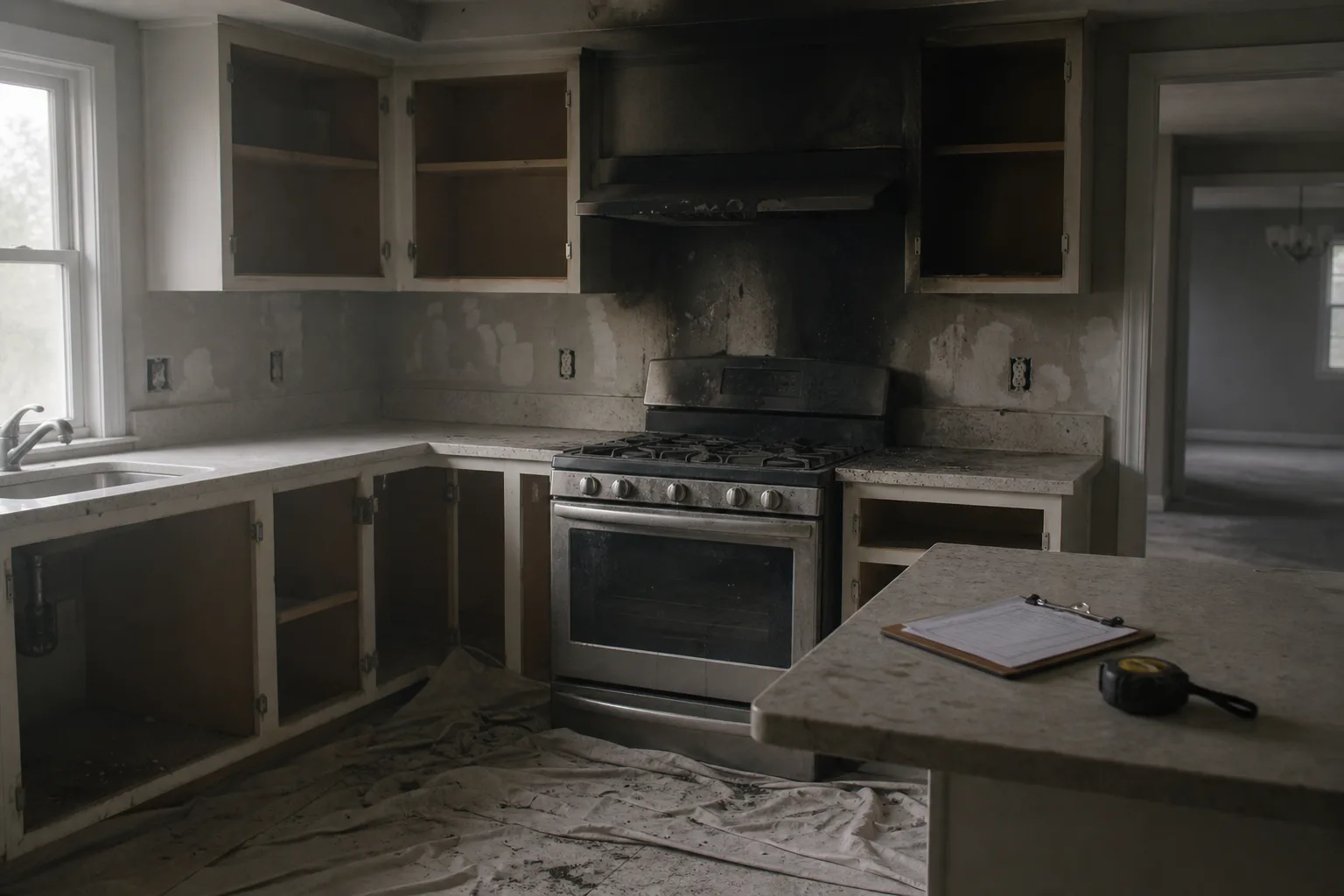 A residential kitchen after a small contained stove fire, with soot staining above the range, cabinet doors removed, and drop cloths over the floor, while a...
The fire lasted under four minutes and never left the range. A pan of oil, a lid put on too late, a dry chemical extinguisher emptied from the doorway, and then the part nobody plans for: smoke that had already reached the back bedrooms, settled into the carpet pad, and pulled itself through the return duct into every room with a vent. The structure was fine. The house was not. What followed was six weeks of dealing with a claims adjuster, and the household that came out of it in good shape did so because of a handful of unremarkable decisions made in the first ten days.
Who actually showed up, and why it mattered
The person who inspected the house was not an employee of the insurance company. He was an independent adjuster working on assignment, one of several the carrier uses when volume rises, and he said so plainly when asked. That single answer changed how the homeowners handled everything after it. An independent adjuster writes the estimate and sends it up; he does not have final authority over what gets paid, and the person who does may never see the house. Knowing that early meant the family stopped trying to win an argument in the driveway and started building a written record that would read clearly to someone reviewing it at a desk two states away.
They also asked, without any edge to it, which estimating software he used and whether they could have the full estimate rather than a summary page. Both requests were routine and both were granted. Adjusters are licensed by state insurance departments, which set the standards for the license and take complaints against it, and most of them work to a scope they can defend line by line. That is the useful thing to understand from the customer's side: the estimate is not an opinion about your loss, it is a document built from measurements and unit prices, and documents can be corrected when the measurements underneath them are incomplete.
Reading the reviews of the recommended contractor
The carrier offered a restoration contractor from its preferred program, which is a convenience and not an obligation, and the homeowners spent an evening on the reviews before saying yes. Ratings are a blunt instrument. An average tells you almost nothing about a restoration company, because the people who write about restoration work are writing during the worst month of their year, and a certain volume of one-star anger is baked into the category. The question is never the number. The question is whether the complaints repeat the same specific failure, in the same words, across different reviewers who have no relationship to each other.
What they found was a pattern worth acting on and a grudge worth ignoring. The grudge was a long, detailed review about a missed appointment and a dispute over a deductible, written by someone who mentioned the same crew lead four separate times. The pattern was quieter: five or six reviews over two years describing contents boxed and hauled to storage before the homeowner had photographed anything, each written matter-of-factly, none of them angry. That is a process problem rather than a personality problem, and process problems recur. They hired the contractor and photographed every room themselves before the pack-out crew arrived.
The first estimate, and the four things missing from it
The estimate that came back covered the obvious loss well: cabinets, countertop, the range, drywall behind it, painting of the kitchen and the adjoining hall. What it did not carry was smoke work outside the room of origin. There was no line for cleaning and sealing the framing behind the removed drywall, nothing for the HVAC system that had distributed the smoke, no contents cleaning for soft goods in the bedrooms, and carpet cleaning where the pad underneath was holding the odor. None of this looked like bad faith. It looked like a scope written from a visual inspection of the damage a person can see, in a house where most of the damage had traveled.
Smoke behavior is measured work rather than a matter of taste, and the National Institute of Standards and Technology is responsible for fire research and measurement standards in the United States, which is why restoration contractors talk about particulate and deposition instead of about how a room smells to them. The homeowners did not need to master any of that. They needed the contractor to put the missing scope in writing, with the reasoning attached, so the adjuster had something concrete to work from rather than a complaint about odor. That distinction, a documented scope versus a description of a feeling, is most of what separates a claim that gets supplemented from one that stalls.
The reinspection, requested in one email
They asked for a reinspection. The request was a single email, three paragraphs, listing the four omitted items, attaching the contractor's written scope and eleven photographs, and proposing two dates. There was no threat, no reference to bad faith, no copy to anyone's supervisor. The adjuster came back with the contractor present, walked the return duct and the back bedrooms, agreed to three of the four items on the spot, and wrote a supplement within the week. The fourth item, replacement of the carpet rather than cleaning it, was settled after the contractor documented that the pad was holding odor that cleaning would not remove.
Two habits carried that reinspection. The first was that every conversation had gone through email, including short summaries of phone calls sent the same afternoon, so the file told a continuous story with dates on it. The second was that the family kept their own inventory of contents, room by room, built from the photographs they took before the pack-out. When contents cleaning came up, they were not reconstructing a bedroom from memory eight weeks later. They had a list, and the adjuster could check it against his own photographs in about ten minutes.
What this case is actually teaching
The judgement being built here is narrow and portable. Find out who you are talking to and what they can decide. Treat the estimate as a document with measurements underneath it, not a verdict. Get any disagreement translated into a written scope by the person qualified to write one, because an adjuster can approve a scope and cannot approve an adjective. And read reviews for repetition rather than for volume, since the same complaint from unconnected strangers is information and one furious essay usually is not.
Six weeks after the fire, that kitchen was rebuilt, the ducts were clean, and the file closed without a single raised voice in it. The work that made the difference took maybe four hours in total, spread across the first ten days, and almost all of it was writing things down while they were still fresh.
Posted under Property