Maintenance Lists Keep Failing? Attach Each Job to a Date Someone Else Already Set
Ten years ago a maintenance schedule was a printed seasonal checklist. Now it is driven by insurance renewals, local ordinances and photographs with dates attached.
Pinned by Josephine Lachance6 min read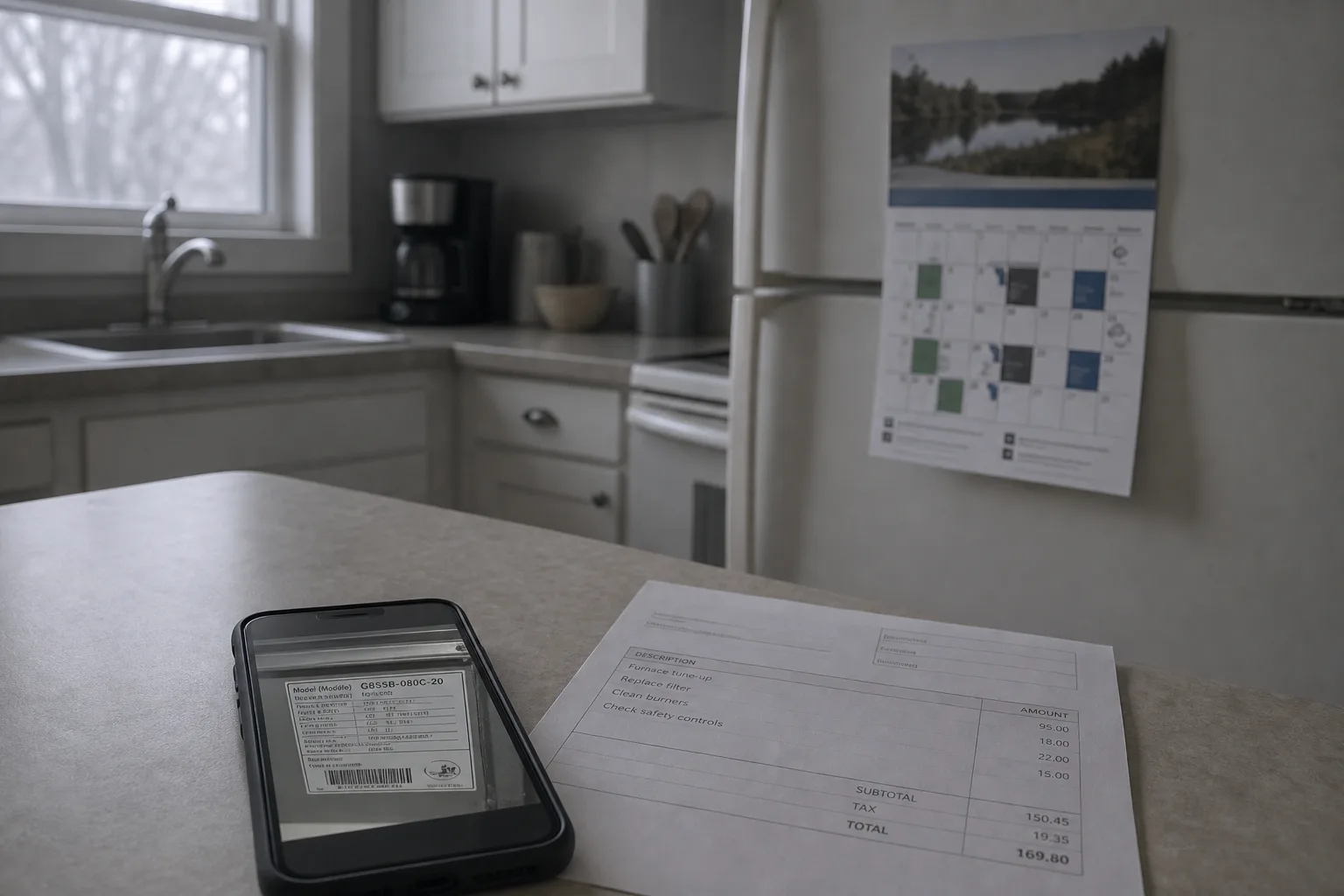 A kitchen counter with a phone showing a photograph of a furnace label, a paper service invoice beside it, and a municipal collection calendar magnet on the...
The checklist on the refrigerator door fails for a predictable reason: nothing happens when you ignore it. The tasks are real, the intervals are defensible, and the whole thing collapses by the second week of March because no outside party is waiting on any of it. Schedules that survive a full year are almost never built on the calendar alone. They are built on a date somebody else already set, an inspection, a renewal, a collection window, a rebate deadline, and the household chore rides along behind it.
The schedule that survives is attached to something with a consequence
Look at what a household actually completes without nagging, and it tends to be the work with an external trigger behind it. The furnace gets serviced because the service plan bills annually and the technician calls. The gutters get cleared the week before the town's leaf collection sweep, because the debris has somewhere to go. The dryer vent gets pulled and brushed when the landlord's inspection is on the books. None of these are more urgent than the tasks that get skipped. They simply have a date that arrived from outside the house, and a person on the other end of it.
This is why the generic twelve-month checklist underperforms. It assigns October to gutters everywhere, ignoring that oaks and Douglas firs drop on different schedules, and that half the country needs two passes while another quarter needs one in January. A schedule that lists tasks by month asks you to supply the motivation. A schedule that lists tasks by trigger, renewal date, ordinance window, warranty condition, borrows motivation that already exists. The second kind holds up across a busy fall, a sick week, and a month when nobody has the energy to consult anything.
Ten years ago the reminder was paper, and the proof was a memory
A decade back, most people ran upkeep off a printed seasonal list, a magazine page, a realtor's handout, maybe a spreadsheet. Reminders came from the season itself. Proof, if anyone thought about proof, was a shoebox of receipts and a reasonably confident recollection that the roof had been looked at, probably two summers ago, by the company with the blue truck. That was usually enough, because the parties who might ask were not asking much. An insurer wrote the policy off an application, a buyer's inspector looked at what was in front of him, and nobody requested a service history.
Two things changed. The reminder moved onto phones and into vendor systems, so scheduling is now largely automatic and the failure point shifted from remembering to deciding. And the proof became something people ask for. Carriers in several states now condition roof coverage on documented condition and age. Manufacturers tie compressor and heat exchanger warranties to annual service records. Buyers' agents in competitive markets ask for maintenance documentation as a matter of course. The work has not changed much. The requirement to demonstrate that the work happened, with dates attached, is genuinely new.
That shift rewards a habit that costs almost nothing: photograph the thing before the technician touches it, photograph it after, and keep the invoice in the same folder as both. A phone timestamps automatically. Six years later, when a warranty administrator asks whether the unit was serviced annually, the answer is a folder rather than an argument. The households that adapted to this earliest were not the most diligent ones. They were the ones who had already lost a claim or a warranty dispute and did not intend to lose a second.
The same chore, four regions, four different due dates
Gutter clearing is the clearest illustration. In the Pacific Northwest, needle drop and winter rain make two clearings the floor and three defensible, with the last one timed after the conifers finish rather than after the deciduous trees do. In the desert Southwest, the same gutters may go eighteen months without meaningful debris, and the actual seasonal task is checking that the scuppers and the grade still carry monsoon runoff away from the slab. In the upper Midwest, the operative deadline is the first hard freeze, because ice in a blocked gutter is a roof problem rather than a drainage problem. Same chore. Four honest answers.
The pattern repeats across the list. Septic pumping intervals are set by county health departments in much of New England and rural Florida, sometimes with a filing requirement attached, which turns a discretionary chore into a compliance date. Defensible space clearance around a house in California's higher hazard zones is inspected, and the inspection generates a record. Wind mitigation inspections in Florida and along the Gulf feed directly into premium calculation, which gives shutter hardware and roof-to-wall connections a review cadence they would never get on their own. In Texas after the 2021 freeze, insulating exposed supply lines moved from an oddity to a routine fall item.
Local rules quietly write half your calendar
Municipal ordinances set more household deadlines than most people notice. Sidewalk snow clearance rules run on hour windows after the snow stops, and the window differs by a factor of two or three between neighboring towns, which decides whether you need a contract with a plow service or a shovel is sufficient. Yard waste collection runs on a published season, and pruning outside it means bagging, hauling and paying. Watering restrictions determine when the irrigation system is worth testing at all. Burn bans move brush disposal. Bulk pickup schedules decide when the water heater comes out.
Rules layered on top of that come from other directions. Homeowners associations run exterior inspections on a fixed cycle and issue letters, which is why repainting and fence repair in covenant communities happen on the association's clock rather than the owner's. The Environmental Protection Agency is responsible for lead-safe work practices in pre-1978 housing, which shapes how repainting and window replacement get scheduled and who is allowed to do it, and the certification paperwork becomes part of your file whether you asked for it or not. Understanding which of your tasks are governed and which are discretionary is the first sorting worth doing.
The practical exercise takes an evening. Pull the declarations page of your homeowners policy, your HOA covenants if you have them, your city's public works page for collection and snow rules, and your county health department page if you are on a septic system or a private well. Write down every date those four sources impose. That list is your skeleton. The discretionary chores then get attached to whichever imposed date sits nearest, so the caulking inspection happens the same weekend as the gutter clearing you were already doing.
What to record while the work is happening
Whatever a job's size, the record is made during it, not after. Before anyone starts, photograph the area wide and then close, including the model plate and serial number of any equipment. During the work, note the date, the company name, the name of the person who actually performed it, and anything the technician tells you verbally about condition, because verbal findings evaporate. After, get the invoice with the work described in specifics rather than the phrase service call. If a technician recommends something you decline, email them a short confirmation of what was recommended and that you declined it, and keep the reply.
Store all of it in one place organized by system rather than by year: roof, HVAC, plumbing, exterior, drainage. When a carrier, a warranty administrator or a buyer asks, the question is always about one system across time, never about one year across all systems. A folder organized the way the question gets asked answers it in a minute.
Rebuild the schedule once, around dates that already exist and rules that already apply where you live, and the following year mostly runs itself. The file it produces turns out to be worth more than the reminders.
Posted under Property