Your Maintenance List Keeps Failing. Here Is What Large Providers Run Instead
Facilities providers do not keep the schedule you were told to keep, and the difference explains why yours collapses by March and theirs does not.
Pinned by Ravi Chandrasekar4 min read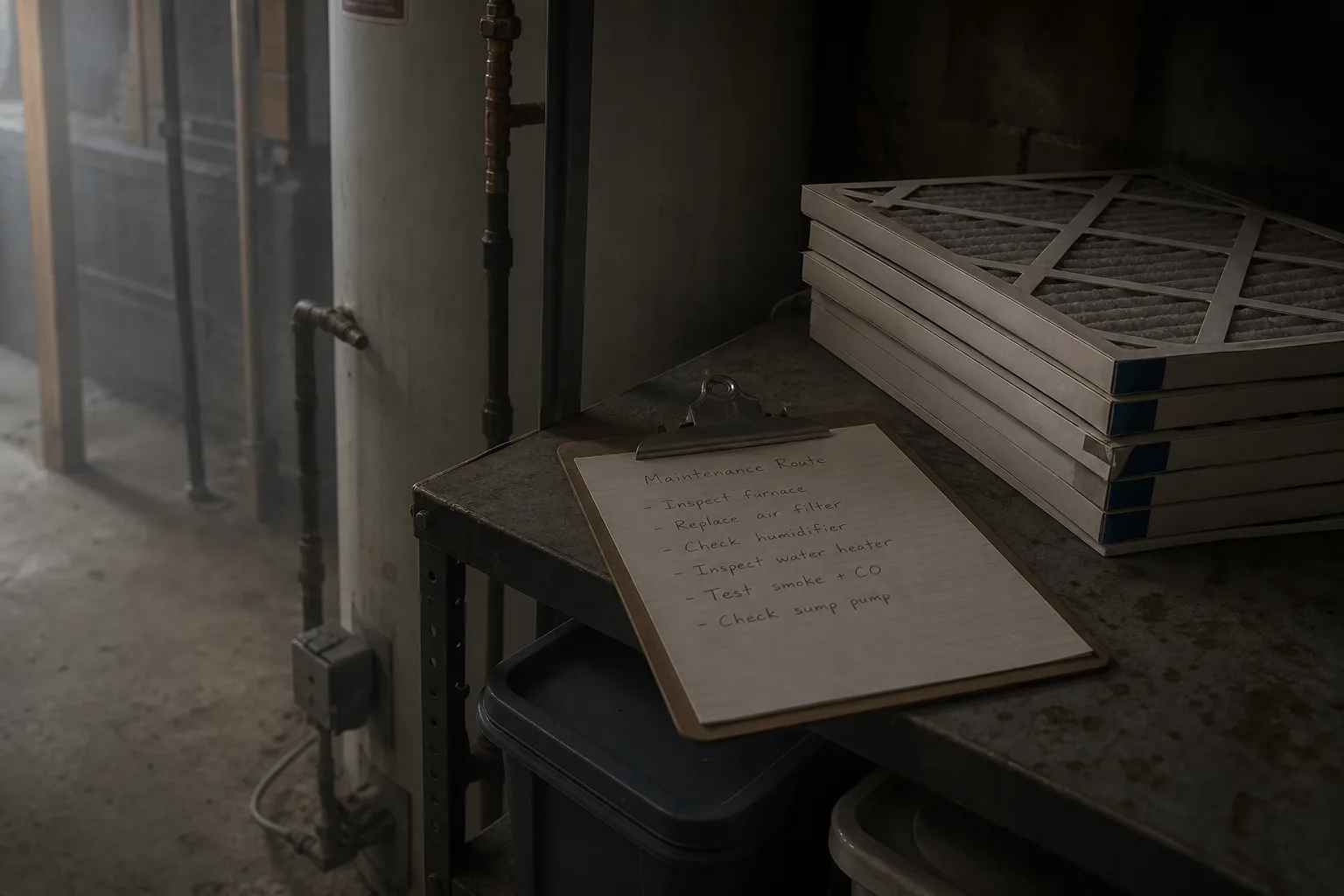 A clipboard with a short handwritten maintenance route list resting on a basement utility shelf beside a water heater and a stack of air filters
The schedule you wrote in January was not unrealistic. It was structurally different from the one a facilities company would have written for the same building, and the difference is not effort or discipline. A commercial provider maintaining forty properties does not carry a list of every recommended task at every recommended interval, because that list is unaffordable and nobody has ever completed one. What they carry is a much shorter set of items tied to routes, triggers, and a contract that says plainly which work is included and which work generates a separate line. Households copy the list and skip the contract.
The assumption is that a good schedule is a complete one
Most household maintenance plans start from the manuals. Every appliance ships with an interval, every trade publishes a seasonal checklist, and stacking them produces something like sixty to ninety discrete tasks a year, spread across intervals that share no common rhythm. Three months, six months, annually, every two years, every heating season. The plan looks responsible on paper and collapses somewhere around the second month, not because any single task was hard, but because the schedule has no mechanism for deciding what gets dropped when a week disappears. Providers solve that first, before they schedule anything.
The way they solve it is by ranking on consequence rather than on manufacturer preference. A missed filter change costs efficiency and eventually a coil. A missed condensate line inspection costs a ceiling. A missed cabinet hinge adjustment costs nothing measurable for years. Commercial schedules are heavily weighted toward the small number of items where deferral produces a claim, a shutdown, or an emergency call at premium rates, and they are frankly indifferent to the rest. That indifference is the part homeowners never copy, and it is the part that makes the schedule survivable.
Calendar intervals, condition triggers, and routes compared
Three models exist and they behave differently under pressure. A calendar schedule assigns a date to each task and fails quietly, because a missed date leaves no evidence and the next date is a full interval away. A condition-triggered schedule waits for a signal, a pressure drop, a noise, a stain, a run time, and it does not fail so much as run late, sometimes very late, because the signal usually appears after damage has started. Neither is what a large provider actually runs day to day.
What they run is a route. A technician arrives at a property with a fixed sequence of stops, mechanical room, roof, exterior drainage, and touches every item on that path in one visit regardless of whether each item was individually due. The efficiency is not in the task, it is in the trip. Households reproduce this by grouping upkeep geographically rather than by system: everything in the basement on one Saturday, everything on the exterior perimeter on another, everything behind an appliance when the appliance is already pulled out. Frequency drops. Completion rises sharply.
A route also solves the drop-out problem, because the sequence itself is the record. You know where you stopped. A calendar list gives you eleven unchecked boxes and no information about which ones matter, while a route tells you that you got through the mechanical room and never reached the crawlspace, which is an actionable fact. The Department of Energy oversees efficiency standards for the heating, cooling, and water heating equipment that dominates these routes, and those are consistently the items where deferral shows up first in operating cost.
Where the scope grows, and who is expected to pay
When a household hires out part of the schedule, the contract matters more than the interval. A residential maintenance agreement typically covers inspection and a defined set of consumables, filters, a flush, a chemical clean, and it explicitly excludes parts, refrigerant, and anything classified as a repair rather than maintenance. The visit that was quoted at a modest flat rate becomes a materially larger invoice the moment the technician finds a failing capacitor, and the agreement almost always says that finding is billable. That is not a trick. It is written down, and it is rarely read before the technician is standing in the basement.
The useful discipline is to ask, before work starts, what triggers an additional charge and who authorizes it. Large providers manage this with a threshold: work under a set dollar amount proceeds on the technician's judgment, work above it requires a call to the property manager. A household can set the same threshold in one sentence at the door, telling the technician that anything over a stated figure gets a phone call before the part goes in. The scope still grows, because scope always grows on inspection. It grows with your consent, at a price you heard first.
The version that survives a bad month
A schedule that people keep tends to have four or five recurring items, not forty, and each one is attached to something already in the calendar. Filters when the utility bill arrives. Exterior drainage the weekend the clocks change. Water heater and shutoff valves when the smoke detector batteries get done. The remaining tasks move to a deferred list that is reviewed once a year, honestly, with most of it left undone on purpose. Providers call that a maintenance backlog and treat it as a normal operating condition rather than a failure.
Write down which items are on the short route, what a service visit includes, and the dollar figure above which someone calls you first. Three pieces of paper, and the schedule stops depending on how the year goes.
Posted under Property