Insured for the Same Amount Since 2014? How the Averaging Clause Turns a Full Loss Into a Partial Check
A composite claim shows how a coverage limit set a decade ago meets today's rebuild costs, and how state rules decide whether the shortfall is shared or absorbed.
Pinned by Miriam Goldfarb4 min read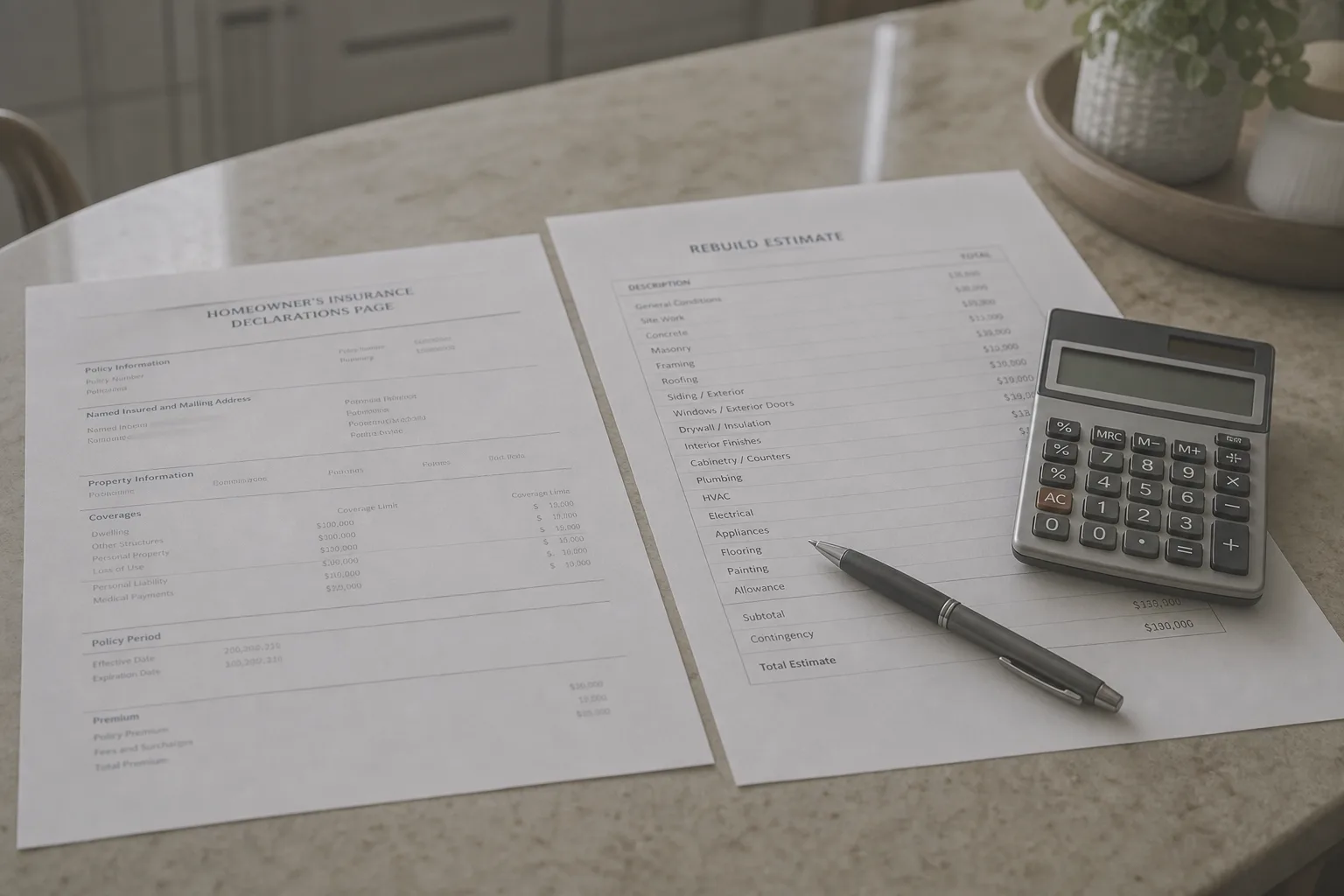 A homeowner's insurance declarations page and a contractor's rebuild estimate lying side by side on a kitchen table, with a calculator and a pen resting on top
One-star reviews of insurers cluster around a single complaint, and it is almost never denial. It is the check that arrived smaller than the estimate, with a letter explaining a percentage the policyholder had never heard of. Read enough of them and the grudges separate from the pattern: the grudge says the adjuster was rude, and the pattern says the payment was reduced by a ratio the homeowner could have calculated years earlier. The pattern has a name in the policy, coinsurance or the insurance-to-value condition, and it does its work quietly, in the years between the day the limit was set and the day the kitchen burned.
The same decision, made in 2014 and made now
Consider a composite drawn from the shape these files take: a two-story house bought in the early 2010s, insured at a dwelling limit the agent produced from a replacement cost estimator at closing, and renewed every year afterward without a conversation. In 2014 that limit tracked the rebuild cost closely, because the estimator, the lumber market, and the local labor pool were all reading roughly the same conditions. The annual inflation guard nudged the number upward by a small percentage each year. Materials and labor did not move at a small percentage each year. By the time a fire took part of the second floor, the limit sat well below what a contractor would charge to put the house back.
The identical decision made today looks different because the tools around it changed. Carriers now run replacement cost estimators that pull regional labor and material costs and refresh them more often, and many push extended replacement cost endorsements, typically an additional cushion above the stated limit, as a default rather than an upsell. The homeowner who buys in 2024 is likelier to be shown a rebuild figure that is not the purchase price, not the tax assessment, and not the mortgage balance. That is the improvement. The exposure sits with the policy nobody reopened.
What the clause actually does to the check
The averaging mechanic is arithmetic, not judgment. The policy requires that the limit equal a stated share of full replacement cost, commonly eighty percent, at the time of loss. If it does, a partial loss is paid at replacement cost up to the limit. If it does not, the insurer pays the loss multiplied by the ratio of the limit carried to the limit required, then subtracts the deductible. Carry two-thirds of what the condition requires and a partial loss is settled at roughly two-thirds, with the homeowner funding the rest. The cruelty of the design is that it bites hardest on partial losses, which are the overwhelming majority, while a total loss simply exhausts the limit and makes the shortfall obvious rather than arithmetic.
Where you live decides which version of the trap closes
State law reshapes this considerably. Several states, Florida and Texas among them, have valued policy or total loss statutes that require the face amount to be paid on a total loss of the dwelling, which protects the catastrophic case while leaving partial losses fully exposed to the ratio. Wildfire states have moved in a different direction, with California regulators pressing carriers on the adequacy of replacement cost estimates and on disclosure of extended replacement cost options. Coastal states add a second layer through percentage hurricane and wind deductibles, which are calculated against the dwelling limit, so a low limit shrinks both the payout and, oddly, the deductible. Flood sits outside all of it, under the National Flood Insurance Program, which the Federal Emergency Management Agency is responsible for administering, with its own limits that stop where they stop.
Ordinance and law, the local rule that makes the gap wider
Building codes are municipal, and they are where a decade-old limit fails twice. A house repaired after a significant loss is often required to meet current code, which in many jurisdictions now means upgraded wind connectors, updated electrical service, or elevation requirements that did not exist when the house was built. Standard policies cover the code upgrade only through an ordinance or law endorsement, usually written as a percentage of the dwelling limit, so an understated limit produces an understated upgrade allowance on top of the averaged payment. Adding that endorsement, and confirming its percentage against what your building department actually enforces, is the cheapest correction available on most policies.
Fixing it before there is a claim
The repair is a phone call and a document. Ask the carrier for the current replacement cost estimate behind your dwelling limit, dated, with the square footage, finish grade, and roof type it assumed, then compare those assumptions against a local contractor's per-square-foot rebuild number. Where they diverge, raise the limit, add extended replacement cost, and confirm ordinance and law coverage in writing. Keep the estimate, the endorsement, and the declarations page together. An adjuster who can see that the limit was set deliberately and recently has nothing to average against.
The reviews were reporting something real, just imprecisely. What sounded like bad faith was usually a ratio, set years earlier by silence, and it is the one part of a claim a homeowner can still change today.
Posted under Money & Finance