Insured for Less Than It Costs to Rebuild? What a Hail Claim on a Six-Unit Building Reveals
A public adjuster explains why the coinsurance clause reduces partial claims, not just total losses, using one hail-damaged roof on a small apartment building.
Pinned by Miriam Goldfarb4 min read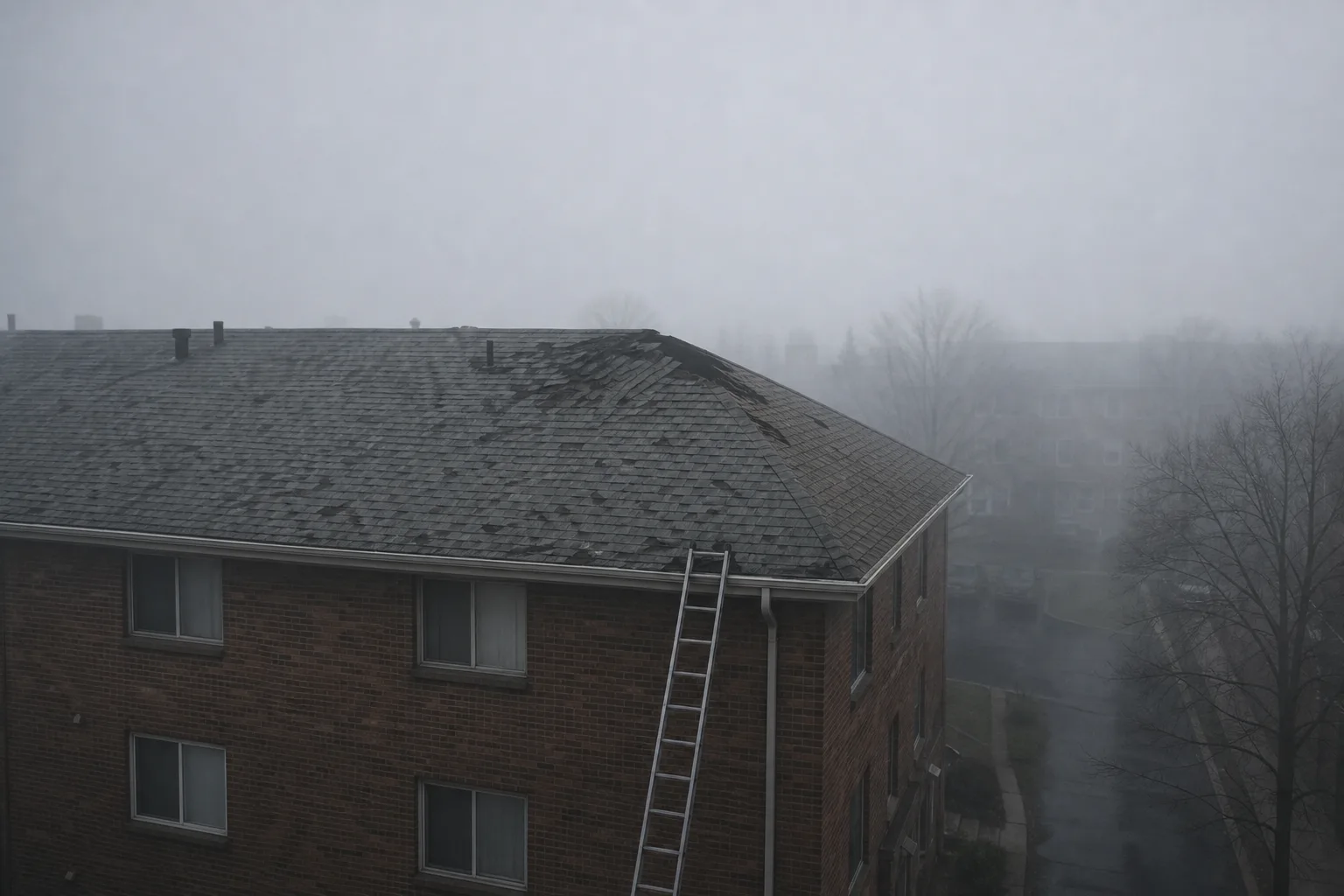 A hail-damaged asphalt shingle roof on a small three-story brick apartment building, with a ladder leaning against the gutter edge and torn shingles visible...
Read enough one-star reviews of property insurers and a pattern separates itself from the noise. Most angry reviews are about speed, or a phone tree, or an adjuster who did not call back, and those are grudges as often as they are evidence. A smaller group says something more specific: the claim was approved, the damage was covered, the paperwork was clean, and the check still came up tens of thousands short with no denial letter attached. That is usually not bad faith. That is a coinsurance clause doing exactly what it says. I asked Dana Reyes, a public adjuster who works small commercial and multifamily losses, to walk through one file.
The assumption almost every owner brings to the renewal
What do owners think they are buying when they insure a building for less than it would cost to rebuild?
They think they are buying a ceiling. The reasoning sounds careful, and I hear a version of it monthly: the building will never burn flat, so paying for a limit that covers a total loss is paying for an event that will not happen, and if something does go wrong the insurer will simply cover the damage up to the number on the declarations page. Owners treat the limit as a cap on the worst case, not as a term that shapes every case. On a partial loss, which is nearly all of them, that is the wrong model of how the policy computes a payment.
So what is actually true?
The clause compares the limit you carried against a required amount, usually eighty or ninety percent of replacement cost at the time of loss, and if you fall short, it pays your loss in the same proportion. Carry eighty percent of what the clause required and you receive eighty percent of a covered partial loss, before the deductible comes off. The penalty is not reserved for catastrophes. It attaches to a roof, a burst riser, a kitchen fire in one unit. Every claim you file for the life of that policy is reduced by the same fraction, quietly, in the adjuster's worksheet.
One roof, one storm, one worksheet
Take me through the file.
A six-unit walk-up, owned by the same family since the nineties, insured for seven hundred eighty thousand dollars on a policy with an eighty percent coinsurance requirement and a ten thousand dollar deductible. Hail took the roof. The scope came in at ninety-two thousand dollars, and the owner expected eighty-two after the deductible. The carrier valued replacement cost at one point two million, so the clause required nine hundred sixty thousand of coverage. Seven hundred eighty over nine hundred sixty is a little over eighty-one percent. The loss was multiplied by that fraction, the deductible came off the result, and the check was roughly sixty-five thousand.
Did the owner see it coming?
No, and that is the part worth sitting with, because nothing in the correspondence looked like a fight. Coverage was confirmed in writing, the scope was not disputed, the contractor's estimate was accepted line by line, and the letter that accompanied the payment referred to the coinsurance provision in a single sentence with a citation to the form. The owner's first instinct was that the carrier had shorted him and his second was to write a review saying so. What he actually had was a valuation that had not been revisited since the building was refinanced.
Why the number drifts even when nothing changes
He never lowered his limit. How did he end up short?
He did not move. The cost of putting the building back did. Replacement cost is priced in today's labor and today's materials, and a limit set against a construction market from several years earlier will trail it without anyone touching the policy. Some carriers apply an inflation factor at renewal, but the factor is generic and the building is not, and it rarely keeps pace with a regional spike in framing lumber or roofing labor. The Bureau of Labor Statistics tracks producer prices for construction inputs, and the direction of that series is the single best argument for revaluing on a schedule rather than on instinct.
What about improvements the owner made himself?
Those are the other half of the drift, and they are worse because they feel like progress. New service panels, a rebuilt back stair, two gut-renovated units with better cabinetry than the building ever had. Each one raises what it costs to restore the property and none of them reaches the insurer unless somebody picks up the phone. The owner improves the asset, the required amount climbs with it, and the limit sits where it was. Documenting upgrades as they happen and reporting them at renewal costs one email and closes the gap before a storm tests it.
Closing the gap before the next claim
What does a fix look like in practice?
Order a replacement cost valuation from someone who will walk the building, not a desktop estimate keyed off square footage and a year built, and compare the result against the coinsurance percentage in your form so you know the required amount rather than guessing at it. Then ask your agent about an agreed value endorsement, which suspends the clause for the policy term once the carrier accepts a stated value. Owners who do both stop carrying a penalty they cannot see. A raised limit costs real premium, but it is priced against every partial claim, not one improbable fire.
The reviews that describe this experience read like accusations, and they are usually descriptions. When a payment is short by a clean, repeatable fraction and the letter cites a form number, the dispute is with a valuation that went stale, and that is a fixable thing on a calendar rather than an argument to be won after a loss.
Posted under Money & Finance