Hired a House Cleaner? What the Star Rating Measures and What Actually Decides the Job
Ratings for household cleaning mostly grade arrival, manner and communication. The work that separates a good job from a barely adequate one happens where you never look.
Pinned by Miriam Goldfarb5 min read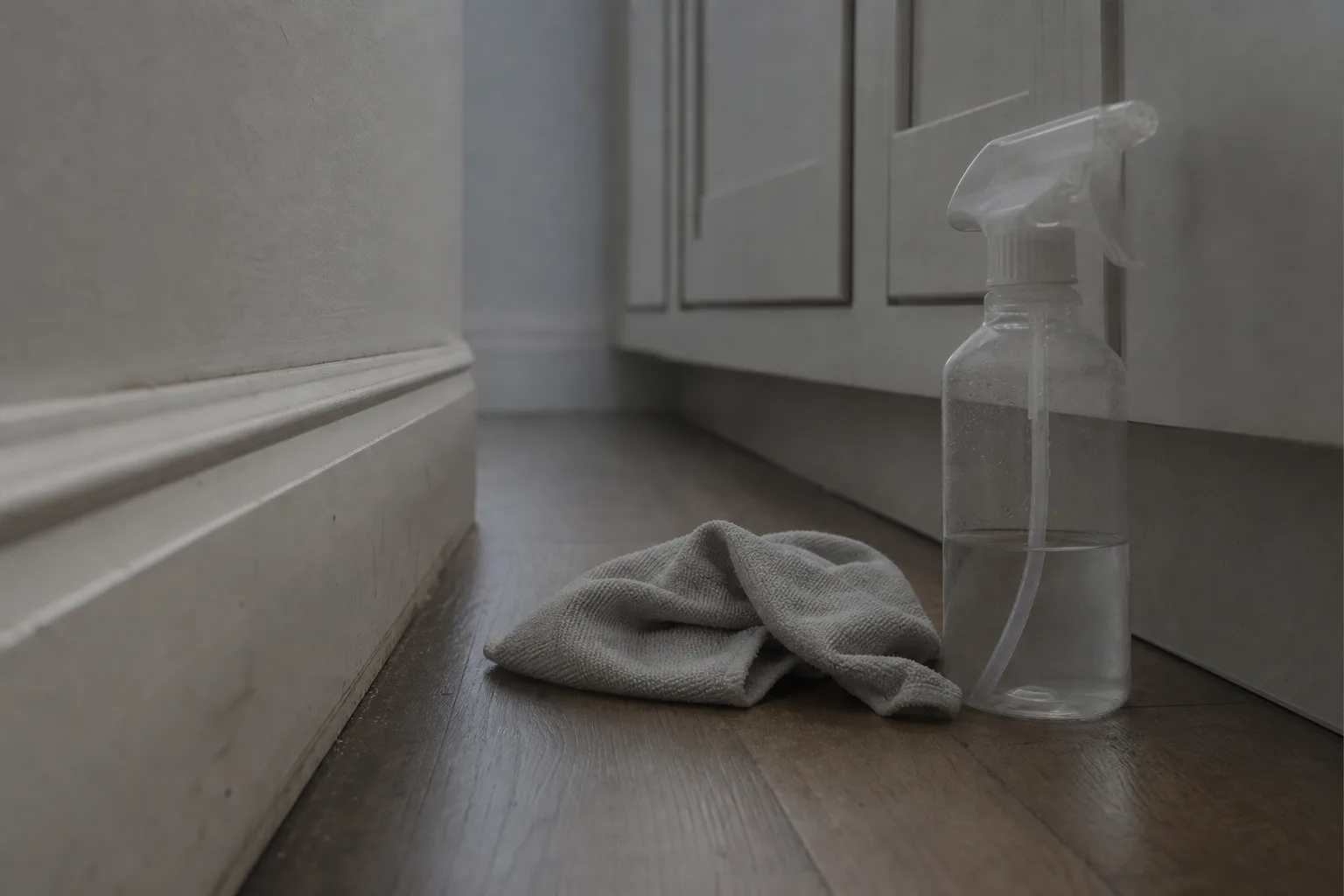 A close view of a kitchen baseboard and the narrow gap of floor beside a cabinet toe kick, with a cleaning cloth and spray bottle set on the floor nearby
The deposit is paid, the first visit is on the calendar, and the question that still has an answer is not whether to hire someone but what to expect from them once they are standing in your kitchen. Household cleaning is one of the few paid jobs where the customer is present for almost none of the work and inspects almost none of the result, because the surfaces that get judged are the ones at eye level. That gap between what gets checked and what gets done is where good work and barely adequate work quietly separate.
What a five-star average is really grading
Read fifty reviews of any residential cleaning service and count what the sentences are actually about. They are about arrival time, about whether the crew was pleasant, about whether the office answered the phone, about whether the price at the end matched the price at the start. Those are real things, and a service that fails them will annoy you every week. But they are all measures of the transaction rather than the work, and they are the parts of the visit a customer can observe directly, which is precisely why they dominate the record.
The work itself appears in reviews only when it fails visibly: a streaked mirror, a missed toilet, a vacuum line that stops at the sofa. Anything that fails invisibly, and most of it does, never reaches the page. A five-star average tells you a household will be treated courteously and billed as quoted. It does not tell you whether the underside of the faucet base was wiped, whether the disinfectant sat long enough to do anything, or whether the crew cleaned top to bottom or dragged dust downward all morning.
The parts of the job you cannot watch, and how to check them anyway
Three things separate a thorough cleaning from a fast one, and none of them are visible while they happen. The first is sequence. Dust falls, so a crew that wipes counters before it wipes the range hood and the tops of the cabinets is redoing its own work or, more often, not redoing it. The second is edges: the strip of floor behind the toilet, the grout line at the base of the shower wall, the four inches of counter behind the coffee maker, the corner of the stair tread. The third is time on the surface.
That last one has an actual technical basis. Disinfectant products for household use are registered with the Environmental Protection Agency, which oversees that category, and every registered product carries a label stating how long the surface must stay visibly wet for the claim on the bottle to hold. A crew that sprays and immediately wipes has cleaned the surface, which is worth something, but has not disinfected it, whatever the bottle says. You can check this without hovering. Ask which products are used in the bathroom and kitchen, then read a label yourself once.
Checking the rest takes about four minutes after the first visit, and it should be done after the first visit rather than the fourth, while you still have leverage and goodwill. Run a finger along the top edge of a door frame and the top of the refrigerator. Look at the floor behind the toilet and under the lip of the bathroom vanity. Pull the trash can out and look at the wall behind it. Check the inside rim of the tub where it meets the tile. None of these are trick questions, and a thorough crew will have gotten most of them.
Telling a pattern from a grudge in the reviews
One furious review about a broken lamp tells you almost nothing, because breakage happens in every household service and the review only records how the customer felt about the resolution, not whether the resolution was reasonable. What matters is repetition of a specific noun. Three separate people over eight months mentioning the shower door, or the baseboards, or that the second visit was noticeably shorter than the first, is a pattern, and patterns in this trade are usually about staffing and scheduling rather than skill.
The most useful pattern to hunt for is drift, because it is the single most common failure in ongoing household cleaning and it almost never appears in a headline complaint. Drift sounds like this in a review: the first clean was excellent, and then it slipped. That is what happens when a service quotes a first visit at four hours, wins the account, and then assigns two hours of route time to it going forward. It is fixable, and the fix is a conversation about hours rather than about quality, but you have to recognize the shape of it first.
Be equally careful with the reviews that praise nothing specific. A wall of short, warm, interchangeable five-star entries describing how lovely the team is tells you the service is pleasant to deal with and tells you nothing about baseboards. The reviews worth weighting, in both directions, are the ones that name a room, a surface, or a number of hours. Those were written by someone who looked.
Turning adjectives into a list of places
The word that causes the most trouble is deep. A deep clean means one thing to a company selling a move-out service and another to a household that has just had drywall work done, and the price difference between those two interpretations can be substantial. The way out is to stop negotiating adjectives and start naming locations. Inside the oven. Inside the refrigerator, including the door shelves. Window interiors on the ground floor. Baseboards throughout, not just the visible runs. Light switch plates and door handles. Under the beds.
Write that list, send it before the first visit, and ask which items are inside the quoted price and which are add-ons with their own line. A good operator will answer item by item and will tell you honestly that the oven adds an hour. That exchange also does something a rating cannot: it shows you how the business handles a specific, slightly inconvenient question from a customer who is paying attention, which predicts how it will handle the first genuine problem far better than any average does.
What good looks like by the third visit
Consistency is the real product, and it shows up in three places. The same people arrive, or at most the same two rotating pairs, because a crew that has cleaned your house four times knows where the hard water sits and where the dog sleeps. The time on site stays roughly stable, within maybe fifteen minutes either way, rather than compressing week over week. And the small things you mentioned once stay fixed, so the shower door you raised in week one is still right in week seven without a reminder.
When those three hold, the checking can stop, and that is the point of paying someone in the first place. Give it three visits before you decide, spot-check the invisible edges after each one, and raise anything you find immediately and specifically, naming the surface rather than the standard. Services that are worth keeping respond well to that, because it is easier to fix a named baseboard than a vague sense that someone is unhappy.
The household that inspects early is the household that stops inspecting soonest.
Posted under Property