Five City Budget Lines You Actually Feel at Home, and What to Write Down
The council budget shows up at your address as response times, plow routes and permit queues, and the record you keep decides how those disputes end.
Pinned by Josephine Lachance5 min read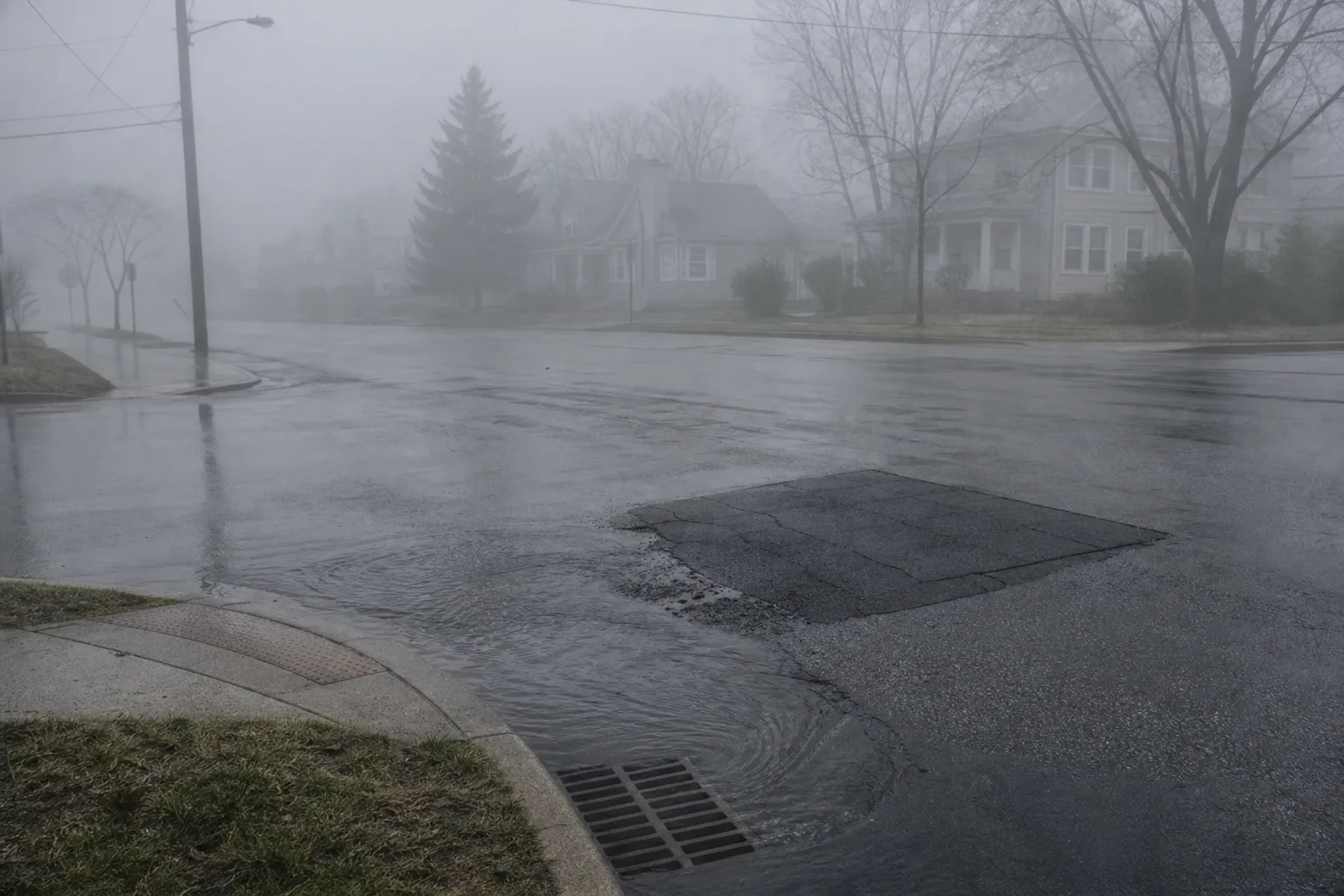 A residential street corner after heavy rain, with water pooled over a storm drain grate at the curb and a patched section of asphalt nearby
A municipal budget is adopted in a room most residents never enter, in a document most residents never open, and then it arrives at your address disguised as something else: a streetlight that stays dark for eleven weeks, a plan review that takes nineteen business days instead of five, a catch basin that backs up into the cul-de-sac every heavy rain. The line item is upstream. What you experience is downstream, and it rarely announces its origin. The five areas below are the ones residents contact a city about most often, and each one turns on a record that either exists or does not.
1. Street maintenance, and the claim that depends on your timestamp
Pavement money splits between resurfacing, which is scheduled years out, and pothole patching, which is reactive and dispatched by complaint. From the resident's side that difference is invisible until a rim cracks. Most cities will consider a damage claim, and most of those claims turn on one question: did the city have notice of the defect before you hit it, and how long had it been on the list. That is why the service request number matters more than the phone call. Report the hole when you first see it, photograph it with something for scale, and keep the confirmation email with its date.
When you file, the record you want is boring and specific: the date you first reported it, the ticket or case number the city issued, the photograph showing the defect and a recognizable landmark, and the repair estimate from a shop on letterhead rather than a verbal figure. Send the claim in writing even if the clerk takes it by phone, and keep your sent copy. Cities process these routinely and many pay them. The ones that get denied are usually denied for a gap in the chain rather than a disagreement about the pothole.
2. Stormwater, which is a utility fee doing quiet work
Many residents pay a stormwater charge on a utility bill without ever connecting it to the grate at the end of the driveway. That fund pays for catch basin cleaning, pipe inspection, outfall repair and the permit compliance the Environmental Protection Agency oversees for municipal storm sewer systems. When the cleaning cycle stretches, the consequence is not abstract. It is a street that ponds, a yard that saturates, and eventually a basement that takes water from the public side of the property line rather than from a failure of your own.
If water is reaching your house from the street, the record starts before the claim does. Photograph the ponding during the storm, not after it drains, with the time visible on the file. Note how long the water stood. Ask the public works department, in writing, when that basin was last cleaned and when it is next scheduled, and keep the answer. Cities keep maintenance histories, and a written request produces a dated document rather than a recollection. That document is what separates a homeowner's theory from a maintenance record the city itself created.
3. Permitting staff, and the review clock you can time
The permit counter is where a budget decision reaches a homeowner fastest. Plan review is labor, and when review positions sit vacant or a department leans on a rotating outside consultant, turnaround lengthens without any announcement to the people in line. A contractor quoting a spring start builds the published review window into the schedule. If the real window runs three times longer, the delay lands on your financing, your rental of temporary space, and your crew's availability, and none of that appears in the budget as a cost to you.
Ask for the published review target before you submit, in writing, and write down the date and time of submission along with the intake clerk's name. Log every correction notice with its date and what it asked for, because the second and third round of comments are where months disappear. If comments contradict an earlier round, put the contradiction in an email and ask for a written answer. That thread is the thing that gets a stalled file escalated, and it is also the thing that tells your contractor, credibly, why the start date moved.
4. Snow, leaves and the route priority you were never shown
Seasonal operations run on a priority map. Arterials and hospital routes are cleared first, collectors second, residential streets last, and in a tight year the last tier gets fewer passes and less material. Leaf collection works the same way, with a posted sweep schedule that thins when the equipment budget or the temporary crew count is cut. Residents experience this as a street that was plowed by Tuesday last winter and Thursday this one, and they usually blame the driver rather than the tier the street sits in.
You can find out where you live on that map, and it is worth knowing before the first storm. Request the current route classification for your block and the posted number of passes for each tier, and save the reply. Then keep a short log through the season: date, time, whether the street was plowed or salted, and a photograph if it was missed. A neighbor's memory of a bad winter persuades nobody. A dated sequence showing a tier-two street treated on a tier-three schedule is the sort of thing that gets a route reclassified at the next review.
5. Code enforcement, where the outcome depends on the paper trail you build
Enforcement is staffing, and staffing is a line item. One inspector covering a jurisdiction that used to employ three means complaints are triaged, and triage means the file that moves is the file that is easiest to act on. From the resident's side, that is the difference between a vacant property cited in six weeks and the same property still open after a year. The department is not ignoring you. It is working a queue, and your position in that queue is partly a function of how completely your complaint arrives.
Build the file the inspector would have to build anyway. Photograph the condition from the public right of way, dated, from the same vantage point each time, so the series shows duration rather than a single bad afternoon. Record each contact with the department, the case number, the name of the person you spoke with, and what they said would happen next, then confirm that in a short email the same day. Ask for the case status in writing at intervals. A complaint with a documented history of persistence and a clean photographic record is the one that gets scheduled.
None of this requires reading the adopted budget, though the adopted budget is public and searchable and will confirm what you already suspect from the street. What it requires is treating your own interactions with the city as a record that will need to stand on its own months later, when the person you spoke with has moved to another department and the only durable thing left is what somebody wrote down. Usually, that somebody is you.
Posted under Public Policy