First Year of Upkeep? Four Ways to Schedule It, and What Each One Actually Costs
A comparison of the four ways households schedule routine maintenance, what drives the cost of each, and the paper trail that keeps the first year from repeating itself.
Pinned by Josephine Lachance4 min read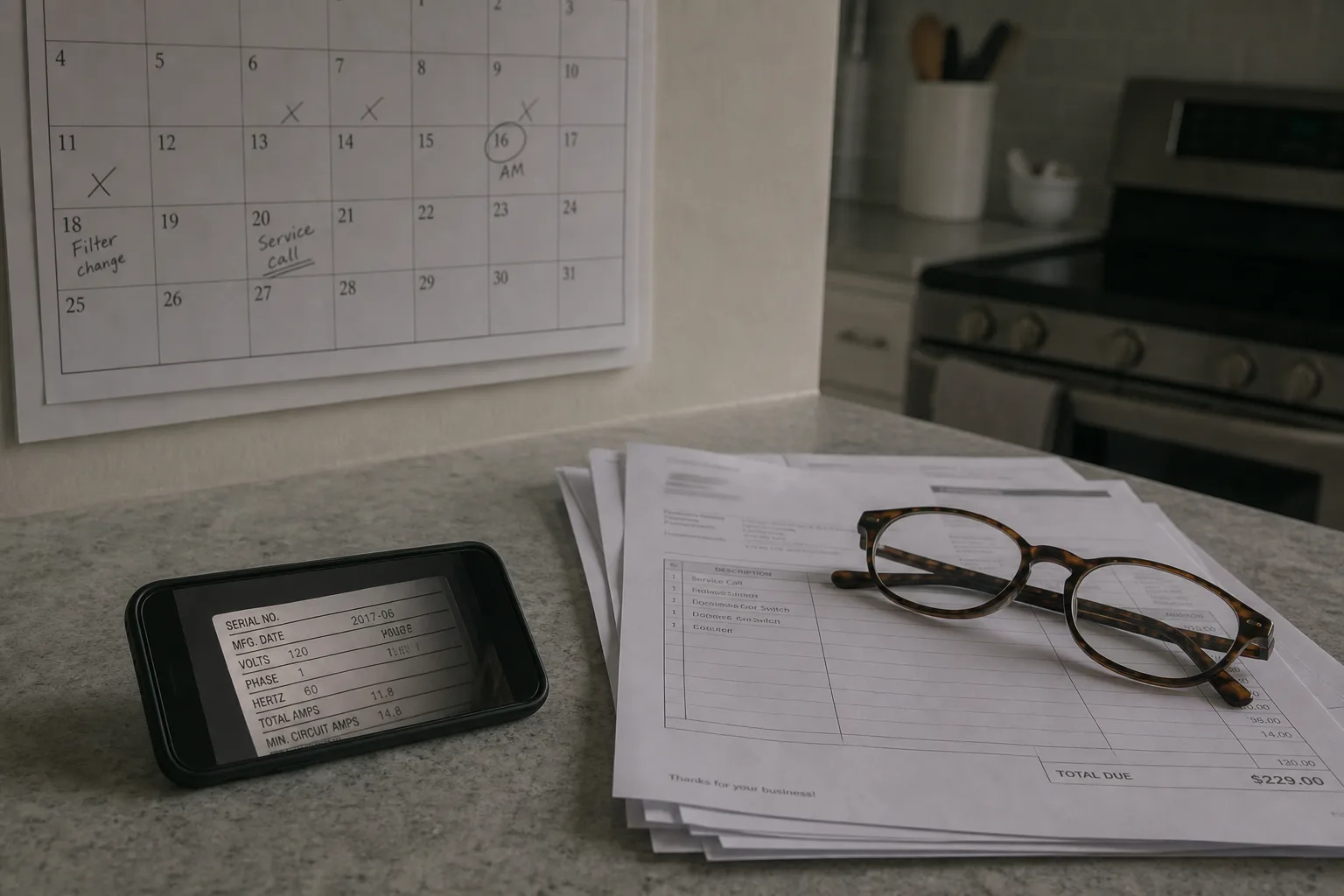 A kitchen counter with a wall calendar marked in pen, a phone showing a photograph of an appliance data plate, and a stack of service invoices held under a p...
The schedule you pick in the first month decides most of what you will spend on upkeep for the next two years, not because one method is cheaper per visit, but because each one fails in a different way, and the failures are what cost money. A missed filter change is a few dollars of neglect and a compressor's worth of consequence. A first-time owner has no history to draw on, no sense of which systems in this particular building drift out of tune, and no record of what the previous owner did or skipped. So the comparison worth making is not which schedule is cheapest to run. It is which one survives a busy October.
The four schedules households actually run, and what each charges you
The first is the self-managed calendar, whether that is a paper wall planner, a spreadsheet, or recurring entries on your phone. Its direct cost is zero and its real cost is attention, which is the scarcest input in any household. The second is a maintenance app or home management platform, usually a modest monthly or annual subscription, which converts your attention problem into a notification problem and does nothing about the labor. The third is a vendor-run plan, the kind an HVAC company or a pest control firm sells: a flat monthly or seasonal fee, two or more scheduled visits, and priority booking when something breaks. The fourth is a handyman on a standing arrangement, paid by the hour or by the half day, several times a year.
Ranked by cash outlay in year one, the order is predictable: the calendar, then the app, then the handyman, then the vendor plan, though the last two often trade places depending on how many systems you are covering. Ranked by the odds that the work actually happens, the order reverses almost exactly. That inversion is the whole decision. You are not buying a reminder. You are buying the probability that someone with a ladder and a filter shows up in a month when you are moving offices, hosting family, or dealing with a leaking hose bib.
What drives the cost, and it is rarely the hourly rate
Four variables do most of the work. Frequency is the obvious one, and the one first-time owners get wrong in both directions, over-servicing a young furnace while ignoring a water heater's anode rod entirely. Access is the quiet multiplier: a crawlspace you can stand up in, an attic with a floored walkway, and a panel that is not behind a built-in bookcase all shorten a visit measurably, while their opposites turn a routine call into a half day. Travel matters more than people expect, since rural and outer-suburban addresses often carry a trip charge or a minimum that swallows a short task. And bundling changes the arithmetic, because a technician already on site for a tune-up will replace a flapper valve or reseat a dryer vent clamp for a fraction of what a separate visit would cost.
The fifth driver is deferral, and it is the only one that compounds. Every skipped cycle moves an item from maintenance pricing to repair pricing, and repair pricing includes diagnosis, parts you did not choose, and someone else's schedule. The Department of Energy is responsible for efficiency standards on the equipment sitting in your basement and utility closet, and the practical consequence for a household is that a neglected system does not simply fail later, it costs more to run every month in between. That monthly drift is invisible on any single utility bill and obvious across a year of them.
Why the first year is priced differently from every year after
Expect year one to run high, and expect that to be correct rather than a sign you were overcharged. A first visit to an unfamiliar house includes discovery: the technician finds the shutoffs, learns that the second-floor zone was never balanced, notices that the dryer vent runs twenty feet through a joist bay, and writes down model numbers nobody has recorded since installation. Some of that arrives as billable time and some as a list of deferred items you did not know existed. The useful move is to treat the first pass as a baseline survey and to keep whatever it produces, because in year two the same visit is shorter, cheaper, and more focused.
This is also where a vendor plan earns its premium for a first-time owner specifically. You are paying someone to hold the schedule while you learn the building, and the priority booking clause matters most in the year when you cannot yet tell a noise that can wait from a noise that cannot. After two or three cycles, many households step down to a calendar plus a handyman, having learned which four or five items genuinely need a professional and which ones are twenty minutes and a shop vacuum.
The record that makes year two cheaper than year one
Whatever schedule you choose, the thing that lowers the bill is written history, and it has to be built while the work is happening rather than reconstructed afterward. Photograph the data plate on every major appliance, the furnace, the water heater, the outdoor condenser, and the panel, and photograph the filter slot with the size legible. After each visit, ask for the invoice to name what was inspected, what was replaced, what was recommended and declined, and the date, then confirm anything verbal in a short email the same day so the account of it does not rest on anyone's memory. Keep the photos and the invoices in one place, dated, and note the meter or hour readings if the equipment reports them.
That file does three concrete things. It stops you from paying twice for the same diagnosis, it gives you a defensible position if a part fails inside its warranty window, and it turns the sale of the house years later into a document handoff rather than an argument. It also tells you, honestly, which schedule you kept and which one you only intended to.
Pick the method that matches the year you are actually about to have, not the year you would like to have, and write down what happens as it happens. The second year rewards both choices.
Posted under Property