First Year in the House? Build the Seasonal Record Before You Build the Checklist
The seasonal maintenance tasks have barely changed in a decade. What changed is who keeps the proof, and how much a warranty claim now depends on it.
Pinned by Josephine Lachance5 min read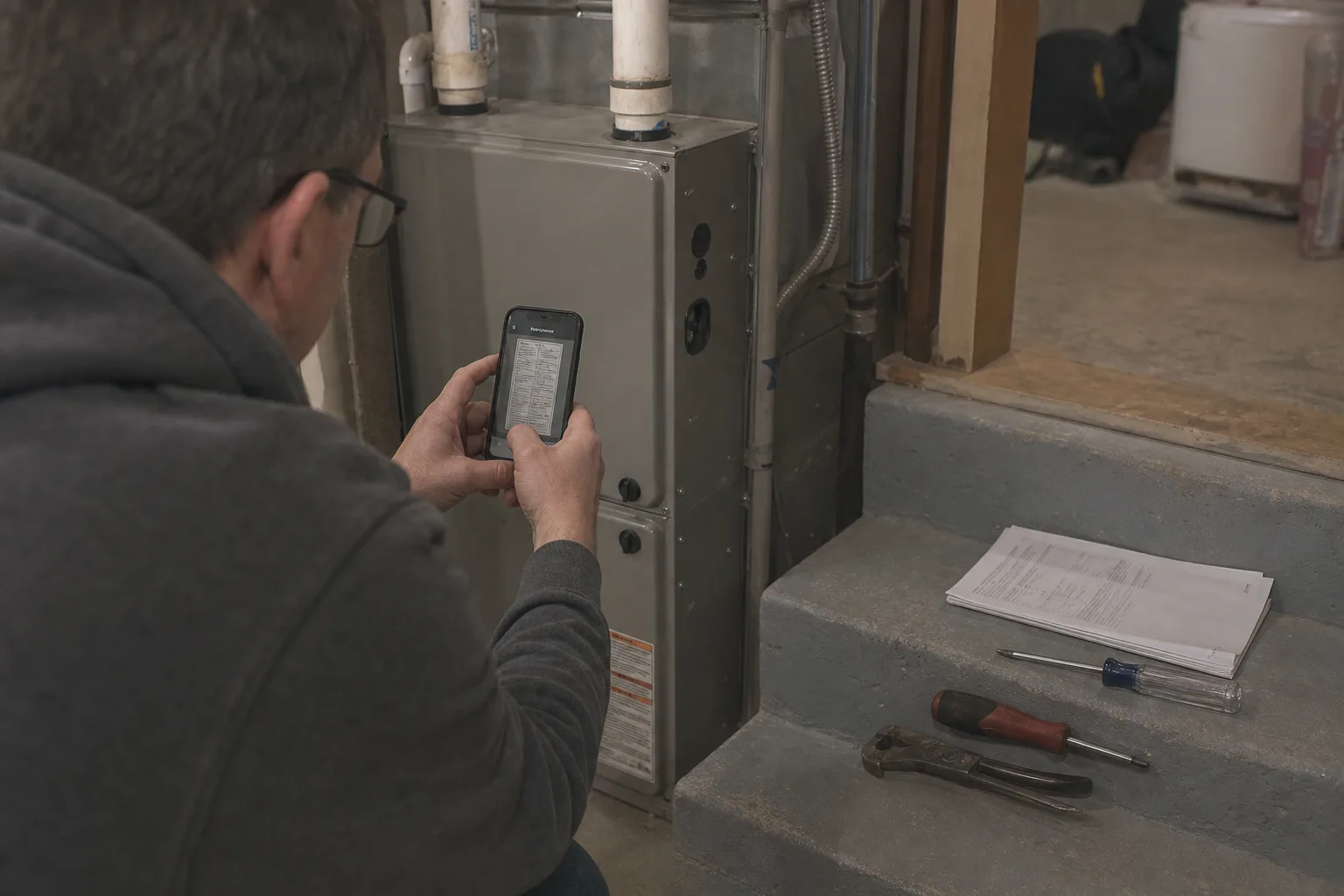 A homeowner photographing the data plate on a basement furnace with a phone, tools and a folded manual resting on a nearby step
The checklist you found is probably fine. Gutters in late fall, furnace before the first cold night, hose bibs shut off and drained, dryer vent cleared, water heater looked at once a year, filters on some cadence nobody agrees on. Those items have not moved much in a decade. What has moved, and what nobody tells a first-time owner, is that the schedule is no longer the hard part. Keeping a record that survives a warranty dispute, an insurance question, or a contractor who says he already did that is now the work.
The tasks stayed put; the paperwork moved off paper
Ten years ago the record of a season's maintenance lived in a kitchen drawer: a carbon-copy service ticket from the furnace company, a handwritten date on a filter frame, a folded manual with the model number circled. It was thin, but it was physical, and it stayed with the house. Now the same job produces an emailed invoice from a dispatch platform, a text with a technician's photo attached, a manufacturer portal that wants you to register the unit within some window, and nothing at all in the drawer. The information is better. It is also scattered across four accounts you set up once and forgot.
That shift matters most in the first year, because the first year is when you are establishing what the house looked like before anything went wrong. A furnace that fails in year six gets evaluated against its service history, and the manufacturer's position on whether neglect voided coverage will rest on dated documents rather than your recollection of a pleasant technician in October. The Department of Energy oversees efficiency standards and labeling for heating and cooling equipment, and manufacturers write maintenance conditions into warranties accordingly. The condition is usually reasonable. Proving you met it is the part people lose.
Anchor the schedule to a season, not to a date
First-time owners tend to build a calendar of twelve monthly reminders, keep it for two months, and abandon it in the third. The schedules that survive are attached to something that already happens: the weekend you put the patio furniture away, the day the clocks change, the first time you run the heat, the week the last leaf falls off the maple in the side yard. Those are not arbitrary. They are the same moments the underlying failure risk actually changes, which is why anchoring to them holds when a numbered date on a phone does not.
Fall is the honest example. Shutting off and draining exterior spigots is not a chore with a due date; it is a chore with a deadline set by the first hard freeze, and a split supply line behind a wall is expensive precisely because it is discovered in spring. Same with gutters, which you clean after the trees finish rather than on a fixed weekend chosen in July. Writing the trigger next to the task, instead of a date, is a small change that makes the list describe your actual year.
Winter's list is short and mostly about watching: how the heat cycles, where the cold air comes in, whether the attic shows frost or condensation on a very cold morning. Spring is when you inspect what winter did to grading, roof edges and downspout extensions. Summer is the season for scheduled service on cooling equipment, and for the outdoor work that needs dry weather. Four groupings, each tied to weather you will notice anyway, and each with its own small folder.
What to photograph the first time through the year
The baseline set is the single most useful thing a first-year owner can produce, and it takes about an hour spread across four weekends. Photograph the data plate on the furnace, the water heater, the air handler and the condenser, close enough to read the model and serial numbers, because those plates get painted over, rusted or hidden behind insulation. Photograph the main water shutoff and the electrical panel with the directory legible. Photograph the roof edge and each downspout discharge, the grading at every foundation wall, and the basement or crawlspace floor while it is dry.
The value is comparative. A stain on a joist means nothing on its own and means a great deal next to a photo of the same joist eleven months earlier. Same with a hairline crack, a dip in the grade, a shingle that has lifted. Date-stamped images resolve arguments that otherwise become a contest between your memory and a technician's notes, and they let you tell an insurance adjuster when a condition first appeared rather than that you noticed it recently. Keep them in one folder per season, named by year, and back it up somewhere outside the phone.
Put the seasonal service visit in writing after the truck leaves
The furnace tune-up is where a first-timer is most exposed, because the visit is short, the technician is competent, and the invoice says something like performed annual maintenance. That line will not tell you in four years whether the heat exchanger was inspected, what the readings were, or which part was flagged as near the end of its life. So send a short email the same afternoon, addressed to the company rather than the technician's cell, listing what you understood was done, anything he recommended, anything he declined to do, and the price quoted for the deferred item. Ask him to correct anything you got wrong.
You will rarely get a correction, and that is the point: an uncontested written summary is a far better record than a two-word invoice, and it costs you six minutes. Do the same after a gutter crew, a chimney sweep, a dryer vent cleaning, a plumber who touched the water heater. Ask for the technician's photos when they take them, because most now do, and save them into the seasonal folder next to your own. Ten years ago you would have had a ticket. Now you can have the readings, the images and a timestamped account of the conversation.
By the end of a first full year you will have four folders, one baseline photo set, and a list of tasks written as triggers instead of dates. None of that makes the work lighter. It makes the second year decidable: you can see what you did, when, and what someone told you to watch, and the next furnace argument, roof estimate or claim starts from a record rather than a recollection.
Posted under Property