First Water Loss? What the Form You Sign in Hour Three Actually Commits You To
A decade ago the first two days after a water loss were a crew, some fans and an invoice later. Now the scope is set in writing before the equipment lands.
Pinned by Ravi Chandrasekar4 min read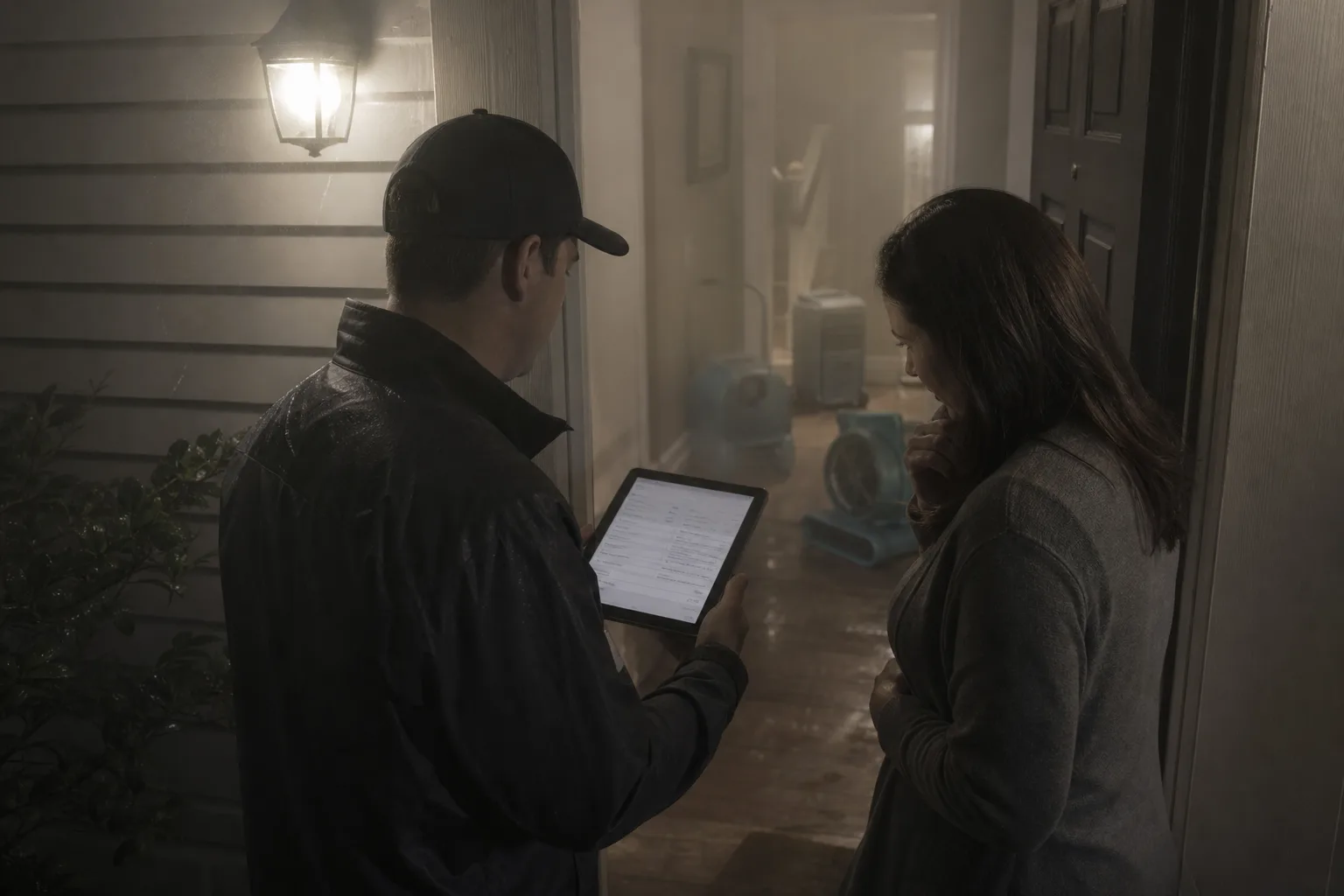 A restoration technician holding a tablet with a scope form at the front door of a house at night, air movers and a dehumidifier visible in the hallway behin...
The call comes in at an hour nobody chose, and within about ninety minutes a truck is in the driveway and someone is holding a clipboard or a tablet at your door. For a first-time claimant, this is the part that feels like help arriving. It is also the part where the scope of the job gets set, quietly, in a document most people sign standing up. Ten years ago that document was thinner and the job that followed was looser. Both of those things have changed, and the change mostly runs in the homeowner's favor if you read what you are handed.
What the paperwork at the door used to be, and what it is now
A decade ago the form at the front door was usually a one-page work authorization and an assignment of benefits, signed in the dark, granting the company permission to begin emergency services and to be paid directly by the carrier. The scope was whatever the crew found. Nobody wrote down the square footage of affected flooring before the fans went in, and nobody recorded the moisture content of the subfloor at the start, so the final invoice was effectively an account of labor and equipment days that could not be checked against anything. Disputes over that invoice happened weeks later, by which time the evidence had dried.
The packet now is longer and more specific, and the length is the point. It typically names the rooms being treated, the category of water, the number of air movers and dehumidifiers being placed, the expected drying duration, and a rate sheet for equipment per day. Several states have also tightened the rules on assignment of benefits, so the form may separate permission to start work from permission to collect the insurance payment. For a first-timer the practical instruction is simple: initial the emergency mitigation, and read the payment assignment twice before you sign it.
Moisture readings turned a judgment call into a record
The single largest change in the first forty-eight hours is that drying is now documented daily rather than declared finished by whoever is carrying the fans. Technicians take moisture readings at marked points, log temperature and relative humidity, and photograph the meter against the wall. The industry standard behind this is widely used by carriers to decide what they will reimburse, and the Environmental Protection Agency is the federal body whose remit covers moisture and mold in indoor environments, which is why the logs tend to be written with an eye toward proving the structure actually reached a dry standard.
The effect on scope is direct. A crew that wants to leave equipment running for two more days now has to show a reading that justifies it, and a crew that wants to pull drywall two feet up has to show the wall is wet two feet up. You can ask for the daily log. Ask on day one, not day four.
Where the job grows, and who asked for the growth
Scope expansion in a water loss almost never arrives as a conversation about money. It arrives as a technician saying the baseboard has to come off to get air behind the wall, then that the insulation in that bay is saturated, then that the cabinet toe kicks are wicking. Each step is probably correct. The question that matters is who requested it and who is expected to fund it, because there are three parties with different answers: the restoration company, the carrier's adjuster, and you. A change the adjuster approved in writing is a change the carrier pays for. A change nobody approved is a change that lands in your deductible or your lap.
Ten years ago this was handled by trust and sorted out afterward. Now most carriers run some form of managed repair or preferred vendor arrangement, which means the restoration company is often uploading photographs and scope line items to the carrier the same day, sometimes from the truck. That is useful to you. It means there is a timestamped record of what was proposed before it was done. Ask the project manager to send you the same scope summary they send the carrier, and ask again each time something is added. A written request before the work beats a reconstruction of the conversation after it.
The handoff from mitigation to repair, which is where first-timers lose money
Mitigation and reconstruction are two different jobs, frequently billed on two different bases, and the gap between them is where an unexamined first forty-eight hours shows up. Mitigation is emergency work priced by equipment days, labor hours and antimicrobial applications. Reconstruction is replacing what was removed, priced by line items for flooring, drywall, paint and cabinetry. You are not obligated to use the same company for both, and you are entitled to see the reconstruction estimate as a document before anyone starts cutting materials. A decade ago the two blurred together on one invoice. Keeping them separate is now normal, and asking for it is not an insult.
The other thing a first-timer should do in those two days is photograph everything before the crew touches it, including the inside of cabinets, the serial plate on the failed appliance and the water line itself. Phones make this trivial, and your photographs are the only record made by someone with no stake in the scope. Save the failed part in a bag. If the cause of loss is later argued, that part and those pictures do more work than any recollection.
Two days is long enough to be exhausted and short enough that nothing has hardened. Everything decided in that window is still written down somewhere, by someone, and you can ask for a copy of all of it.
Posted under Property