First Claim of Your Life? Three Ways to Work With an Adjuster, and What Each One Costs You
A staff adjuster, an independent hired by the carrier, and a public adjuster you pay yourself are three different arrangements, with three different answers to who pays for scope that grows.
Pinned by Ravi Chandrasekar5 min read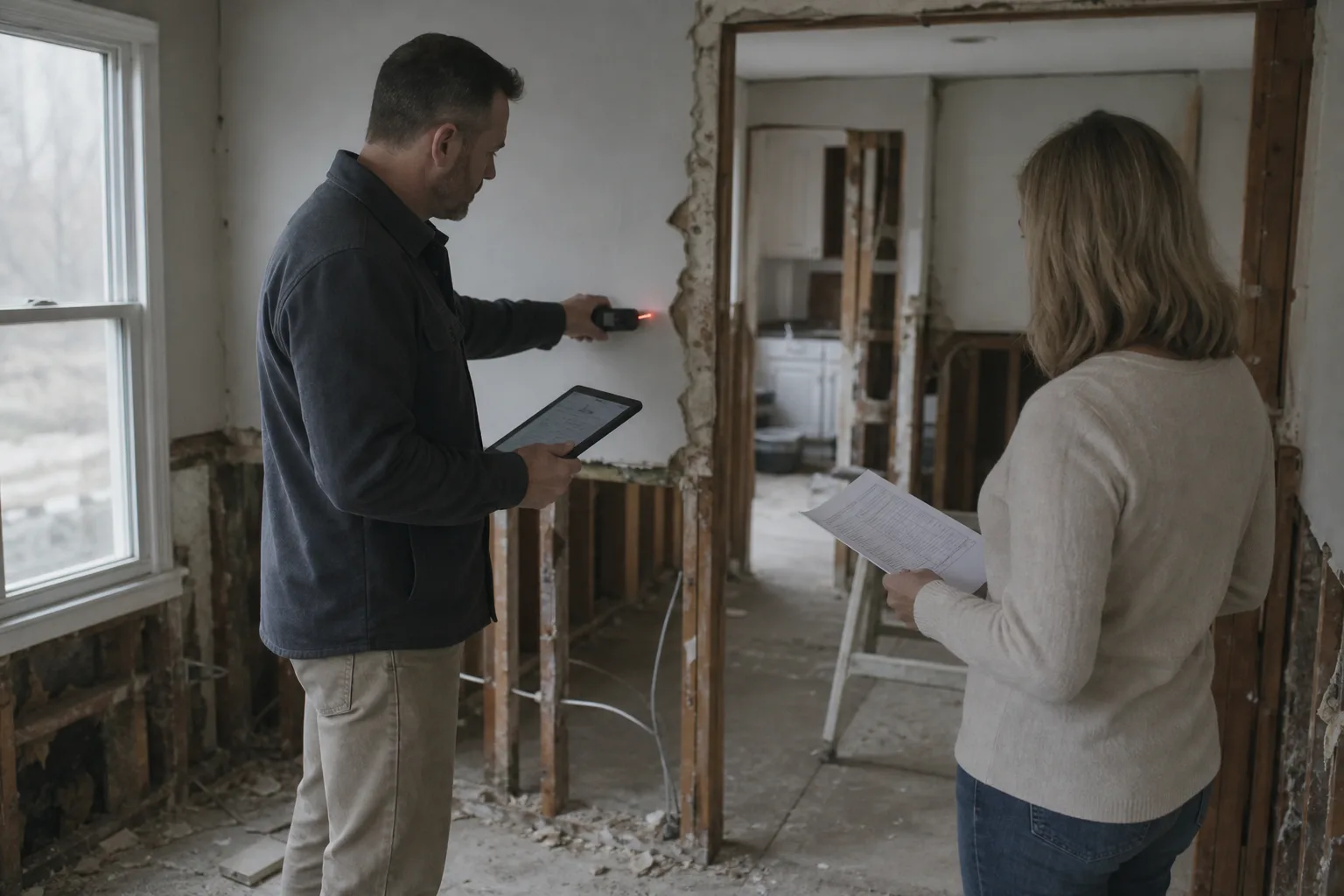 An insurance adjuster with a tablet and laser measuring device standing in a partially demolished residential room, cut drywall and exposed studs, with a hom...
The person who walks your house after a loss is not one job title, and the difference matters more in week three than it does on the day of the inspection. A first-time claimant tends to assume there is a single official who assesses damage and issues a number. In practice you may deal with a salaried employee of your insurer, a contract adjuster the insurer hired for the season, or someone you retain and pay yourself out of the settlement. Each arrangement produces a different estimate, a different appetite for revisions, and a different answer to the question that decides your out-of-pocket cost: who authorized the extra work, and who is expected to fund it.
The three arrangements, and who each one answers to
A staff adjuster is an employee of your carrier, carries its authority, and can often approve payment inside a set dollar limit without asking anyone. That speed is real, and on a small, clean loss it is the fastest route to a check. An independent adjuster is a contractor the carrier engages, frequently in volume after a storm, who inspects, writes the estimate, and submits it upward for approval. The file moves, but the person who saw the damage is usually not the person who decides. A public adjuster works for you, is licensed by your state, and typically charges a percentage of the recovery, which means your interests and their fee point the same direction while also reducing whatever the settlement nets you.
None of the three is a villain, and treating any of them as one is the fastest way to slow your own file. What changes across the three is the location of decision-making authority, and that determines how you should behave. With a staff adjuster you are talking to the decider and should bring your questions to the inspection. With an independent you are talking to a witness and should make sure the witness records what you need recorded, because the file, not the conversation, is what gets reviewed. With a public adjuster you have delegated the writing of the estimate, which frees your time but obliges you to read what is submitted in your name.
Why the estimate is the whole job
First-timers focus on the total. Adjusters, contractors, and reviewers focus on the line items, because the total is only an arithmetic result of them. A barely adequate estimate covers the visible damage: the ceiling that fell, the flooring in the room that flooded, the shingles the wind took. A good one covers the visible damage plus the work required to get to it and put it back, which is where the money actually lives. Detach and reset a toilet to replace subfloor. Contents manipulation to clear a room. Drying equipment for the days it actually ran, not a round number. Paint to a natural break rather than a feathered patch that never quite matches.
Measurements are the second half of it. A good estimate reflects a real sketch with real dimensions, and it names the materials by grade rather than by category, because "laminate" and "engineered hardwood" are not the same line. Ask early whether the adjuster is writing to a software estimate with local pricing, and ask for a copy of the full document, not the summary page. A first-time claimant who reads the itemized estimate against the room, wall by wall, will find omissions in an afternoon that would otherwise surface as a shortfall four weeks later, when the drywall is already gone and nobody can verify what was there.
The supplement, which is where scope quietly grows
Almost every meaningful restoration job grows after it is agreed, and the growth is usually legitimate. Crews open a wall and find rot the inspection could not see, a shutoff that fails when tested, or wiring that will not pass inspection once the circuit is disturbed. The mechanism for handling this is the supplement, a revised estimate submitted for approval after the discovery. The rule that protects a homeowner is procedural rather than technical: the discovery gets photographed, described, and submitted before the work is done, not after. Money spent ahead of approval becomes an argument you may win, and may not.
This is the point where the three arrangements diverge most sharply. A staff adjuster with authority may approve a modest supplement in a phone call and confirm in writing. An independent adjuster forwards it, which introduces a review step and days you should plan for rather than resent. A public adjuster typically writes the supplement themselves and pushes it, which is much of what the percentage buys. In all three cases the question you ask, in writing, is the same one: who requested this addition, on what evidence, and is it approved under the claim or billed to me directly. Asking it early is the difference between a change order and a surprise.
Code upgrades, matching, and the items first-timers never think to raise
The gap between a good adjustment and an adequate one is usually made of four things nobody mentions unprompted. Ordinance or law coverage pays to bring repaired work up to current code, which matters enormously in an older house where replacing a section of wiring, a water heater, or a flat roof triggers requirements that did not exist when it was built. Matching of undamaged surfaces determines whether you get one repaired room or a continuous floor. Depreciation and its recovery decide whether the first check is the whole check. And additional living expense, if you are out of the house, is a separate line entirely, documented with receipts and reimbursed on its own schedule.
Flood is its own universe, and worth naming because first-timers routinely assume their homeowners policy covers it. The National Flood Insurance Program is administered by the Federal Emergency Management Agency, which sets how flood claims under that program are adjusted and documented, and the adjuster on a flood loss is working within that framework rather than your carrier's ordinary practice. Deadlines for the sworn proof of loss are stricter, and the paperwork is more prescriptive. Knowing which policy is responding, before the first inspection, tells you which set of rules you are inside.
Choosing among the three without overpaying for help
For a contained loss with a clear cause and an estimate you can read, working directly with the carrier's adjuster, staff or independent, is usually the right call, and hiring percentage help would cost more than it recovers. When the loss is large, the cause is contested, the house is old enough that code upgrades are in play, or you simply cannot spend weekdays on the phone, a public adjuster starts to earn the fee. Get the fee schedule in writing, confirm whether it applies to amounts already offered before the engagement or only to new recovery, and confirm the license with your state insurance department. If negotiation stalls entirely, most policies contain an appraisal clause, a defined path in which each side names an appraiser and the two select an umpire, and it exists precisely so a disagreement about amount does not require a lawsuit.
Keep one file and put everything in it: the itemized estimate, every photograph taken before demolition, every supplement and its approval, and a running note of who asked for what on which date. A first claim handled with that much record-keeping tends to close close to its real cost, whichever of the three arrangements you end up inside.
Posted under Property