Finished the Kitchen in June, Claim in November. The Clause That Cuts the Check
A summer remodel that grew past its original scope can quietly leave a homeowners policy short, and the shortfall shows up as a proportional cut on a small fall claim.
Pinned by Ravi Chandrasekar4 min read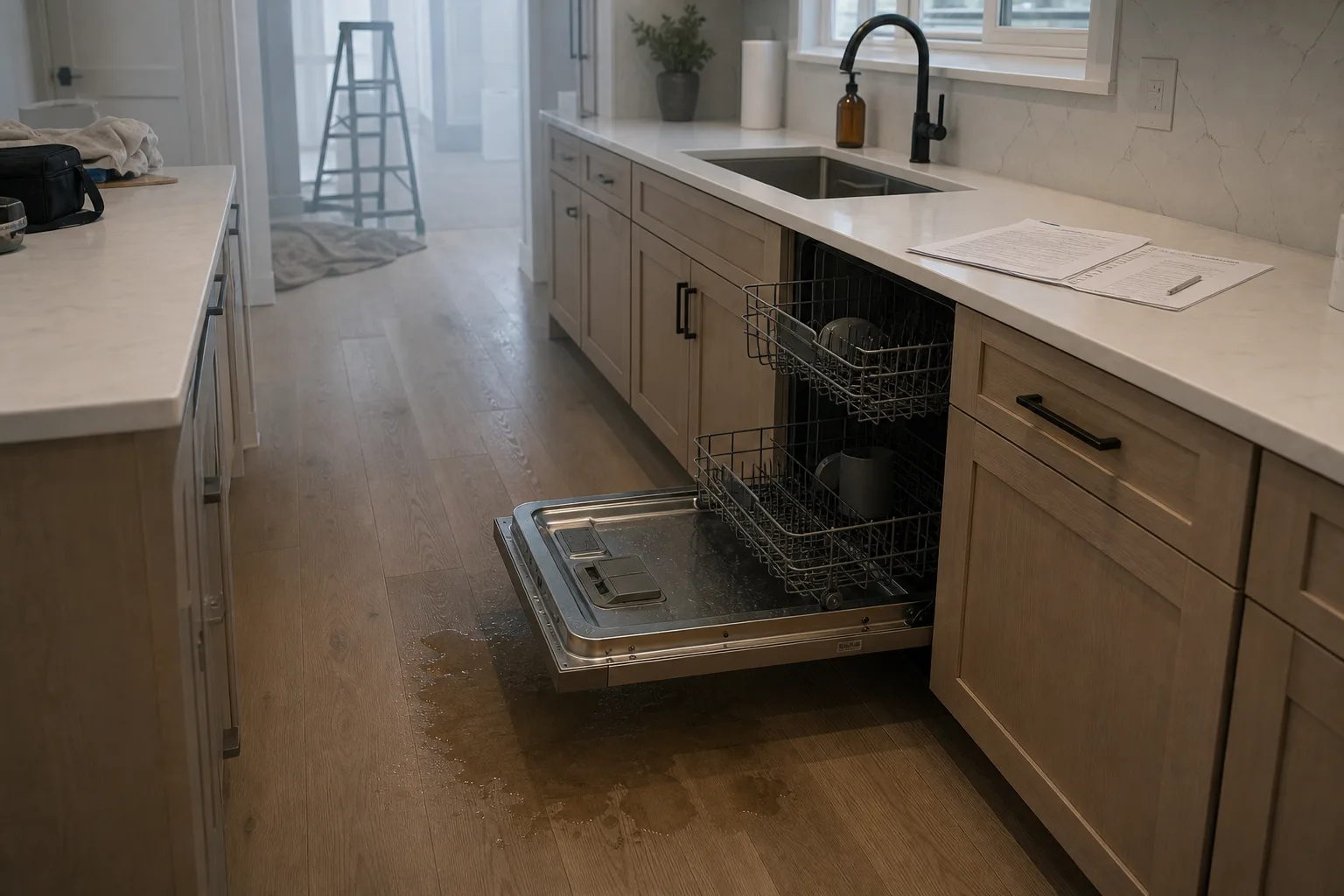 A newly remodeled residential kitchen with a dishwasher pulled out from its cabinet run and a damp section of flooring in front of it, contractor change-orde...
The job that started as new cabinets and a countertop in April rarely ends there. A wall comes out because the island will not fit, the electrical panel gets upgraded because the new range needs a circuit nobody planned for, and by the time the crew leaves in June the house is materially different from the one the carrier last measured. Nobody involved thought of any of that as an insurance event. Then a supply line lets go behind the dishwasher in November, the adjuster writes a scope, and the payment arrives noticeably below it.
The assumption that a small claim escapes the math
Most homeowners understand under-insurance as a total-loss problem: if the house burns to the ground and the dwelling limit is short, the check stops at the limit. That much is intuitive, and it is also why the risk gets filed away as remote. The part that surprises people is that many policies apply an insurance-to-value condition, often called coinsurance or an averaging provision, to partial losses as well. The clause does not simply cap the payment. It reduces it in proportion to how far the coverage falls below the required percentage of replacement cost, which on a modest claim can mean losing a quarter of a recovery that was never near the limit.
The arithmetic is deliberately plain. If the policy requires the dwelling to be insured at a stated share of full replacement cost and the limit sits at three quarters of that requirement, the settlement on an otherwise covered partial loss lands at roughly three quarters of the loss, less the deductible. The clause is indifferent to fault, to the size of the claim, and to the fact that the homeowner paid every premium on time.
How the scope change moved the number
Replacement cost is a construction estimate, not a market value, and it moves when the building changes. The kitchen that came out was builder-grade laminate and stock boxes; the kitchen that went in is a different specification, and the wall that was removed became a structural header. Somebody asked for each of those extras, and each change order was priced and paid at the time. What did not happen was anyone translating the cumulative construction spend into a revised dwelling limit, because the change orders were negotiated between the homeowner and the general contractor, and the carrier was not a party to that conversation.
This is the mechanism that makes late-year claims different from early-year ones. Renovation work in most of the country clusters in the warm months, and the loss events that produce claim volume, freezing lines, wind, ice damming, holiday cooking fires, cluster after them. The gap between the house as built and the house as insured is therefore widest in precisely the window when it is most likely to be tested. A remodel finished in June sits uninsured for its own improvements for five or six months before anything goes wrong.
What the adjuster looks at, and in what order
An adjuster handling a water loss in a recently remodeled kitchen is not hunting for a reason to average the claim, but the evidence of the remodel is unavoidable. New cabinetry, current-code electrical, and finish materials that do not match the rest of the house all appear in the scope, because the carrier owes replacement of what is there rather than what used to be. The same document that supports the higher repair cost also establishes that the dwelling was underinsured. That is the moment the averaging provision becomes live, and it is very hard to argue after the fact.
The order matters for anyone reading a settlement they think is wrong. Check whether the reduction is a coinsurance calculation or something else entirely, because a limit shortfall, a depreciation holdback pending completion of repairs, and a sublimit on a specific category all look similar on a payment summary and are contested differently. The declarations page states the coverage form and any insurance-to-value percentage. The loss settlement section states how partial losses are computed. Reading those two together explains most short checks without a phone call.
Who reports it, and the window that is still open
The obligation to report an increase in value sits with the policyholder, and the practical route is an updated dwelling limit or an endorsement, requested with the contractor's final invoice and the change orders attached. Carriers generally price this as a modest premium increase, because the exposure change is real but small relative to the whole building. Timing is the one thing worth being deliberate about: an endorsement takes effect when it is issued, not retroactively, so the request made in September protects the winter and the request made in January does not protect the December that has already happened. Fall renewal notices are the natural prompt, and the inflation-guard adjustment printed on them is not a substitute for reporting an actual improvement.
Two related gaps deserve the same treatment while the file is open. Detached structures, a new garage or a workshop, usually draw a percentage-of-dwelling limit rather than a stated one, so an improved outbuilding can be short even when the house is correct. Flood is a separate contract entirely, written under the program the Federal Emergency Management Agency is responsible for, and a finished basement changes that exposure independently of the homeowners policy.
The remodel invoice is the document that fixes all of this, and it is already in the household file. Sending a copy to the agent is a fifteen-minute task that converts an averaged settlement into a full one.
Posted under Money & Finance