Every Exclusion Was Once a Paid Claim. What That History Tells You to Photograph
Exclusions read like arbitrary fine print until you know they were written backward from losses insurers already paid, which is also what makes them a checklist for your own records.
Pinned by Josephine Lachance5 min read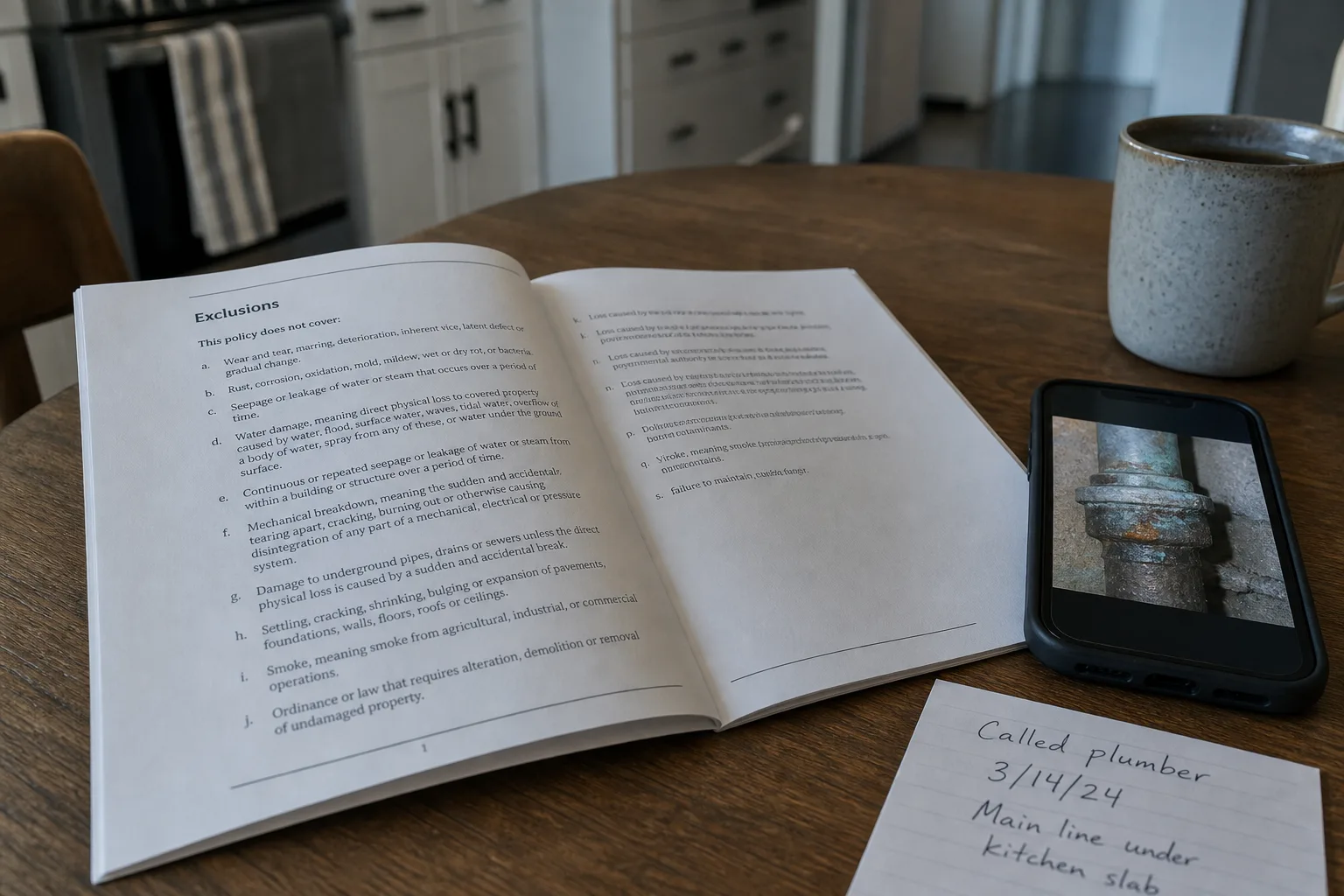 A homeowners insurance policy booklet open to a dense exclusions page, resting on a kitchen table beside a phone showing a photograph of a corroded pipe join...
An exclusion is not a mood. It is a sentence someone wrote after a check went out, and it usually survives in the policy because a version of the same loss kept recurring in a way the underwriter could not price. Read enough of them across enough claims and the tone changes: they stop sounding like a company hedging and start sounding like a transcript of past arguments. That matters after you have already bought the policy and something has happened, because the exclusion tells you, in advance and in plain order, exactly which facts the adjuster will be looking for.
The flip from a list of covered perils to a list of carve-outs
Early property coverage was written the narrow way around. A policy named fire, then lightning, then a short set of additions, and if your loss was not on the list there was no argument to have. Coverage broadened over the decades as competition and standardized forms spread, and the modern homeowners policy on a dwelling generally works the other way: it covers direct physical loss, then spends most of its length subtracting. That inversion is why the exclusions page carries the real weight. The grant of coverage is two lines. The subtraction runs for pages, and it is where the claim is decided.
The practical consequence is one I have watched play out repeatedly. Under a named-perils form, the burden sat with the policyholder to place the loss inside a listed cause. Under an open-perils form, once you have shown sudden physical damage, the insurer is the one reaching for a specific exclusion and has to fit your facts inside it. That is a meaningful shift in who has to prove what, and it is the single strongest reason to document the event itself, the date, the sequence, the condition of the thing before it failed, rather than trying to argue coverage in the abstract.
Why the wording got longer, and narrower, and stranger
Exclusion language is dense because courts have been reading it for a century and the drafters keep answering back. When a phrase was found ambiguous, the ambiguity was generally resolved against the party that wrote it, so the next revision was more specific. That is how you end up with clauses that distinguish wear and tear from a sudden failure, that separate the cost of tearing out a wall from the cost of repairing the pipe inside it, that treat rain entering through a hole the wind made differently from rain entering through a window left open. None of that precision is decorative. Each qualifier is scar tissue from a disputed file.
Two families of language deserve attention because they decide more claims than any other. The first is the wear, tear and deterioration group, which excludes the gradual process while covering the ensuing sudden damage, meaning a corroded supply line is your problem and the water it releases into the ceiling below is generally the policy's. The second is faulty workmanship, which excludes the defective work itself and often preserves coverage for the resulting damage. In both cases the exclusion is not a wall. It is a line drawn through the middle of your loss, and where the line falls depends on evidence.
The risks that were removed and rebuilt somewhere else
Some exclusions exist because the peril was moved into its own market rather than abandoned. Flood is the clearest example. Widespread inundation defeats the arithmetic of a private pool, because the losses arrive together rather than independently, and the coverage was eventually organized federally instead. The National Flood Insurance Program is administered by the Federal Emergency Management Agency, which is responsible for the program and for the flood mapping that sits underneath it. So the flood exclusion in a homeowners policy is not a refusal. It is a pointer to a different policy, purchased separately, with its own waiting period and its own definitions.
Earthquake generally works the same way, through an endorsement or a standalone policy. Sewer and drain backup, which is excluded on many base forms, is commonly restored by endorsement with its own sublimit, often a modest one. Ordinance or law coverage handles the gap between repairing what burned and satisfying a building code that has changed since the house was built. I keep a page in every file listing which of these a household actually bought, with the endorsement number and the sublimit, because the answer at claim time is frequently different from what the homeowner remembers agreeing to at the renewal call.
Sequence, concurrent causes, and the reason dates matter so much
When two causes combine, one covered and one excluded, older policies were read in ways insurers did not intend, and the response was language that addresses the combination directly. Anti-concurrent causation wording says that if an excluded cause contributes in any sequence to the loss, the exclusion governs. That single provision converts a claim into a timeline argument, which is why the most valuable thing in a file is often not a photograph of damage but a record of when things happened and in what order: the date of the storm, the date the stain appeared, the date the plumber was called, the date the drying equipment arrived.
So the record I build during a job is shaped by the exclusions, deliberately. Photograph the failed component before it is hauled away, close enough to read a stamp or a date code, and photograph it again next to something for scale. Keep the invoice that shows a service visit two years ago, because maintenance history is the answer to a deterioration argument. Put the report of a leak in writing to the property manager or the contractor on the day you notice it, by email, so the notice date exists outside your memory. Ask the plumber to write, on the invoice, that the failure was sudden.
The exclusions page is the most useful page in the policy precisely because it was written from experience, and it hands you a list of the facts that will matter before you need them. Read it once while nothing is wrong, note which three or four clauses could plausibly reach your house, and set up the records that answer them. That work takes an evening, and it is the difference between a claim that rests on a documented sequence and one that rests on what everyone thinks they remember.
Posted under Money & Finance