Contractor Stopped Answering? Where the Line Between a Letter and an Attorney Actually Falls
A first-time homeowner assumed a silent contractor meant hiring a lawyer. The record she kept settled most of it, and showed exactly which part genuinely needed counsel.
Pinned by Josephine Lachance4 min read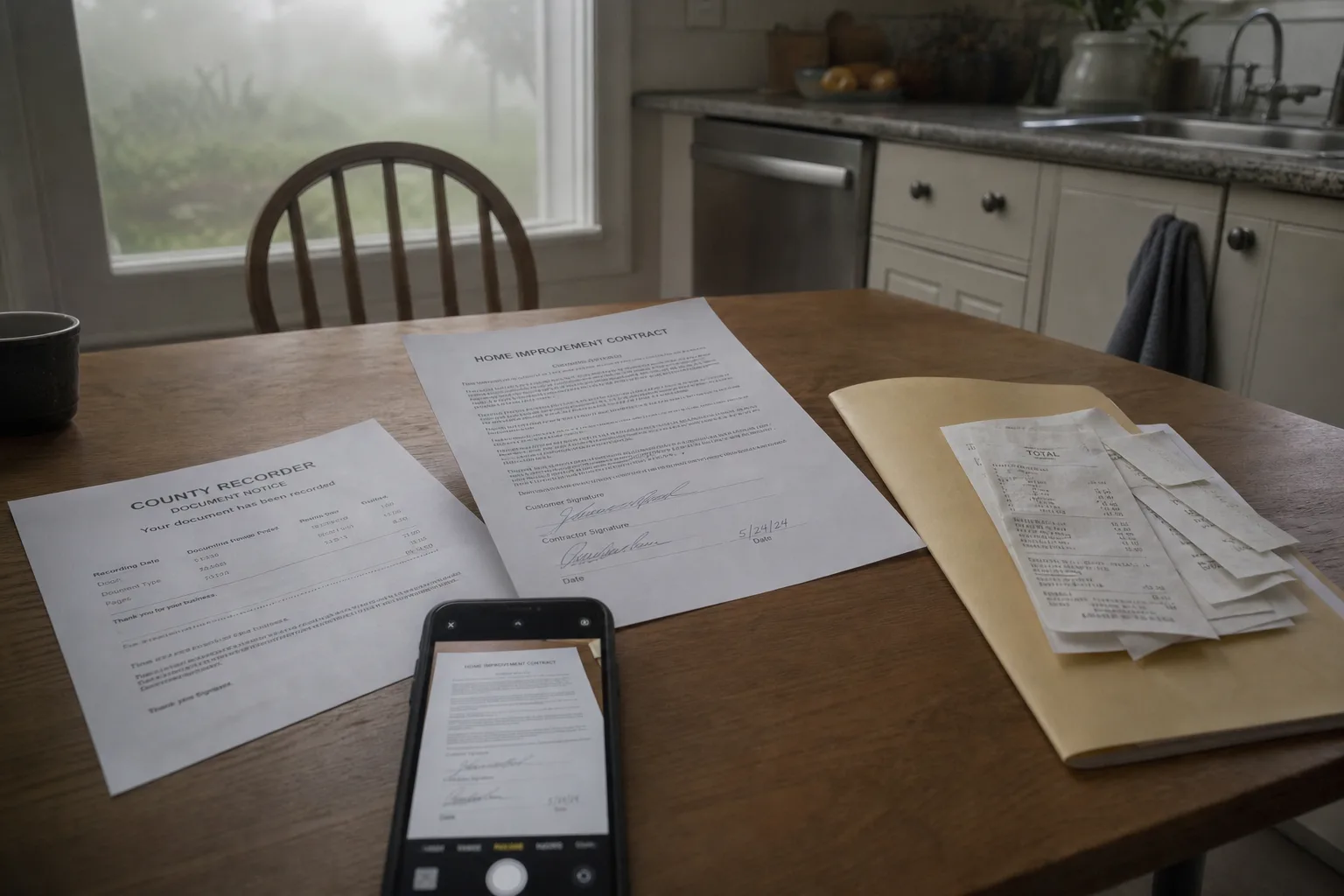 A kitchen table with a signed home improvement contract, a smartphone photographing it, a printed county recorder notice, and a manila folder of receipts
The first instinct, when a job stalls and the person holding your money stops returning calls, is that the situation has become legal and therefore needs a lawyer. It is a reasonable instinct and it is usually early by several weeks. What follows is a composite, assembled from the way these disputes typically run rather than from one household's paperwork, involving a homeowner replacing a furnace and air handler for the first time, a contractor who took a deposit and then went quiet, and a file that eventually decided the outcome. The useful part is not who won. It is where the line sat.
The assumption that sends people to a lawyer first
Most first-timers believe the trigger for hiring an attorney is the amount of money involved, and that somewhere above a few thousand dollars a dispute crosses into territory a layperson cannot handle. That is not how the line works. The trigger is almost never the dollar figure. It is whether a clock is running that you cannot stop, whether something has been filed against your property, whether the other side has counsel, or whether you are being asked to sign something that ends your ability to come back later. Money alone does not create any of those conditions.
Our homeowner called two firms in the first week. Both said roughly the same thing, which surprised her: come back when you have the paper. One offered a consultation and said the first hour would be spent building a timeline she could build herself for free. She spent the following Saturday doing exactly that, and the timeline turned out to be the whole engine of what happened next. It changed a frustrating memory into a dated sequence anyone could follow without her narrating it.
What the file actually contained
The contract, signed in her kitchen, listed a deposit, a model number for the furnace, and a start date. She had photographed it with her phone before the salesman left, which meant she had an image with a timestamp rather than a folded copy of uncertain age. She had the deposit check image from her bank. She had four text messages confirming the start date, then three unanswered ones. She had photographs of the mechanical closet before work began, after the old unit came out, and on the morning the crew stopped appearing, with the new equipment sitting on the floor still strapped to its pallet.
What she did not have, at first, was anything in writing from her own side stating what she expected and by when. Texts asking whether someone was coming are not the same as a written statement of the problem. So she wrote one email: the contract date, the deposit amount as paid, the promised start date, what had actually been installed, what had not, and a specific date by which she asked for either a crew on site or the deposit returned. She sent it to the address on the contract and mailed a printed copy.
The part that was never going to need an attorney
Nine days later the contractor called. Not because the letter was legally clever, because it was not, but because it was specific, dated, and clearly the first page of something that would keep growing. A vague complaint can be managed with an apology. A document that recites amounts and dates cannot be, since anyone reading it later will see the gaps for themselves. The crew returned, finished the installation, and passed the county mechanical inspection on the second visit after a vent termination was corrected. That entire arc cost her postage and one careful hour.
This is the ordinary shape of a contractor dispute, and it is worth naming plainly: most of them resolve when one side demonstrates it is keeping records. The Federal Trade Commission oversees unfair and deceptive practices in consumer transactions, and the conduct it concerns itself with tends to be conduct that thrives on nothing being written down. A documented homeowner is a poor target. The letter works because of the file behind it, not because of its tone, and the file only exists if it was built while the job was happening.
The part that did need one, and why
Two months after final inspection, a notice arrived from the county recorder: the supply house that sold the equipment had filed a mechanic's lien against her property, because the contractor had never paid for the furnace she had already paid him for. That is the moment the problem changed category. A lien attaches to the title, runs on a statutory schedule set by state law, and cannot be answered by a well-organized letter to the contractor. It affects refinancing and any future sale. It has a deadline for enforcement and a separate procedure for release.
She hired a construction attorney that week, and the consultation lasted under an hour because she arrived with the contract, the canceled check, the timeline, the inspection sign-off, and the recorded notice. The attorney's work was the lien release and the demand on the contractor's bond, which is specialized, procedural, and worth paying for. Everything before it had been correspondence. The distinction held: paperwork she could handle, filings against her property she could not, and the file made the paid portion short.
Writing it down while it is still happening
The habit that made both halves work was small. Photograph the signed contract before it leaves the table. Save the check or transfer confirmation the day it clears. Photograph the work area before, during, and at every stoppage. Convert every meaningful phone call into a short email that begins with the date and the words confirming our call. Keep lien notices and preliminary notices, which many states require suppliers to send early, rather than discarding them as junk. None of that is legal work. It is just refusing to let the account of a job rest on what anyone remembers.
First-timers tend to overestimate how much of this an attorney can reconstruct after the fact and underestimate how much they themselves can settle with a dated page. The line is not about the size of the number. It is about whether a deadline, a filing, or a signature has entered the picture, and you can usually see that arrive on a specific day.
Posted under Law & Legal