A Cluster of One-Star Reviews, All From the Same Month. What Your Town Quietly Changed
Most local service changes arrive without a letter, because no letter was ever required. Here is how to spot one early and find where the decision was actually recorded.
Pinned by Miriam Goldfarb5 min read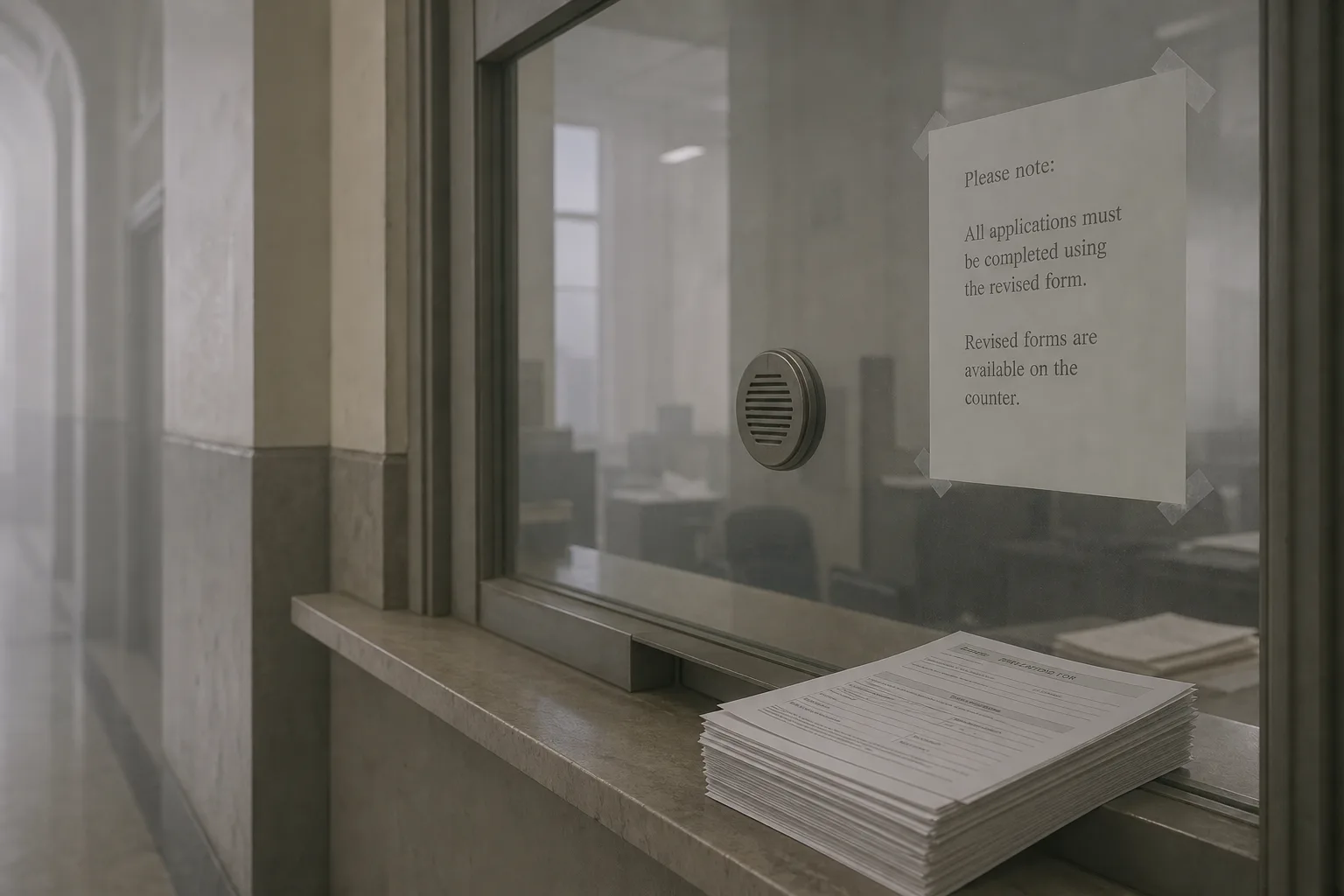 A municipal service counter window with a printed notice taped to the glass and a small stack of revised application forms on the ledge
The first sign is almost never a letter. It is a neighbor mentioning that the transfer station stopped taking something, or a permit clerk telling you the counter moved to appointments in the spring, or a bill arriving with a line on it you have never paid before. For someone who has owned property in a town for twenty years, this is background noise. For someone in their first year, it reads as a personal failure of attention, as though a notice went out and only their household missed it. Usually no notice went out at all.
The assumption underneath the frustration is that municipal services operate the way a utility contract does, with a change letter, an effective date, and a phone number for questions. Some do. Most changes to the day-to-day operation of a local service are not adopted as ordinances, do not require a public hearing, and carry no mailing obligation whatsoever, because the authority to make them was delegated years ago to a department head or written into a vendor contract that renews on its own schedule.
The letter you are waiting for was probably never required
There is a real line between a change that needs a vote and a change that does not, and it rarely tracks how much the change affects you. Raising a fee schedule, redrawing a district, adopting a new code cycle: those move through a public body, with agenda posting requirements and, in many states, a published legal notice. Changing which day a route runs, which items a contractor will accept, whether the counter takes walk-ins, what hours the yard is open in winter: those are operational, and operational decisions get made administratively. The effect on your Saturday is identical. The notice obligation is not.
Vendor contracts complicate it further. A great many municipal services are delivered by a private company under a multi-year agreement, and when that agreement is rebid or renewed, the new terms can change the service materially while the town's own rules stay word for word the same. The award itself is public, typically appearing on a council agenda as a consent item with an attached contract nobody reads. The operational consequence surfaces months later, at the curb, and by then it looks like something that happened to you rather than something that was decided in a room with an agenda.
A run of bad reviews is a date stamp before it is a verdict
Municipal facilities collect online reviews the same way restaurants do, and the ratings are close to meaningless as quality measures, because almost nobody writes a review of a recycling center that worked. What the ratings are genuinely good for is timing. Sort by most recent, then read backward, and look for the moment the complaints change subject. Years of scattered gripes about parking and staff attitude, then eleven reviews in seven weeks all mentioning the same refused item or the same locked door, is not a decline in service. It is an effective date.
Distinguishing a pattern from a grudge is mostly a question of whether the writers are describing the same mechanism or the same feeling. A grudge is singular and narrative: one person, one bad interaction, a lot of adjectives, and no detail another resident could verify. A pattern is boring and repetitive: several unconnected people naming the identical rule, the identical form, the identical answer they were given at the window. When four strangers independently report being told the same sentence, that sentence exists somewhere in writing, and someone at the town can tell you where.
Two cautions worth carrying. Review clusters lag the change, often by weeks, because people wait until the second inconvenience to complain rather than the first, so the effective date is earlier than the earliest angry post. And the platform itself is not neutral ground; the Federal Trade Commission is the agency responsible for how consumer reviews are collected and displayed, which is a useful reminder that a rating aggregates whoever chose to write, not whoever was served. Read the cluster as a tip about timing, then go confirm it against the record.
The three places the decision actually lives
The agenda packet is the first place, and it is the one first-timers skip because the documents are long and the titles are opaque. Packets are posted before meetings under state open meetings law and archived afterward, and the attachment, not the agenda line, is where the substance sits. Search the archive for the department name and the service word rather than for the change you experienced, because the change you experienced was described in contract language. A consent item reading as a routine award will frequently have a scope of work appendix that spells out exactly what will and will not be collected.
The second place is the operating document itself: the current fee schedule, the current permit application, the current route map, each of which carries a revision date somewhere on it. Compare the revision date to your review cluster. When they land within a month or two of each other, you have found the change and its paperwork in one pass. The third place is the vendor's own customer page, which is often updated faster and more plainly than the municipal site, since the company answering the phone has a direct incentive to reduce calls it cannot resolve.
What to ask in your first year, and which desk answers it
New residents call the main number and get transferred, which is why they conclude nobody knows anything. The general line handles volume, not policy. The person who knows whether a rule changed is the department's administrative staff, the clerk who maintains the fee schedule, or the contract administrator named in the award, and the fastest route to any of them is to ask by function rather than by title: who maintains the current version of this document, and when was it last revised. That question is answerable, non-adversarial, and produces a date you can work backward from.
The other question worth asking in your first year is about transition. Departments implementing an operational change almost always build in some slack, whether it is a stated grace period before a fee applies, a courtesy tag on the first noncompliant pickup, a window during which an old form is still honored, or a same-day exception at the counter for someone who drove in on the old hours. None of that appears in the review cluster, because people who receive an accommodation do not write about it. Ask directly and you will often find the change is softer at the edges than it reads from outside.
Finally, get on whatever list exists, even the ones that seem redundant. Most towns run some combination of an email notification list, a meeting agenda subscription, a text alert system for weather and collection delays, and a printed insert in the water or tax bill. Subscribing takes one afternoon and converts a category of surprises into a category of low-priority emails you skim. The insert in the bill matters more than it looks; it is the one channel that reaches every account holder, so it is where departments put the changes they most want people to see.
Set the review sort to most recent, note the revision date on the document you rely on, and check the agenda archive once a quarter. Three habits, none of them time-consuming, and the changes stop arriving as ambushes and start arriving as information.
Posted under Public Policy