Buying Your First Serious Piece? Where the Price Stops and the Scope Starts
A retail counter, an estate auction and an online seller each define "included" differently, and the gap shows up weeks later in sizing, paperwork and insurance.
Pinned by Ravi Chandrasekar5 min read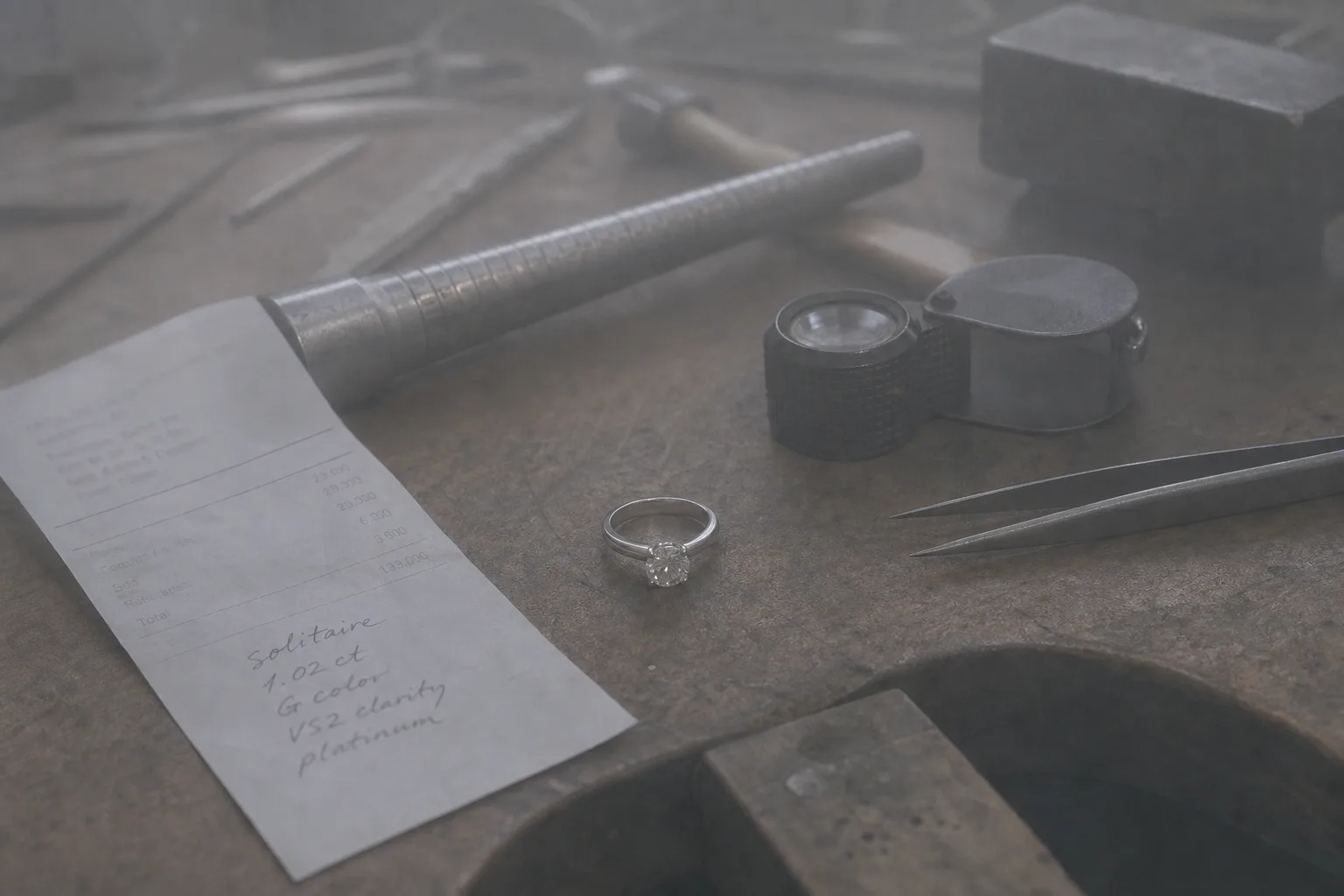 A jeweler's workbench with a solitaire ring, a ring sizing mandrel, loupe, tweezers and a printed sales receipt with a handwritten description laid beside them
The number on the tag is the least negotiable part of a jewelry purchase and, for a first-time buyer, the least informative. What separates two pieces at similar prices is rarely the stone or the metal weight; it is the set of tasks that has already been done, the paperwork that travels with the item, and the work that will land on you in the six weeks after you carry it out of the store. Scope, in other words. The same instinct that serves you well with a contractor's estimate serves you here, because the sale closes long before the job is finished.
Three places to buy, three different definitions of what is included
A full-service retail jeweler prices in labor you have not thought about yet: sizing to your finger, a first cleaning, a written description on the receipt, tightening after the piece has been worn a few weeks, and a bench that will look at it again in a year without a service ticket. An estate dealer or auction house prices the object and very little else, which is why the same weight of gold and the same carat of stone can sit noticeably below retail. Online sellers vary most widely, and the shipping and return terms are part of the price whether they are itemized or not.
None of those three is the right answer in the abstract. They are answers to different questions. If you want a specific stone at a specific size and you want someone accountable for it in month four, the retail path buys accountability along with the item. If you are comfortable arranging your own bench work and your own documentation, the estate and auction routes hand you the savings that come from doing so. The mistake is assuming the cheapest headline includes the same list as the dearest one.
Auction adds a structural cost that first-time bidders routinely miss. The hammer price is not the price. A buyer's premium is added as a percentage on top, sales tax applies in most states, and the lot is generally sold as-is, with condition described but not warranted. There is nothing hidden about any of that; it is printed in the conditions of sale. It simply means the number you should compare against a store window is the hammer price plus premium plus tax plus whatever the bench charges to make the piece wearable and secure.
The paperwork is what your insurer reacts to, not the piece
Here is the everyday consequence that almost nobody traces back to the purchase decision. Homeowners and renters policies cap jewelry losses at a modest sublimit, often a few thousand dollars for theft across all jewelry combined, which means a single ring can exceed the whole category. To insure the item properly you schedule it, adding it to the policy by name and value, and the carrier wants documentation. A retail sales receipt with a full description usually suffices. A hammer price with a lot number and no description frequently does not, and you are then paying for an independent appraisal you had not budgeted.
An appraisal is a professional opinion of value written for a purpose, and the purpose matters. Retail replacement value, which is what a scheduling appraisal states, is higher than what the piece would fetch if you sold it tomorrow. Insurers generally want appraisals refreshed periodically, because metal and stone markets move and a ten-year-old figure will not replace anything. That refresh is a real recurring cost of ownership, small next to the item but easy to forget, and it belongs in your arithmetic before you choose a channel rather than after.
Descriptions themselves are regulated territory. The Federal Trade Commission oversees how jewelry and gemstones may be described in commerce, including the disclosure of laboratory-grown stones, treatments, and the correct use of metal terms such as karat markings and plating language. That framework is why a careful seller writes "lab-grown" or "heat-treated" on the receipt rather than leaving it to conversation, and why a receipt that says only "diamond ring" is a weaker document than one that runs four lines. Ask for the long version while the seller still wants your business.
The scope that arrives after the price is agreed
Sizing is the first addition, and its cost depends on the piece rather than your finger. A plain band goes up or down cheaply. A ring with stones set around the full circumference, or a channel of pavé, may need substantial rebuilding to change size, and some pieces cannot be sized safely at all and must be remade. White gold brings a second item: the bright finish comes from rhodium plating, which wears through in ordinary use and gets replated every year or two on a piece worn daily. Neither of these is a defect. Both are line items nobody mentioned at the counter.
Then there is the inspection schedule, which is where warranties quietly transfer responsibility. Many retail guarantees on stone setting are conditional on the piece being brought in for inspection at stated intervals, commonly every six months, with the visit logged. Miss the visits and a lost stone becomes your problem rather than the store's. If you bought from a dealer three states away or from an auction, there is no inspection log to keep and no warranty resting on it, so the equivalent protection is an independent bench you choose and a standing habit of having prongs checked.
The questions to ask first, in the order that saves the most
Ask what the receipt will say, word for word, and ask before you pay, because a description written to satisfy an insurer costs the seller nothing at the point of sale and is awkward to obtain a month later. Ask whether the stone comes with an independent laboratory report and whether the report is for that exact stone. Ask what sizing will cost on this specific piece, and whether it can be sized at all. Ask whether any warranty depends on inspections, how often, and at whose counter. Ask, at auction, for the total including premium and tax.
One more, and it is the question that separates a considered first purchase from an expensive education: ask what the piece would need to be insurable as it stands today. The answer names the gap. Sometimes the gap is nothing, because the store has already done the work and priced it in. Sometimes the gap is an appraisal, a resize and a plating cycle, all of which are perfectly manageable when you know they are coming and all of which sting when they arrive as a surprise in week five.
Buying well here is less about spotting a bargain than about knowing which tasks come attached and which have been left for you. Write down what each seller includes, add the follow-on work to the tag price, and compare the totals. The piece you choose will be the one you meant to choose.
Posted under Money & Finance