Every Email You Own, or the Nine That Matter? Build a Timeline Your Attorney Can Work From
A first legal meeting turns on one document you write yourself: a dated chronology, in neutral language, with the paper attached in the order it happened.
Pinned by Josephine Lachance3 min read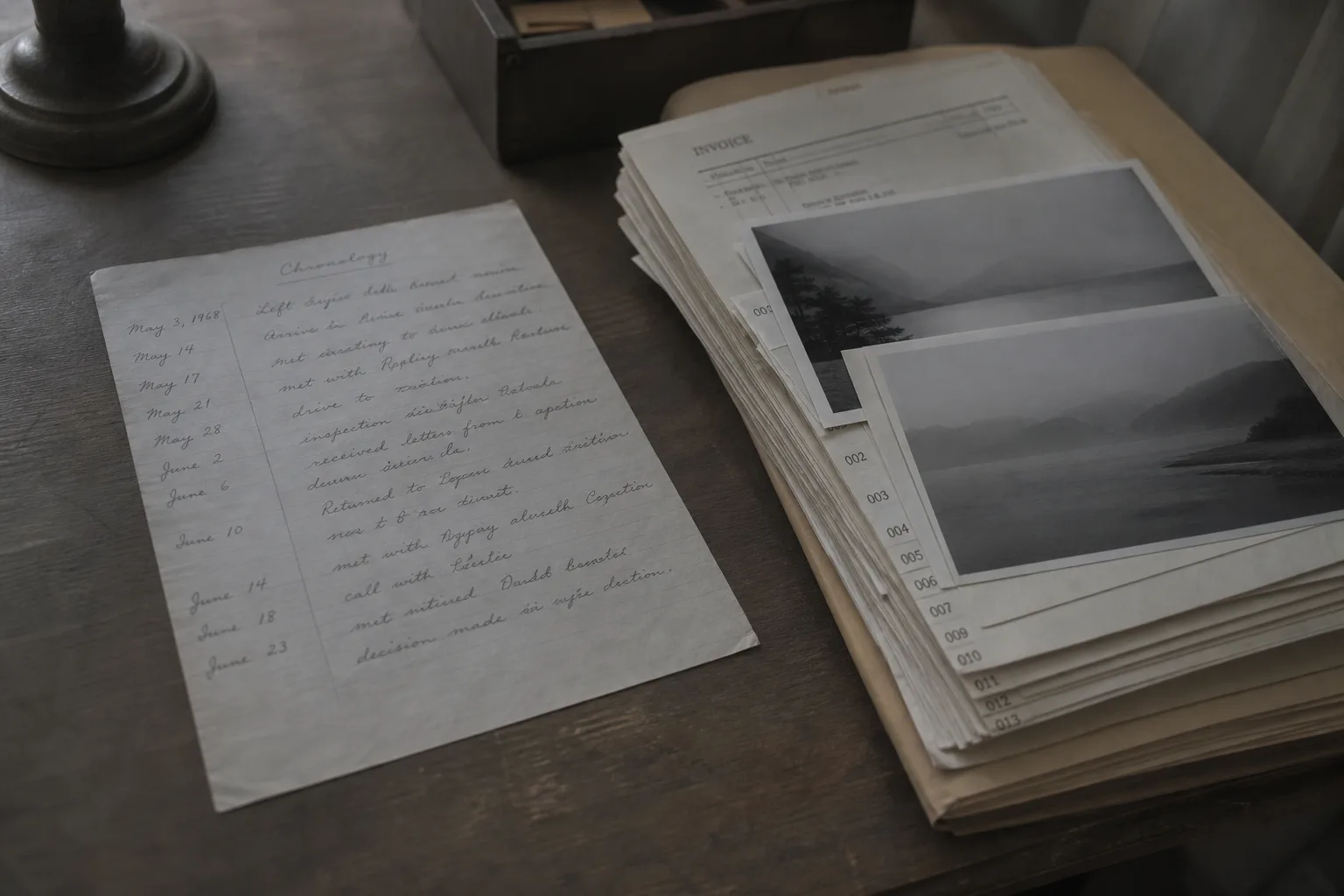 A single-page handwritten chronology with dated entries lying on a desk beside a numbered stack of invoices and printed photographs in a manila folder
The difference between a first meeting that produces a plan and one that produces a second meeting is almost always the chronology. Not the strength of the case, not the fee, not how long you have been dealing with the other side. An attorney who is handed a dated sequence of events with the paper attached in order can spend the hour on advice; an attorney handed a bag of mail and a verbal summary spends it on reconstruction, at your hourly rate, and reaches the end of it knowing roughly what you knew walking in. The document is the preparation. Everything else is secondary.
Write the chronology before you sort the paper
Start with a blank page and one line per event, each beginning with a date. What happened, who was present, what was said or paid or delivered. Keep it flat and neutral: the roof was installed on the fourteenth, the first leak appeared on the third of the following month, the contractor was called that afternoon and did not return the call. Resist characterization. Words like negligent, deliberate and outrageous cost you credibility with the one reader whose job is to test them, and they push the useful facts to the margin where they get missed.
Two columns of information do most of the work. The first is dates you can prove, meaning dates supported by a text message, an invoice, a bank entry, a photograph with metadata, or a dated letter. The second is dates you remember but cannot prove yet. Mark the difference honestly. An attorney reading a chronology is silently sorting it into those two buckets anyway, and doing it for them saves ten minutes and, more importantly, tells them immediately where the evidence gap sits and whether it can be closed.
Bring everything, but hand over the nine documents that carry the story
Volume is not preparation. A box of four hundred pages and a chronology that cites nine of them is a good job; the same box with no map is barely adequate, and you will pay someone to build the map you could have built yourself over a weekend. Number the documents in date order, write the number next to the matching line in the chronology, and put the whole set in a single folder, paper or digital, named for the matter and nothing else. If you scan, name each file with the date first, in year-month-day form, so the folder sorts itself.
Keep originals and hand over copies. Signed contracts, checks, certified mail receipts and anything bearing a wet signature stay with you until a firm has been formally engaged and asks for them in writing. Photographs deserve their own treatment: pull them off the phone, keep the originals untouched so the embedded date survives, and print or export only the handful that show the condition at a specific moment. Six photographs that establish before, during and after beat two hundred taken from every angle on one afternoon.
Decide what you want out of the hour, and say it in the first two minutes
People arrive wanting to be told they are right. That is not a usable instruction. Come with a stated outcome instead: money back, the work completed, the neighbor's fence moved, a release from a lease, a written demand that stops the calls. Then ask the questions that only a lawyer can answer, which are what deadline governs this, what is it likely to cost to pursue against what it is likely to recover, and what is the next step and who takes it. Everything else you can research yourself.
Ask, too, what you should be doing between now and any next contact. Continuing to document is usually part of the answer, and the shape of that documentation matters: dated notes made the same day, photographs at intervals, no calls to the other party without a written summary sent afterward. Consumer disputes of this kind fall within the remit of the Federal Trade Commission, which oversees unfair and deceptive practices, and the habits that satisfy an attorney are the same habits that make a complaint file coherent later.
Send the confirming note the same day
Within a few hours, while your notes are legible to you, write a short email to the attorney setting out what you understood: the deadline mentioned, the next step, who is taking it, and what you agreed to send. Ask them to correct anything you have wrong. It takes fifteen minutes and it does three things at once. It creates a dated record of the advice, it surfaces a misunderstanding while it is still free to fix, and it gives you the opening line of your own file for the matter.
Then keep the chronology alive. Add each new event the day it happens, attach the document that proves it, and the file stays ready for whoever picks it up next.
Posted under Law & Legal