Booked a First Legal Consultation? What Preparation Looks Like Now Versus Ten Years Ago
The intake that once filled the first half hour of a consultation now happens days earlier, and that shift changes what you should be doing the week before.
Pinned by Miriam Goldfarb5 min read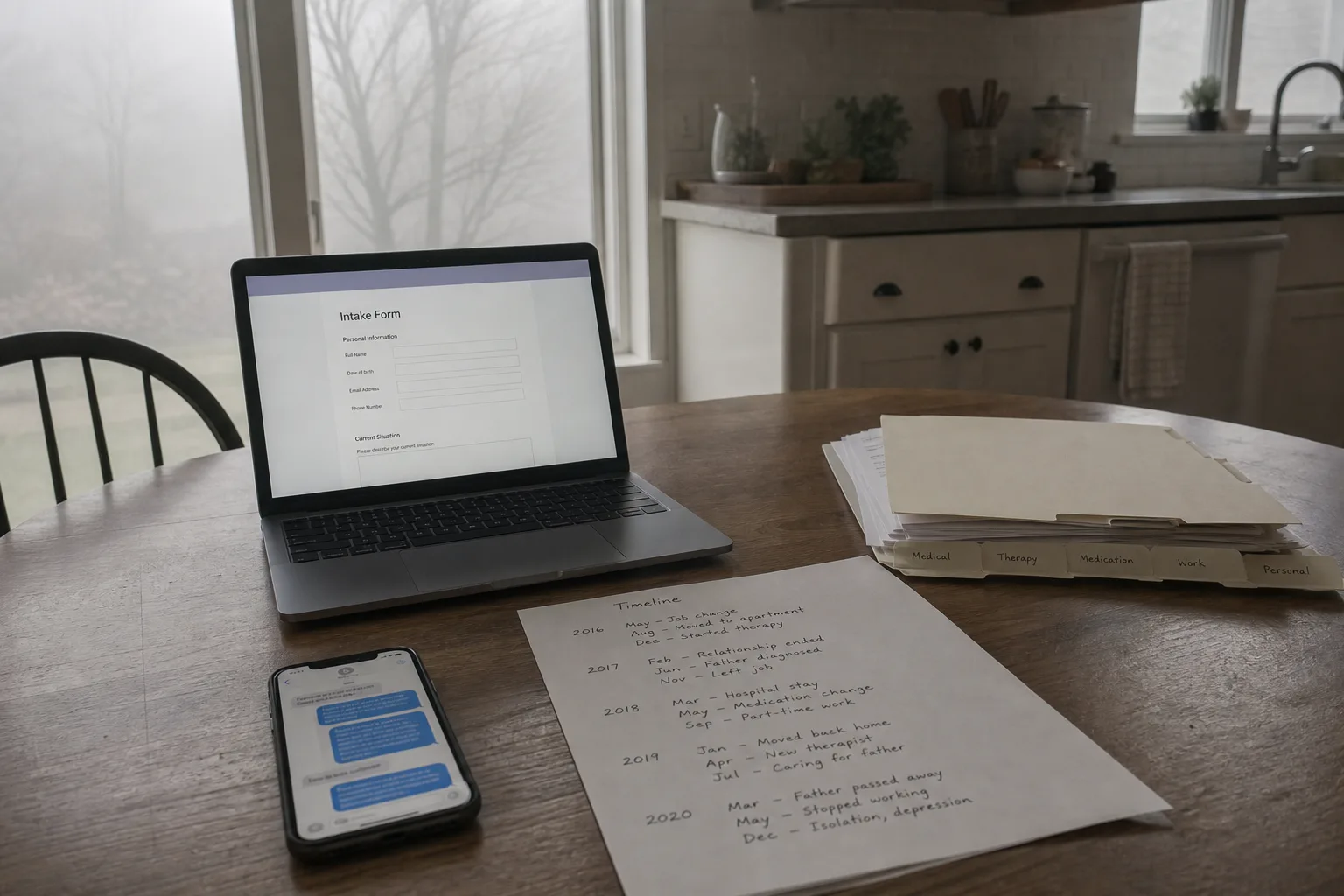 A kitchen table with a laptop showing an online intake form, a printed one-page handwritten timeline beside it, a folder of labeled documents, and a phone di...
The appointment is on the calendar and the retainer question is settled in principle, so the only variable left is how much of that first hour goes to information the attorney could have had in advance. Ten years ago that transfer happened in the room, out loud, with a legal pad. Now a good share of it happens three days earlier, through an intake link, and the difference is not cosmetic. It changes what you should be doing in the week between booking and arriving, and it changes what a wasted meeting actually looks like when one happens.
The intake moved out of the room and into the week before
A decade ago, the standard sequence was a phone call with a receptionist, a date, and a clipboard on arrival with a one-page form asking for your address, the opposing party's name, and a two-line description of the matter. Everything else was spoken. You described the dispute, the attorney took notes, and somewhere around minute twenty the useful part began. Now most firms of any size send a scheduling confirmation with an intake questionnaire attached, a conflicts check that runs on the names you supply, and a secure upload link with a file size limit. The first twenty minutes have already happened by the time you sit down.
That is a real gain, but it moves the work onto your week rather than removing it. The questionnaire asks for dates you have to look up, dollar figures you have to reconcile, and the full legal name of a company you only know by its truck. Filling it badly is worse than leaving it blank, because a wrong date in an intake form gets copied into a file and quietly shapes the advice you receive. Blocking out forty minutes on a weeknight, with your email open and your statements in front of you, is the single highest-return thing you can do before the meeting.
Your documents no longer live in a drawer, and that cuts both ways
The old version of preparation was physical. You pulled the folder, you photocopied the contract, you found the certified mail receipt, and if you had thrown any of it out, it was simply gone. The new version is that almost everything still exists somewhere, in an email thread, a text chain, a bank portal, a contractor's estimating software, or a photo roll organized by date whether you meant it or not. Recovery is usually possible. Retrieval is the problem, because the material is scattered across six logins and none of it is in order.
The practical consequence is that assembling a chronology now takes longer than assembling documents did, even though nothing is missing. A text thread is not a record until someone reads it in sequence and pulls out the four messages that matter. Bank portals commonly show a limited window online and make you request anything older, which can take days, so a statement you need for a payment dispute is a task to start on Monday rather than a file to print on Friday. Export what you can to PDF, name the files by date, and put them in one folder.
One habit that has aged well is the paper timeline. A single page listing what happened on what date, in plain sentences, with a note of which document proves each line, is still the most useful thing you can hand across a table. The portal will accept forty attachments without complaint and nobody benefits from that. Forty pages of uploads with no map gets billed as review time, and review time is the least productive money you will spend on the matter. The map costs you an hour at your kitchen table and saves considerably more than that.
What the reviews actually tell you, and what they leave out
Ten years ago, choosing counsel meant a referral from a friend, a bar association listing, and possibly a directory profile written by the firm itself. Now there are star ratings, which are genuinely informative if you read them for the right thing. What a review reliably measures is process: whether calls were returned, whether the bill matched the estimate, whether the person you met is the person who handled the file, whether documents arrived when promised. What a review cannot measure is whether the legal advice was correct, because the client who wrote it was not in a position to judge that and neither is the client who lost on the merits of a weak case.
Reading for patterns rather than sentiment is the discipline. One furious review describing a single unreturned call is a grudge, or a bad week, or a person who was always going to be unhappy. Six reviews across two years all mentioning that the retainer ran out faster than expected is a billing practice, and it should change the questions you ask in your first meeting. Look for the specific and repeated: the same complaint about paralegal turnover, the same praise for an intake process that felt organized. Vague enthusiasm and vague anger are both noise.
There is one piece of cross-checking worth doing regardless of what the ratings say, which is the state bar's own attorney lookup, confirming that the license is active and in good standing, and noting any public discipline. That check takes four minutes and sits outside the review economy entirely. The Federal Trade Commission oversees deceptive advertising claims in consumer services generally, and the effect of that oversight, alongside state bar advertising rules, is that firm websites are considerably more careful about outcome claims than they were ten years ago, which is another reason to read process reviews rather than promises.
The questions that still have to be asked out loud
No intake form asks what you want to happen. That question belongs in the room, and the answer is what separates a productive first meeting from an expensive orientation session. Decide before you arrive whether you want the neighbor's fence moved, or a dollar figure, or a letter that makes the problem stop, or simply a clear read on whether you have a case worth pursuing at all. Those are four different matters with four different budgets, and an attorney who does not know which one you want will price the most cautious version.
The second thing to raise out loud is any deadline you are aware of, including ones that belong to the other side: an insurer's proof of loss window, a notice period in a lease, a statute of limitations you half remember reading about. Deadlines are the only part of the picture where being a week late changes the available options permanently, and they are frequently buried in a document you have not thought about in two years. Bring the document. Ask directly what the controlling date is and get the answer written into the follow-up email.
The week between booking and meeting is the part of this that is still entirely in your hands, and it has gotten more structured rather than more demanding. The portal handles the identification, the conflicts check, and the file transfer. You handle the chronology, the retrieval of anything behind a login, the reading of reviews for process rather than praise, and the decision about what outcome you are actually buying. An hour of that on a Tuesday evening is what makes the paid hour on Thursday worth its price.
Posted under Law & Legal