A Bathroom Fan Swap That Became Four Trades. Where the Scope Actually Turned
One exhaust fan replacement grew into insulation, drywall and paint, and the moment the scope turned had nothing to do with the crew on site.
Pinned by Ravi Chandrasekar5 min read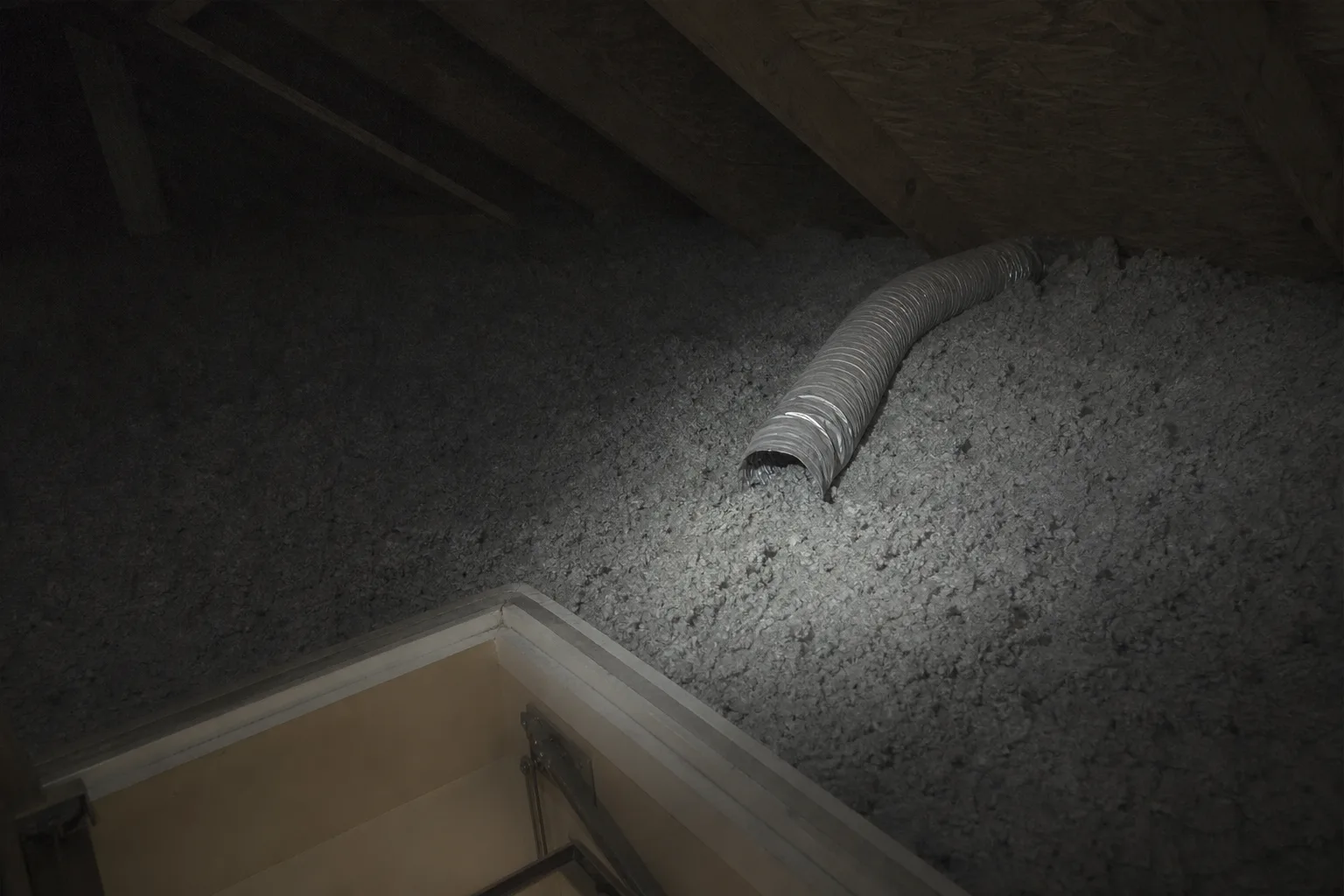 An open attic hatch with a flashlight beam on a disconnected flexible bathroom exhaust duct lying in blown-in insulation, its end buried and uncapped, matted...
The work order ran to one line: remove and replace a builder-grade exhaust fan in the second-floor bathroom, one visit, half a day, materials included. The homeowner approved it by text on a Tuesday and expected to be done by Thursday. The house came out of that week with a section of replaced attic insulation, two repaired drywall seams, a repainted ceiling and four separate invoices from three companies. Nothing went wrong on site. The scope grew because the first person to open the attic hatch found a condition that the old fan had been quietly feeding for years.
The half-day job as it was written
Quotes for fan replacement are priced on an assumption almost nobody reads out loud, which is that the existing duct is intact, insulated where it needs to be, and terminated through a roof jack or a gable wall to the outside. The language on the estimate said existing duct to remain. That phrase is not filler. It is the boundary of the job, and it means the installer has priced the fan housing, the grille, the electrical connection and the drywall opening, and has priced nothing at all beyond the point where the flexible duct clamps onto the outlet collar.
A homeowner reading that estimate sees a price for fixing a noisy fan. A contractor writing it sees a price for one component in a system that has three other parts, all of them out of sight and none of them inspected before the number was given. Both parties are acting in good faith. The gap between those two readings is where nearly every change order in residential work is born, and it opens before anyone has picked up a tool.
What ten minutes at the attic hatch settled
The installer went up to confirm the duct run before cutting the ceiling, which is ordinary practice and the reason the rest of this happened at all. The flexible duct was still clamped at the fan and was lying loose about six feet away, its far end buried in blown-in insulation and pointed at nothing. There was no cap on the roof. Every shower taken in that bathroom for an unknown number of years had been vented into the attic, in winter onto cold sheathing, and the insulation directly under the duct had matted down into a dense gray mass.
The compounding is not dramatic and that is precisely the problem. A disconnected duct produces no leak, no alarm and no stain until the moisture has cycled through enough seasons to darken sheathing and flatten insulation to the point where it stops working. The grille had also never been vacuumed, so airflow had dropped year over year, which lengthened how long each load of moist air lingered. The Environmental Protection Agency is the federal body responsible for guidance on indoor air quality and moisture control in homes, and residential ventilation ductwork sits squarely inside that remit.
Who asked for the extra, and who was expected to pay
This is the part worth being precise about. The installer recommended. The homeowner authorized. Those are different acts, and keeping them separate in writing is what stops a job like this from turning into a dispute six weeks later over an invoice nobody remembers agreeing to. The recommendation came by phone from the attic, was followed by photographs, and was then written as a revised scope with its own price before anything was cut, hauled or reconnected. The homeowner signed the revision. That sequence cost about forty minutes and settled the entire question of liability for the additional work.
Payment fell to the homeowner, and correctly so. The condition predated the contract, was not caused by the crew, and was not concealed by anyone still involved. It is also the kind of loss a homeowners policy generally treats as maintenance rather than sudden damage, because the moisture accumulated gradually rather than arriving in one event. Anyone in this position should call the carrier and ask rather than assume, but the shape of that answer is usually the same, and planning around it is more useful than hoping.
The second scope question was who would actually perform the added work. The fan company installs fans and does not blow insulation or hang drywall. The homeowner could have accepted a single managed price with the fan company subcontracting the rest, or contracted the trades directly and saved the coordination markup while taking on the coordination. He chose the second, which is defensible, and it is why there were four invoices. The thing to establish before choosing is who warranties the finished assembly if moisture shows up again, because a chain of separate contracts leaves that answer with the homeowner.
The people who stood next to this decision and were never asked
Four trades had been within arm's reach of that duct over the preceding years. A roofer had replaced a section of shingles on that slope and had no reason to look for a vent cap that was never there. An insulation crew had topped up the attic and blown material over a duct end they did not install and were not paid to trace. A home inspector at purchase had noted the fan as operating, which it was. A painter had covered a faint ceiling stain during a repaint, and the stain was the only visible symptom the house ever produced.
None of them failed. Each worked to a narrow scope that was reasonable on its own terms, and the duct fell in the space between all four scopes, which is exactly where this class of problem lives. The practical lesson is that somebody has to own the whole path from grille to exterior cap, and by default that somebody is the owner. Naming it out loud, once, in a sentence added to the next relevant estimate, is enough to make the next tradesperson look and to make the finding part of the record.
The cadence that keeps this from recurring
What the house runs on now costs almost nothing in time. The grille comes down and gets vacuumed with the brush attachment a few times a year, which takes minutes and preserves the airflow the fan was rated for. Once each winter someone puts a head through the attic hatch with a flashlight and looks at the duct connection and the sheathing above it, because cold weather makes moisture problems visible when nothing else will. From the ground, the exterior cap is checked for a damper that still swings freely.
The fan itself is now on a humidistat switch that runs it past the end of the shower without anyone remembering to, which removes the only variable that depended on household habit. Together those steps address the three things that let the original condition build: reduced airflow, an unverified termination, and run times too short to clear the moisture. The added work was real money, paid once. The upkeep that protects it is a quarterly vacuum and one winter look.
If a fan swap, a range hood or a dryer vent is on your list this year, add one sentence to the request before the price comes back: confirm where the duct terminates and photograph it. A contractor will do it in ten minutes, and you will either learn nothing, which is a good outcome, or learn it while the scope is still open and the number is still yours to approve.
Posted under Property