Approved With Conditions? The Ones That Add Cost, and How to Push Back
A planning approval rarely arrives as a plain yes, and the conditions attached to it are where the budget moves. Here is how to read them and who to ask.
Pinned by Ravi Chandrasekar4 min read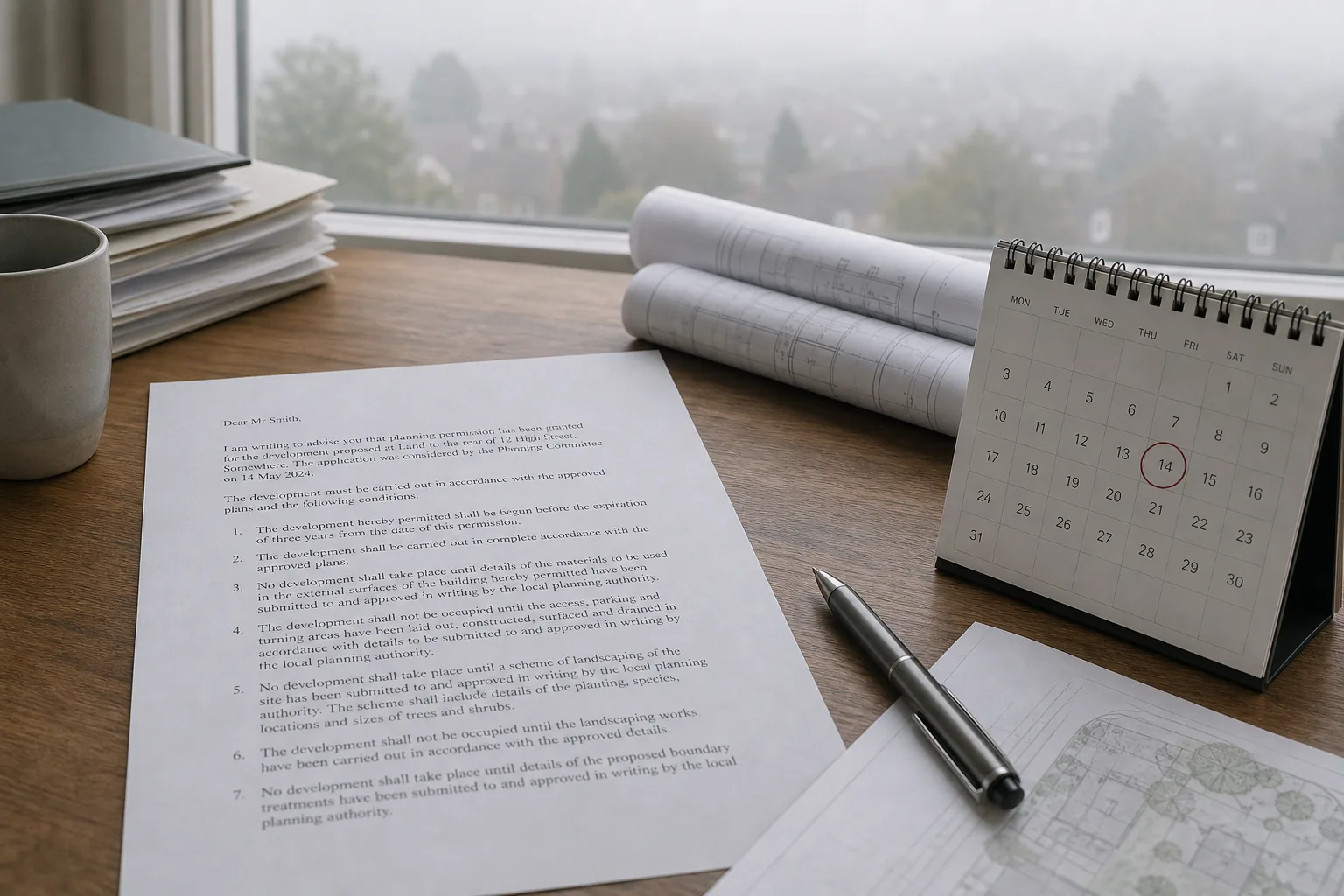 A planning approval letter with numbered conditions spread across a desk beside rolled site plans and a calendar with a date circled
The decision arrives as a letter, and the first line usually says approved. Two pages later there are fourteen numbered conditions, and three of them will cost more than the permit fee, the survey and the architect's last invoice combined. This is the normal shape of a planning outcome in almost every American city and county, and it catches applicants because they were bracing for a yes or a no. The yes came. What came with it is a scope document, written by people you have never met, and it is negotiable in ways the letter does not advertise.
How the decision became a list instead of an answer
Early zoning codes did roughly one thing: they sorted land into districts and said what could be built in each. A proposal either fit or it did not. Over the following decades, cities kept adding review layers rather than rewriting the base rules, so drainage, tree canopy, fire access, historic character, parking and traffic each acquired its own reviewer and its own say. None of those reviewers can approve your project alone, and none can reject it alone either. What each can do is attach a condition. The list on your letter is the accumulated output of that arrangement, gathered by a planner whose job is compiling it rather than authoring it.
That matters for how you respond. A condition is not a judgment handed down by the commission or the board that signed the decision. It is a line forwarded from a department memo, sometimes written months before your hearing, sometimes copied from a template that predates your parcel's current conditions. The signing body usually adopted the packet whole, without discussion of item nine. When you ask about item nine, you are not reopening the decision. You are asking about a line that nobody in the room defended out loud.
Sorting the conditions by what they actually cost you
Read the list twice, and on the second pass mark each condition with the stage at which it bites. Some are satisfied by paperwork you already have, a recorded easement or a copy of a contractor's license. Some are satisfied at building permit, which means a drawing change and a fee. Some are satisfied before a certificate of occupancy, which means real construction you have not bid. And a few are ongoing obligations that outlive the project, maintenance of a detention basin, annual reporting, a landscaping guarantee. The cost is not spread evenly across fourteen items. It is concentrated in two or three, and those are almost always the ones written in the fewest words.
Phrases worth pricing before you sign anything: to the satisfaction of the city engineer, as determined during final review, and shall be upgraded as necessary. Each of those hands the dollar figure to someone else, later, after your contract is already priced. The fix is not to fight the language in the abstract. It is to call the department that wrote it and ask what satisfaction looks like on a project your size, then get the answer in an email that you keep in the same folder as the decision letter.
Finding out who asked for the extra
Every condition has an author, and the file will tell you who. The staff report attached to your decision cites its sources by department, and the underlying comment memos are public records you can request, usually by email to the planning counter and often at no cost. Once you know that the stormwater condition came from public works rather than from planning, you are talking to the right person on the first call instead of the fourth. The Environmental Protection Agency oversees the stormwater permitting framework that local public works departments administer, which is why that particular condition tends to be the least flexible on the list and the most worth understanding early.
Knowing the author also settles the question of who pays. If a condition requires improvements in the public right of way, ask whether the jurisdiction has a fee-in-lieu option, a reimbursement agreement, or a cost-sharing program for work that serves more than your parcel. These exist in many places and are rarely mentioned unless you raise them.
The three response routes and their clocks
Clarification is the first and cheapest: a written question to the assigned planner asking what a condition requires, answered in writing. Modification is second: a formal request to amend or delete a condition, usually decided administratively if the change is minor. Appeal is third, and it is the only one with a hard deadline, commonly a short window of days from the decision date, filed with a fee and a stated ground. That window closes whether or not you have finished reading the letter, so calendar it the day the decision lands, then use the remaining time to do the other two.
Treat the conditions as the contract they are, priced line by line, with an author's name against each. Applicants who do that reach construction with a budget that holds, and with a file that answers every question an inspector asks eighteen months later.
Posted under Public Policy