Abandoned the Maintenance List by March? Five Checks That Make the Next One Stick
A maintenance schedule that survives its first year is built around local triggers, local rules and a done test for every task, not around calendar months.
Pinned by Miriam Goldfarb5 min read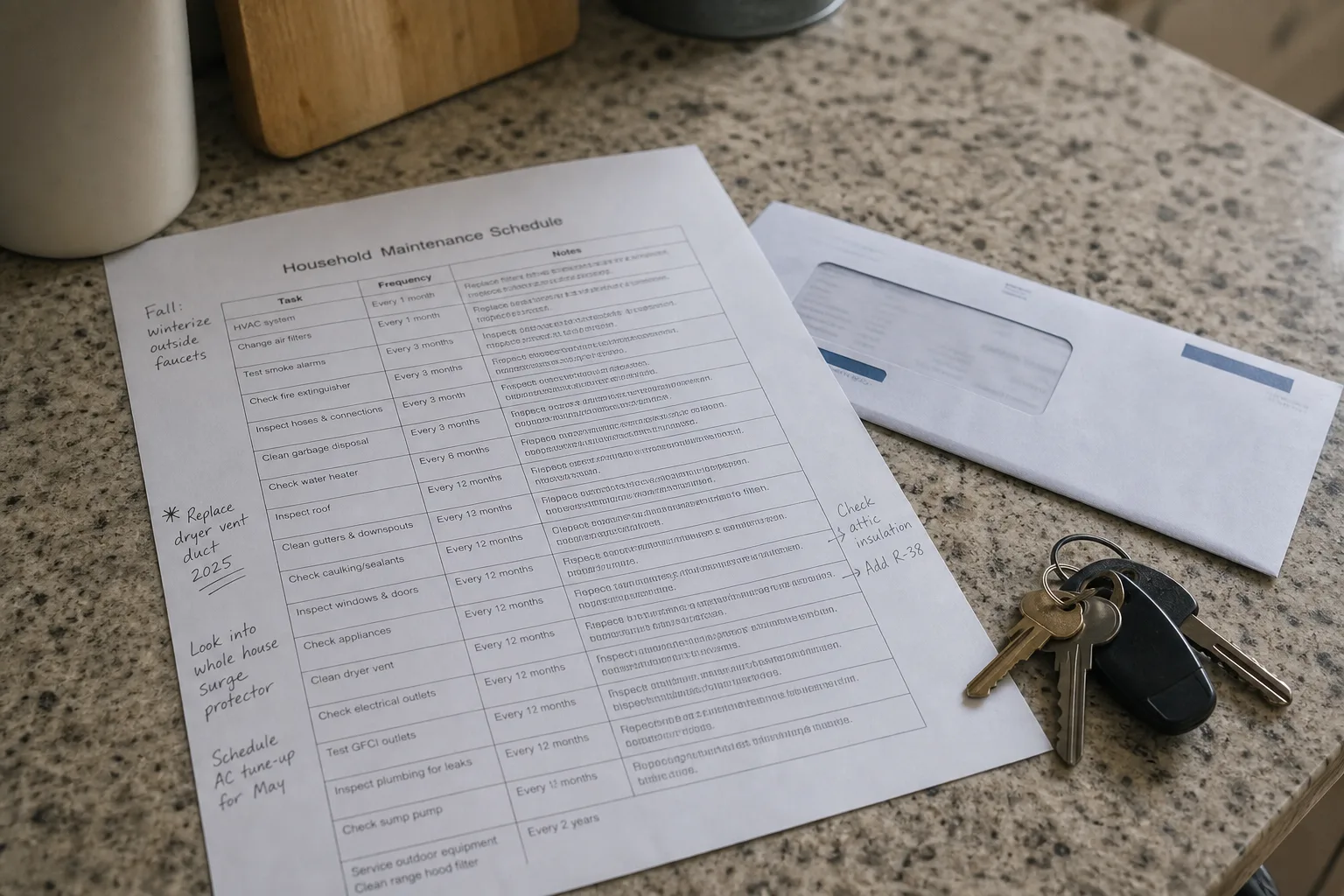 A printed household maintenance schedule on a kitchen counter with handwritten annotations in the margins, beside a utility notice envelope and a set of keys
Most household maintenance schedules are abandoned in the same place, somewhere between the second month and the first genuinely busy weekend, and the reason is almost never laziness. The schedule was written by someone who had never lived through a February in that particular house, in that particular county, with that particular roof pitch and that particular water utility. It listed twelve months of generic chores. What separates a schedule people actually keep from one that decorates a refrigerator door is not discipline, and it is not the app. It is five structural things you can check before you commit to it.
Whether the trigger is a date or an event
A generic schedule says gutters in October. In coastal Georgia the oaks drop through December, in northern Vermont the freeze arrives before the last leaf does, and in much of Arizona the whole task is about a monsoon season that has nothing to do with autumn. Schedules that hold up hang each task on an observable event: the first hard frost, the end of leaf drop, the week the pool of standing water appears at the downspout. Events are self-announcing, and a task tied to one gets done because the trigger arrives whether or not you looked at the list. Dates only work for tasks that genuinely have no local weather component, like testing a smoke alarm.
The practical check is to read the schedule and count how many entries would still make sense if you moved four states north. If nearly all of them survive, the schedule was written for nobody in particular. The good ones read as though someone stood in a specific yard. They mention the species of tree, the direction the weather comes from, the month the ground actually thaws. That specificity is the difference between an item you skip and an item you notice you have skipped.
Whether it names your region's real failure mode
Every region has one or two ways houses fail, and a schedule earns its place by putting those first rather than distributing attention evenly. In the upper Midwest and interior Northeast it is ice damming and the attic ventilation and insulation that feed it. Along the Gulf and the southern Atlantic it is standing humidity, subterranean termites and the annual question of whether the storm shutters and their hardware are still where you left them. In the interior West it is defensible space, ember-resistant vents and the five feet closest to the siding. In the Ohio and Mississippi valleys it is a sump pump nobody has tested since the last time it mattered.
A schedule that treats a foundation vent inspection in Tucson with the same weight as one in Baton Rouge is telling you it was assembled from a template. The Environmental Protection Agency is responsible for indoor air and moisture guidance, and its remit is a useful reminder that the same house behaves differently depending on what the soil and the air are doing outside it. Rank the tasks. The top three should be the things that, left alone for three years in your climate, would produce a five-figure repair rather than an annoyance.
Whether it carries the local rule, not just the good practice
This is where most published schedules quietly fall short, because good practice is national and rules are municipal. Many water utilities require an annual backflow preventer test on irrigation systems, performed by a certified tester, with a report filed by a set date, and the penalty for missing it is a fee or a shut-off rather than a polite reminder. Septic pumping intervals are set by county health departments and vary from two years to five for identical tanks. Chimney inspection frequency, dryer vent access in a multi-unit building, hurricane shutter permits, brush clearance deadlines enforced by a fire district: all local, all with real dates.
A schedule worth keeping has a column for who requires the task and what proof they want afterward. That single addition changes the character of the document, because a task with an external deadline and a filed report survives a busy month in a way that a self-imposed chore does not. Check the schedule for at least two entries that reference a local authority by function, the county health department, the water utility, the fire district, the homeowners association. If there are none, the schedule is a wish list and you will need to build the compliance layer yourself.
Whether every task has a done test
The difference between a good job and a barely adequate one, on almost every line of a maintenance schedule, is whether the entry describes a state or an activity. Clean the gutters is an activity, and it is satisfied by twenty minutes and a leaf blower. Water poured at the far end of the run exits the downspout within a few seconds and lands more than four feet from the foundation is a state, and it fails visibly when the job was rushed. Flush the water heater is an activity. Water runs clear from the drain valve and the valve closes without dripping is a state.
State-based entries also give you something to hand a contractor, which matters more than it sounds. When you hire out the annual furnace service, the schedule that says the technician records static pressure and combustion readings and leaves the numbers behind gets a different visit than the one that says have the furnace serviced. Barely adequate work thrives in the gap between what was asked and what was measurable. Close the gap in writing and you will find that the same crew, at the same price, does noticeably more.
Whether the vendors on it survive a careful reading of their reviews
Three or four items on any honest schedule are jobs you will not do yourself, and the schedule is only as good as the people attached to those lines. Ratings compress badly: a 4.6 built from two hundred reviews and a 4.6 built from eleven are not the same claim. Read for pattern rather than temperature. One furious review about a missed appointment during a regional ice storm is a grudge; six reviews across three years describing the same unexplained line item, or the same technician who arrives without the part he was told to bring, is a pattern, and it will repeat with you.
Weight the reviews from your own region heavily, because a company that is excellent at spring irrigation startups may have no useful experience of the freeze protection your climate demands. Look for the reviews that mention the local rule, the backflow report filed on time, the septic paperwork sent to the county. Those reviewers are describing exactly the transaction you are about to enter. Attaching two named, vetted vendors to the recurring outside jobs is what turns a schedule from an intention into something that runs on its own.
Run these five checks against whatever schedule you were about to adopt, and most of it will survive. What changes is the ordering, the triggers and the handful of entries that only your county cares about, which is precisely the part that decides whether the document is still in use next spring.
Posted under Property